
- PRICING
- LIVE QUOTES
- LEARN
- HELP


EN
A profit warning broke through the 60 billion “AI concept” bubble - Yijun Group Holdings (02442) plummeted 40% in a single day
The stock price curve of Yijun Group Holdings (02442) has drawn a dizzying parabola.
On September 21, Yijun Group Holdings experienced one of the fiercest single-day sell-offs since listing. At the close of the market, the company's stock price was reported at HK$64.15, a decrease of 43.28%. The turnover was about HK$61.625 million, and the total market value evaporated to HK$26.17 billion.
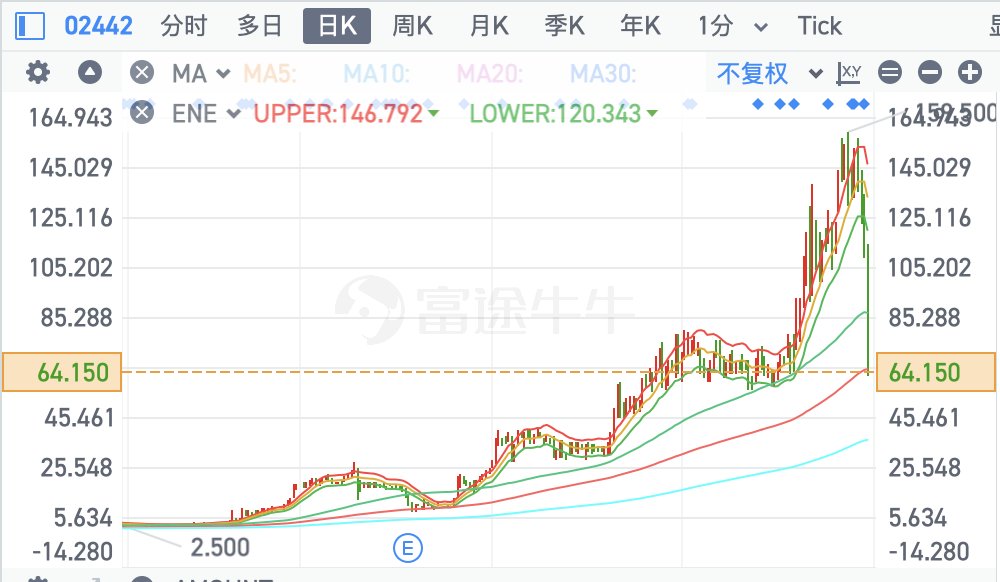
What is even more astonishing is that just a year ago, the price of this stock was still hovering around HK$3. The stock price soared more than 20 times in just one year, but now it has collapsed at a high level, creating a thrilling “roller coaster” market.
This can't help but make people wonder, what is actually disrupting this capital frenzy?
A profit on paper triggered a sell-off
In fact, the trigger for the collapse was ignited four days ago.
The Zhitong Finance App noticed that on the evening of September 17, Yijun Group Holdings issued a profit warning. It is expected that the year ending June 30, 2026 will record a loss attributable to the company owner of no more than HK$32 million. The loss for the same period last year was only about HK$500,000, and the scale of losses surged 64 times over the same period last year.
Behind the “face change” in performance is the continuous deterioration of the company's main business. The company attributed the sharp increase in losses to two points: first, a number of large-scale public projects already carried out before this year had been completed or were close to completion, leading to a decrease in revenue and gross profit; second, customers focused on price and intense market competition, which led to a decrease in profit margins for newly tendered projects.
And it's not untraceable. In fiscal year 2025, the company achieved revenue of HK$314 million, a year-on-year decrease of 10.9%. Net profit changed from profit to loss, and recorded a net loss of approximately HK$480,000, and gross margin plummeted to 8.3% from 18.01% in FY2024. Entering the first half of fiscal year 2026, the situation worsened. Earnings fell 24.2% year over year to HK$139 million, net loss reached HK$5.1 million, and gross margin fell further to 4.9%. At the same time, the original total value of contracts in hand fell from HK$687 million a year ago to HK$480.7 million. In the interim report, the company admits that “the Hong Kong construction industry is undergoing a major transformation phase” and is facing “extremely intense competition”, and warned that “this trend may continue in the foreseeable future.”
How are “demon stocks” made
Looking back at the stock price trend of Yijun Group Holdings, it can be called a “monster stock” development record. The company was listed on the main board of the Hong Kong Stock Exchange on May 9, 2023, with an issue price of only HK$1.28. The stock price has been sluggish for a long time since listing, and it is still hovering around HK$3 in the second half of 2025. The turning point came at the end of 2025: Offeror Talent International Group completed the acquisition of 306 million shares at HK$230 million, accounting for 75% of the total issued share capital, equivalent to only HK$0.75 per share, a discount of more than 80% from the stock price before the suspension of trading. This “ultra-low price change” ignited expectations of a “difficult reversal” in the market. On the day of the resumption of trading (December 3, 2025), the stock price soared by more than 60%, and then climbed more than 300% in the following month.
And the real madness began in August 2026. Yijun Group Holdings announced that the controlling shareholder, Talent International Group, completed the transfer of 102 million shares of Yijun to the artificial intelligence company Guangte Yuanzhi, accounting for 25% of Yijun's total share capital. The consideration was not cash, but about 45.88% of the shares of Guangte Yuanzhi's wholly-owned subsidiary. After the transaction was completed, Tianfu International held 39.57% of Yijun's shares, and its controlling position remained the same; Guangteyuanzhi held 25% of the shares and became the second largest shareholder. Based on the closing price of the day, this transaction corresponds to a market value of approximately HK$7 billion.
A passive fire engineering subcontractor with annual revenue of HK$300 million and just falling into a loss became an “AI concept stock”, and its market capitalization once surpassed HK$60 billion in a short period of time. The company's main business is designing, procuring and installing fireproof materials for buildings in Hong Kong. It is a typical traditional construction industry and has no real connection with AI. An attempt was made to achieve “cross-border transformation” by introducing AI shareholders, but after all, the popularity of the concept made it difficult to hide the chill in business reality — this extreme divergence has already laid the groundwork for today's sharp decline.
Hidden concerns after the concept faded
It is worth mentioning that, three days before the announcement of Yingjing, the company also announced a technical arrangement: starting October 6, 2026, the trading unit for each lot will be changed from 2,000 shares to 100 shares. Lowering the entry fee per lot is generally seen as a means to increase liquidity and attract retail investors to participate, but against the backdrop of three-digit stock prices and a sharp deterioration in fundamentals, this move has instead heightened the market's doubts about “maintaining stock price liquidity to match a certain narrative.”
From an industry perspective, the challenges facing Yijun Group Holdings are just as serious. The passive fire engineering market in Hong Kong is small, with an estimated total value of only HK$1,247 billion in 2026. Although the company is a leading enterprise in the industry, the growth ceiling is obvious. At the same time, competition in the industry is becoming more intense, the concentration of customers is high (the top five customers accounted for 86.9%), and fluctuations in subcontractor fees and building materials costs all put continuous pressure on the company's profit margin.
Although the company proposed a strategy to diversify the mainland medical and pharmaceutical industry and introduced AI companies as strategic shareholders, these transformation initiatives are still in their early stages, making it difficult to contribute to real results in the short term. As the main business continues to lose blood and the transformation story has yet to be realized, once the profit market accumulated during the previous period starts to be realized, the stock price collapsed like a domino.
Taken together, from HK$3 to HK$115, Yi Chun Group Holdings completed an astonishing shift in valuation in less than a year; from HK$115 to HK$64, it only took a day. It should be noted that after today's sharp decline, there is still an intractable distance between the stock's valuation and the reality of its own operations. Passive fire engineering is a traditional industry that is highly dependent on the construction industry cycle, gross margin is under pressure, and the competitive landscape is scattered. An annual loss of HK$32 million is not fatal for any engineering company of the same size, but when the market capitalization is based on the imagination of “AI shareholders entering the market,” the truth revealed by the Ying Police is enough to trigger a stampede.
For investors who have bought above 100 yuan, the real risk is probably not how big today's decline is, but rather what the company will use to support the remaining valuation after the “AI concept” narrative dividends are exhausted.