
- PRICING
- LIVE QUOTES
- LEARN
- HELP


EN
How Google AI Shopping At Tapestry Stock Has Changed Its Investment Story
- Tapestry brought Coach and Kate Spade into Google's AI shopping ecosystem in the U.S., enabling direct product purchases from Google Search, AI Mode, and the Gemini app using the Universal Commerce Protocol and Google Pay.
- Tapestry was also added to the FTSE All-World Index, which can influence how large global funds gain exposure to the company alongside its AI commerce push.
- We will now look at how Tapestry's AI driven Google checkout integration could influence the broader investment narrative around the business.
Scan how Tapestry’s AI commerce push compares with other potential breakouts by reviewing our hand picked list of 36 AI small caps in this space.
Tapestry Investment Narrative Recap
For someone owning Tapestry, the core belief is that Coach and Kate Spade can keep attracting younger shoppers, grow outside the U.S., and use digital tools to support direct to consumer sales and margins. The Google AI commerce rollout fits into that story but does not suddenly change it. The near term swing factor still looks like execution on brand health, especially Kate Spade.
The biggest risk remains pressure on profitability. Tariffs, heavy marketing and store investment, and high debt all constrain how much room Tapestry has if demand softens or consumers shift away from its brands. The FTSE All World inclusion may support liquidity, yet it does not directly address those operational constraints.
The Google AI shopping integration is the announcement that ties closest to the current catalyst debate. It tightens the buying funnel for Coach and Kate Spade by cutting out website redirects and moving checkout into Google Search, AI Mode, and Gemini, with Google Pay handling payment. That can matter if Tapestry wants more full price, direct to consumer volume.
What really matters now is whether this AI commerce setup can scale beyond the U.S. and meaningfully contribute versus ongoing tariff and SG&A headwinds. The system relies on the Universal Commerce Protocol, which should help Tapestry plug into more agent based platforms if they grow. Execution risk sits in merchandising, pricing, and keeping brand heat high enough so those AI surfaced “Buy” buttons actually convert.
Tapestry's current analyst storyline points to revenues of $9.1 billion and earnings of $1.6 billion by 2029, based on a 5.0% yearly revenue growth rate and a move from $662.8 million in earnings today to that $1.6 billion figure. This implies earnings would need to rise by roughly $937 million over the period.
Discover how Tapestry's fair value indicates a 45% potential upside to its current price, a gap that could narrow quickly as sentiment resets.
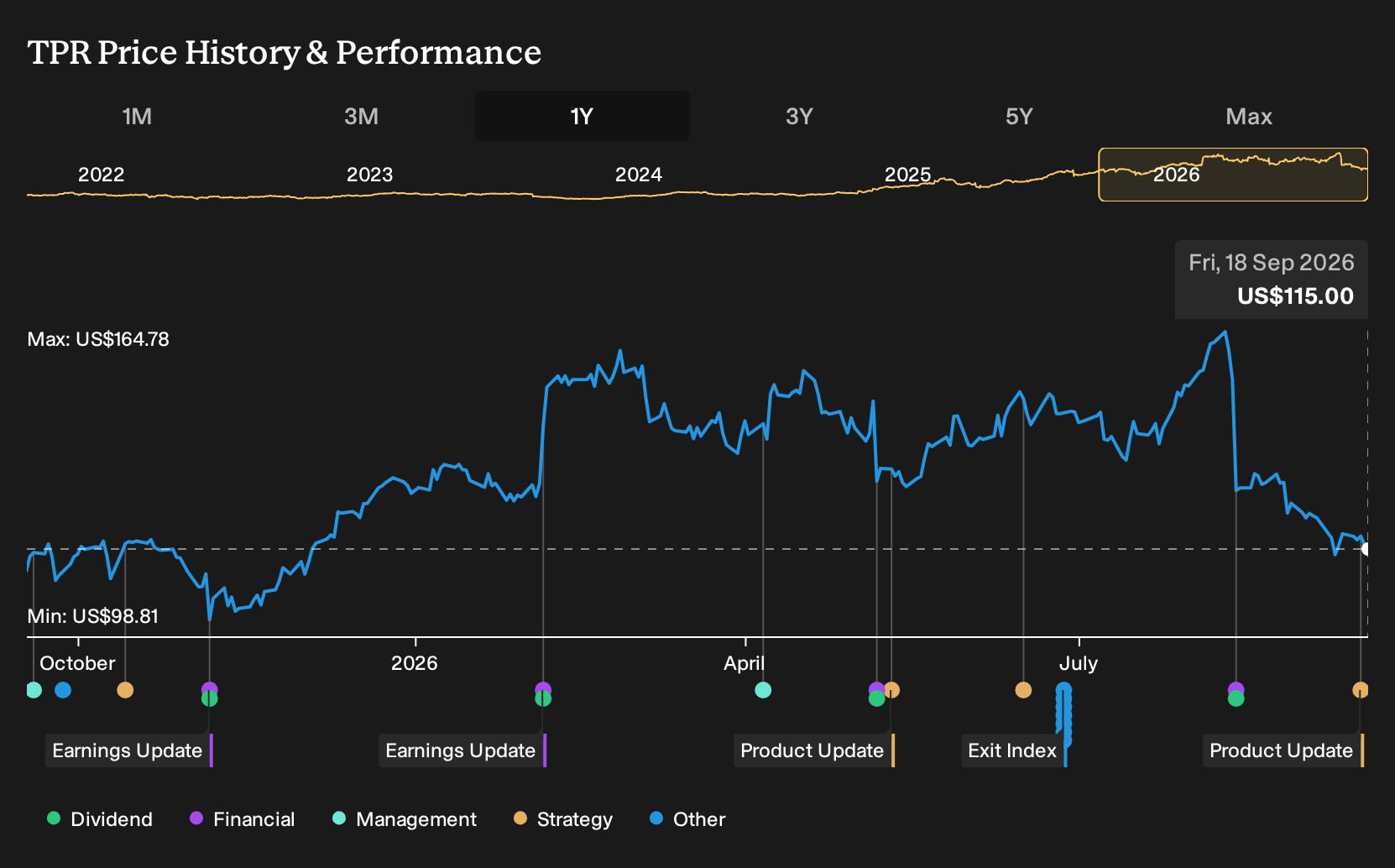
Exploring Other Perspectives
One more optimistic angle on Tapestry focuses on how the AI driven Google checkout could amplify what the most bullish analysts already expected. They were modeling about $9.8b in revenue and $2.1b in earnings by 2029, well above consensus. Those projections came before this news, so you may see those narratives shift.
Explore 3 other Tapestry fair value estimates, including one that suggests as much as 66% upside from the current price.
Form Your Own Verdict
Don't just follow the ticker. Dig into the data and build a conviction that's truly your own.
- A great starting point for your Tapestry research is our analysis highlighting 4 key rewards and 2 important warning signs that could impact your investment decision.
- See our latest analysis for Tapestry. The report includes a comprehensive fundamental analysis summarized in a single visual, the Snowflake, making it easy to evaluate Tapestry's overall financial health at a glance.
Looking For More Ideas Beyond Tapestry?
If the Tapestry story has you thinking about where else to deploy capital, it can help to scan a wider field of stocks that match different risk and return profiles.
- If capital protection matters most, start with a basket of relatively steady businesses screened as 30 resilient stocks with low risk scores that may suit a more cautious approach.
- If income is your priority, focus on companies flagged as 7 dividend fortresses that could help anchor a portfolio with regular cash payouts.
- If you are hunting for future leaders before they are widely followed, sort through the 16 high quality undiscovered gems that pair strong fundamentals with lower market attention.
This article by Simply Wall St is general in nature. We provide commentary based on historical data and analyst forecasts only using an unbiased methodology and our articles are not intended to be financial advice. It does not constitute a recommendation to buy or sell any stock, and does not take account of your objectives, or your financial situation. We aim to bring you long-term focused analysis driven by fundamental data. Note that our analysis may not factor in the latest price-sensitive company announcements or qualitative material. Simply Wall St has no position in any stocks mentioned.
Have feedback on this article? Concerned about the content? Get in touch with us directly. Alternatively, email editorial-team@simplywallst.com