
- PRICING
- LIVE QUOTES
- LEARN
- HELP


EN
Is Board Refresh Altering The Investment Case For Ross Stores (ROST)?
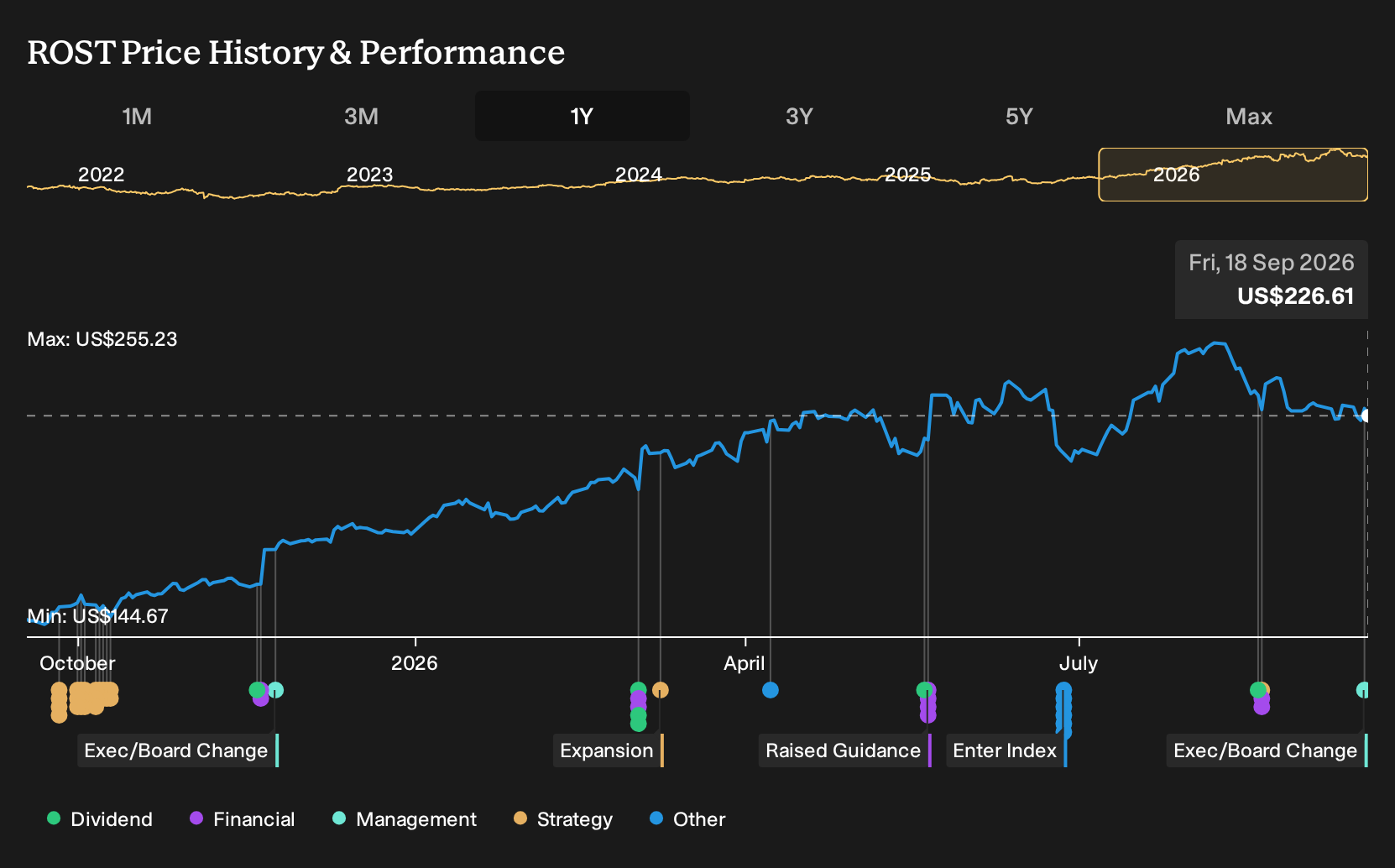
- Ross Stores announced board changes effective October 2026, adding Microsoft executive Shelley H. Bransten and consumer investor Christian B. Johnson, while long-serving director Sharon D. Garrett retired after more than two decades of service.
- The refreshed board brings deeper technology, data and consumer investment experience that could influence how Ross Stores approaches merchandising, store expansion and supply chain priorities.
- We will now look at how Ross Stores' refreshed board mix could reshape the existing investment narrative around growth and margins.
Scan how Ross Stores' board refresh compares with other retailers evolving their leadership and tech focus by reviewing our curated list of 16 high quality undiscovered gems.
Ross Stores Investment Narrative Recap
To own Ross Stores, you need to be comfortable with a brick and mortar heavy, off price model that leans on value hungry shoppers, steady store openings, and access to closeout inventory. The key near term swing factor is how well it manages tariffs, distribution costs, and limited pricing power without eroding its value promise. The recent board refresh does not materially change that near term setup.
The biggest operational risk remains margin pressure if costs keep rising faster than what Ross Stores can pass through or offset with mix and sourcing. Store expansion and the lack of a strong digital channel add execution risk if traffic softens. The new directors could influence long term decisions around technology and capital allocation, but any impact on results is likely gradual.
The most relevant update for this governance shift is the appointment of Shelley H. Bransten and Christian B. Johnson alongside the retirement of long serving director Sharon D. Garrett. This adjustment matters because the core catalysts for Ross Stores hinge on merchandising, supply chain efficiency, and disciplined physical expansion, all of which reside at the board and management level.
Bransten brings technology and consumer experience from Microsoft, Salesforce, and Gap, which could shape how Ross Stores thinks about data usage, store level productivity, and potentially its limited omnichannel capabilities. Johnson’s background investing in consumer facing companies may sharpen oversight on returns from new stores, distribution investments, and margin projects. For investors tracking execution on growth and cost control, this refreshed mix is worth watching as a supporting factor rather than a primary catalyst.
Ross Stores is currently modeled to reach about $29.9b in revenue and $3.1b in earnings by 2029, based on analyst estimates that incorporate 6.9% yearly top line growth and an earnings increase of roughly $0.4b from $2.7b today.
Uncover how Ross Stores' fair value indicates a 19% potential upside to its current price, which could narrow quickly if sentiment improves.
Exploring Other Perspectives
Some of the most optimistic analysts lean hard into store expansion as the key upside catalyst for Ross Stores, with forecasts that reach about $31.2b in revenue and $3.4b in earnings by 2029, versus the roughly $29.9b and $3.1b consensus view. Those estimates were set before this board shake up, so you may see opinions shift as investors reassess what fresh technology and consumer investing experience could mean for that more aggressive store growth story.
Explore 3 other Ross Stores fair value estimates, including one that suggests up to 19% upside from the current price.
The Verdict Is Yours
Disagree with existing narratives? Extraordinary investment returns rarely come from following the herd, so go with your instincts.
- A great starting point for your Ross Stores research is our analysis highlighting 2 key rewards and 1 important warning sign that could impact your investment decision.
- See our latest analysis for Ross Stores. The report includes a comprehensive fundamental analysis summarized in a single visual, the Snowflake, making it easy to evaluate Ross Stores' overall financial health at a glance.
Looking for more Ross Stores style investment ideas?
If the Ross Stores story has you thinking about where else value, quality and resilience might intersect, the Simply Wall St Screener can help you widen your watchlist quickly without drowning in data.
- For investors who care most about paying a fair price for strong fundamentals, scan our curated pool of 35 high quality undervalued stocks that combine healthy balance sheets with attractive valuations.
- If capital preservation is front of mind, filter for steadier names through a focused set of 30 resilient stocks with low risk scores that score well on financial strength and business stability.
- When you want to go beyond the usual large caps, cast a wider net across a list of solid balance sheet and fundamentals (23 results) to find lesser known businesses with sturdy finances and room to grow.
This article by Simply Wall St is general in nature. We provide commentary based on historical data and analyst forecasts only using an unbiased methodology and our articles are not intended to be financial advice. It does not constitute a recommendation to buy or sell any stock, and does not take account of your objectives, or your financial situation. We aim to bring you long-term focused analysis driven by fundamental data. Note that our analysis may not factor in the latest price-sensitive company announcements or qualitative material. Simply Wall St has no position in any stocks mentioned.
Have feedback on this article? Concerned about the content? Get in touch with us directly. Alternatively, email editorial-team@simplywallst.com