
- PRICING
- LIVE QUOTES
- LEARN
- HELP


EN
The boom in AI computing power is being questioned by the top V: Rothschild sings “AI New Cloud”, “Big Short” warns of $3 trillion off-balance sheet promises
The Zhitong Finance App learned that according to some Wall Street analysts who are optimistic about the future of the new cloud power's bullish stock market, artificial intelligence new cloud leaders such as Nebius (NBIS.US) and CoreWeave (CRWV.US) are expected to gain a wider and more sustainable business space in the AI reasoning era. However, Rothschild & Co., an independent investment research institution owned by Rothschild When Redburn covered these two new cloud leaders for the first time, it conveyed a clear logic of prudence and sell-off, saying that the credit market is sending an alarm signal. The agency believes that the current profit performance and valuation of new cloud companies are being boosted by the boom cycle. In particular, Nebius's stock price already reflects the most optimistic results of the revaluation of computing power and economy; CoreWeave's downside risk is relatively small, but the risk-to-benefit ratio is still insufficient to support a positive rating.
The common logic underpinning the relatively strong stock price performance of CoreWeave and Nebius this year can be described as the expansion of demand for AI training and inference, while GPU clusters, power, and computer room capacity that can be delivered in a timely manner are still scarce, driving some Wall Street analysts who are optimistic about these new cloud forces to raise their expectations for the revenue scale and pricing capacity of these two new cloud companies. Nebius, in particular, has accumulated a cumulative increase of about 167% since this year.
Nebius announced on September 17 that the on-demand rental price for some GPUs will be raised again from October 1. The report summarizes the increase of about 20%. This is the second price increase in three months; CoreWeave also said that it is signing a contract at a higher price. These changes reinforce the bullish logic that “demand for computing power can be converted into commercial revenue”. Among them, Nebius adjusted this time for some on-demand services, and the stock long-term contracts are still executed according to their respective terms.
Looking at the economics of data center projects, Rothschild's research report asks how much return can GPU rental income leave to shareholders after covering equipment depreciation, operating expenses, and financing costs. CoreWeave's second-quarter revenue reached US$2,575 million, and net interest expenses for the same period were US$640 million, indicating that financing costs are already an important variable affecting profits. Rothschild further believes that the overstated promises of hyperscale cloud vendors have increased actual economic leverage; following this logic, if customers expand their budgets or tighten financing conditions, the pace of new cloud companies' follow-up orders, project commissioning, and cash recovery may be affected.
Therefore, Rothschild's core investment inspiration for the future performance and valuation level of AI new cloud computing power leasing forces in the world is that it may increase the market's intensity of scrutiny of the two companies' valuations, financing capabilities, and return on capital, which in itself does not represent order cancellations or company downgrades; for some time to come, some investors may begin to observe order growth in combination with capital recovery capacity, and re-compare the return structure of computing power operators, computer room leasers, and power resource holders.
Stocks look at growth, credit looks at promises! Rothschild says credit market “is sending more important signals”
Rothschild & Co., owned by Rothschild Redburn said that the profits and valuations of new cloud companies are “cyclically inflated,” but they still maintain a cautious stance of “neutral” AI infrastructure as a whole.
Rothschild & Co Redburn has an equity and management relationship with the Rothschild family. It is a stock research and securities service business under the Rothschild Group. It mainly provides research and trade execution services to institutional investors. The Group is a family-owned company, jointly owned by members of the Rothschild family, senior partners and other long-term investors. Alexandre de Rothschild is responsible for the overall management of the group.
On Monday, the agency's position on Nebius (NBIS.US) and CoreWeave (CRWV.US), the world's two largest new cloud power leaders, was more careful than Bitcoin (BTC) mining companies that are transitioning to AI computing power infrastructure — putting the pessimistic bottleneck of “selling” Nebius (NBIS.US) and CoreWeave (CRWV.US). The core reason is that the credit market is pricing the risk of AI stocks that have basically been ignored.
Rothschild covered CoreWeave and Nebius for the first time, both with a “sell” rating, and for the first time covered Core Scientific (CORZ.US), TeraWulf (WULF.US), Applied Digital (APLD.US), Cipher Mining (CIFR.US), Hut 8 (HUT.US), and IREN (IREN.US), all of which are investing in AI computing power infrastructure resource providers One character accelerated the transformation, but Rothschild all gave it a “neutral” rating.
Rothschild said that the stock market's investment narrative around generative AI infrastructure “remains firm and bullish,” but added that “the credit market is beginning to price risks that the stock market has largely ignored.”
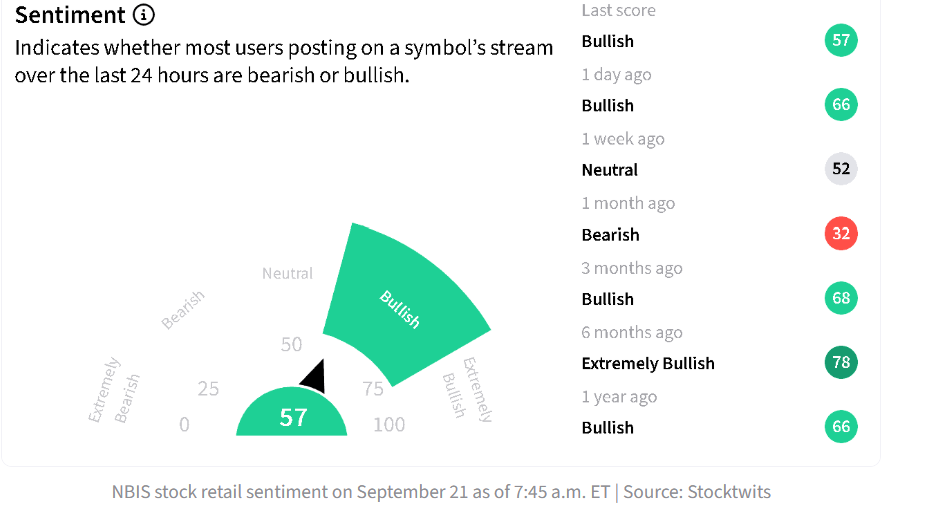
Against the backdrop of a general rise in the general market, the stock price of the new cloud company NBIS rose 1.1% during the opening session of the US stock market. Over the past day, retail sentiment on the Stocktwits platform was in a “bullish” range. CRWV shares rose by about 1.8%. Over the past day, related sentiment was also in a “bullish” range.
The credit market sends a very different signal of AI caution. Rothschild believes that the credit market “is sending a more important signal” because the actual economic leverage of hyperscale cloud vendors is higher after taking off-balance sheet promises into account. This is also the core logic of the credit market's cautious signal worthy of investors' collective attention.
The agency said this may limit their ability to continue providing financial support for the next phase of large-scale AI infrastructure construction.
This warning is particularly relevant for companies moving from Bitcoin mining to AI and high-performance computing. CORZ, WULF, CIFR, HUT, and IREN are all developing data center businesses outside of the cryptocurrency mining business or in parallel with the mining business, seeking to use AI requirements to monetize power resources and data center capacity.
Among the companies mentioned above, HUT shares led the rise. There was a violent rise of 6% at the beginning of the session, followed by CIFR, which rose sharply by 4% at the beginning of the session. On the Stocktwits platform, retail sentiment surrounding HUT continued to be in a “bearish” range over the past day, while sentiment surrounding CIFR remained in the “bullish” range.
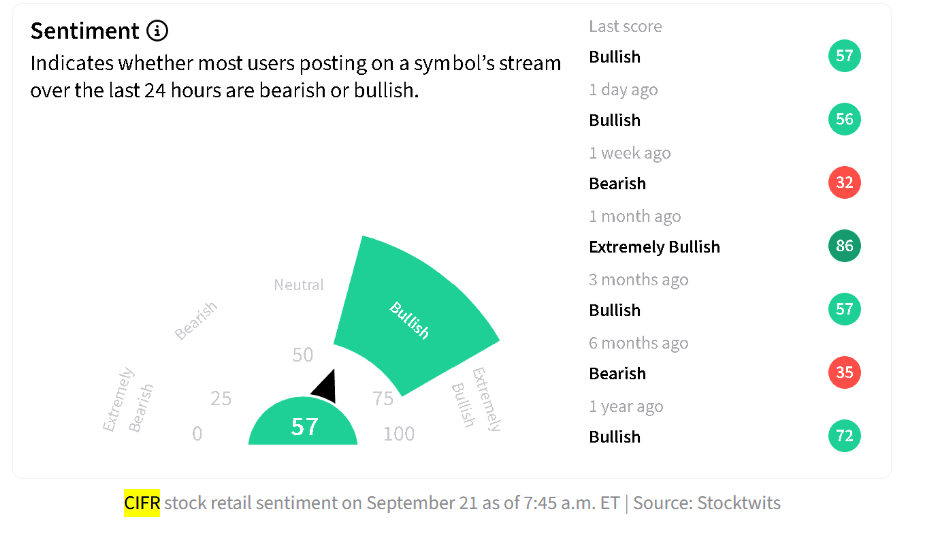
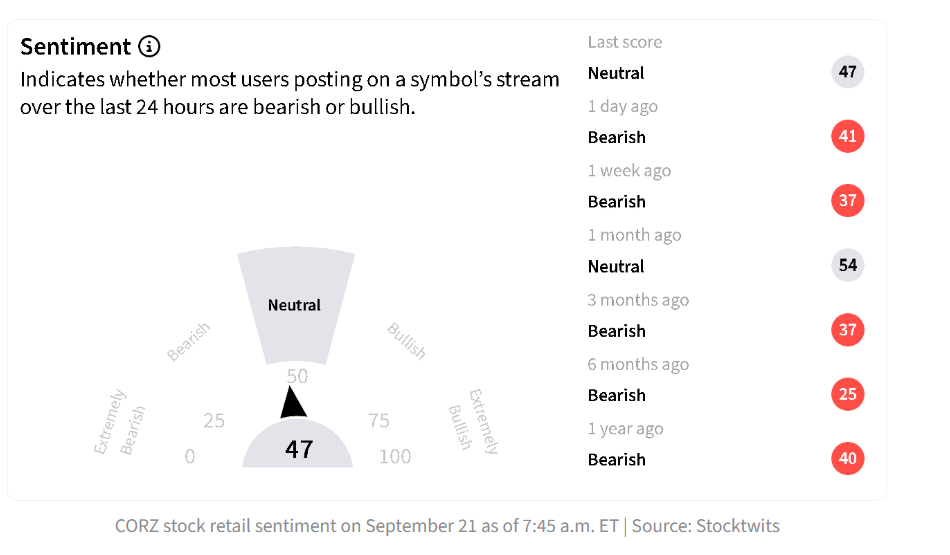
Meanwhile, IREN's stock price rose sharply by 3% at the beginning of the session, WULF rose 2.5%, and CORZ rose about 2%. Over the past day, retail sentiment surrounding IREN and WULF changed from “neutral” to “bearish,” while sentiment surrounding CORZ changed in the opposite direction.
Rothschild said that Nebius, which is funded and supported by AI chip superleader Nvidia (NVDA.US), faces the greatest downside risk, saying that its stock price already reflects the most optimistic results in the ongoing revaluation of computing power economy.
The agency believes that CoreWeave's downside risk is less than Nebius, but its risk-to-return ratio “is still not attractive enough” and should therefore be given a “sell” rating.
Companies directly involved in the new cloud business model face greater valuation concerns, while traditional real estate investment trusts may benefit from ongoing data center construction. Rothschild said that traditional real estate investment trusts “deserve particular attention as indirect beneficiaries that have not received sufficient attention.”
The price of Bitcoin rose during morning trading, once approaching $85,000, then fell back. Over the past 24 hours, the world's largest cryptocurrency once rose 5.5%, and the transaction price was around $84,800 at press time. BTC is the most popular trading code on the StockTwits platform. Over the past day, retail sentiment improved from “bearish” to “neutral.”
“New Cloud Power” AI computing power resource price increases ignite expectations, but the credit market continues to ask about returns
Long-term computing power procurement from hyperscale cloud vendors not only supports orders from new cloud companies, but also forms payment obligations that customers need to fulfill in the future. If terminal AI commercialization revenue falls short of previous expectations, and rent, equipment updates, and financing expenses continue to be realized, the pressure may spread to new cloud companies such as CoreWeave and Nebius through slowing new orders, contract renewal negotiations, and counterparty credit risk. That's why Redburn thinks credit market signals are more important.
The almost endless expansion of demand for AI inference computing power resources can still create business growth, but valuation also needs to examine how much cash these increases ultimately leave behind. Therefore, the new cloud competition in the AI reasoning era will place more emphasis on order quality, prepayment arrangements, equipment utilization, and return on capital after covering hardware updates and financing costs.
What Rothschild's Redburn calls a “credit market” is a market where companies borrow money and investors price debt repayment risks. It mainly includes risk hedging tools such as corporate bonds, bank loans, private equity credit, and data center project financing, and credit default swaps (CDS). Stock investors are concerned about how much growth AI can bring, while creditors are more concerned about whether the company's future cash flow can cover interest and principal. Looking at the credit market, the key is to look at credit spreads — the yield on corporate bonds compared to additional compensation for the same period — and the cost of CDS default protection; the rise in these indicators usually means that investors are demanding higher risk compensation.
Redburn, a subsidiary of Rothschild, believes that stocks are still actively pricing AI growth, but debt funds are beginning to be factored into the repayment and financing pressure behind huge construction expenses. According to the summary of the public research report, its core judgment is that after including off-balance promises such as leases that have not yet begun, hyperscale cloud vendors have higher actual economic leverage, which may limit their ability to continue to support the next round of AI infrastructure expansion. Recent examples quoted by Rothschild show that the $18 billion loan related to Oracle's Project Jupiter data center is priced at about 89-91 cents per dollar, reflecting investors' caution about project progress and financing risks. Such severe credit market restrictions may be transmitted to the growth and valuation of CoreWeave and Nebius through customer expansion budgets, order fulfillment, and financing conditions.
Rothschild's Redburn's focus on the credit market can be described as echoing the latest warning from Michael Burry, who has the title of “Big Short.”
According to reports, Bury estimates that Amazon, Meta, Alphabet, Microsoft, and Oracle together have close to $1.2 trillion in unstarted leasing commitments and over $1.5 trillion in procurement commitments, plus exposure to special purpose entities, guarantees, and contingent support, and the total scale exceeds $3 trillion. He made it clear that fraud was not charged. The core concern is that long-term leases and procurement expenses are locked down, but the economic value of the equipment, technical requirements, and future demand may change faster, and as a result, the company faces a mismatch between capital recovery and hardware renewal.
It is worth noting that the $3 trillion here is a summary estimate of Burry's multi-term commitments, and cannot be directly equated with the losses that have already occurred; the specific meaning of the investment is mainly that evaluating the expansion capacity of AI data center supergiants requires a simultaneous review of future cash expenses in the footnotes to financial reports.