
- PRICING
- LIVE QUOTES
- LEARN
- HELP


EN
Is Synchrony Financial Stock Underperforming the Nasdaq?
Stamford, Connecticut-based Synchrony Financial (SYF) is a leading consumer-financing company specializing in private-label and co-branded credit cards.
Companies worth $10 billion or more are generally described as “large-cap stocks,” and SYF, valued at $24.4 billion by market cap, falls into that category. It partners with major retailers, healthcare providers, and other businesses to offer financing and credit solutions to their customers, generating revenue primarily from interest and fees on its loan portfolio. Its broad network of merchant partnerships and focus on consumer financing give it a differentiated position in the credit-card market.
Despite its strong position in consumer financing, Synchrony Financial has struggled to keep pace with the broader market. SYF shares have slipped 15.4% from their 52-week high of $88.77, achieved on Jan. 9. Over the past three months, SYF stock has declined marginally, trailing the broader Nasdaq Composite ($NASX), which gained marginally during the same period.
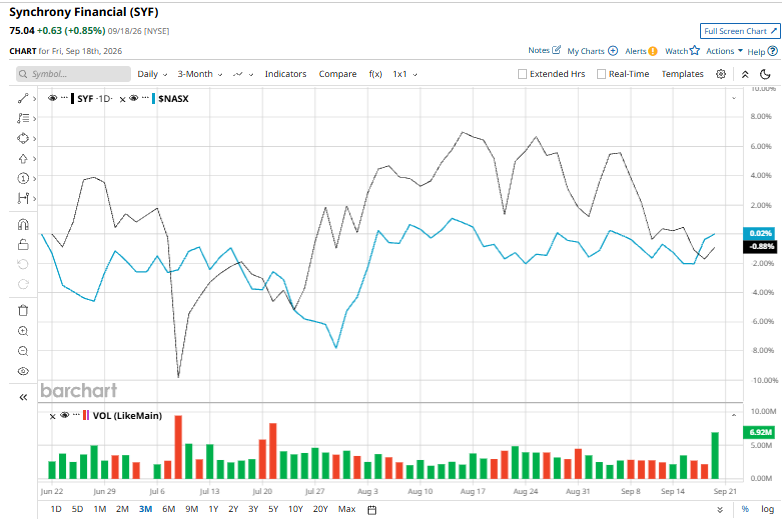
Shares of SYF fell 10.1% this year and 2% over the past 52 weeks, underperforming NASX’s YTD gains of 14.1% and 18% returns over the past year.
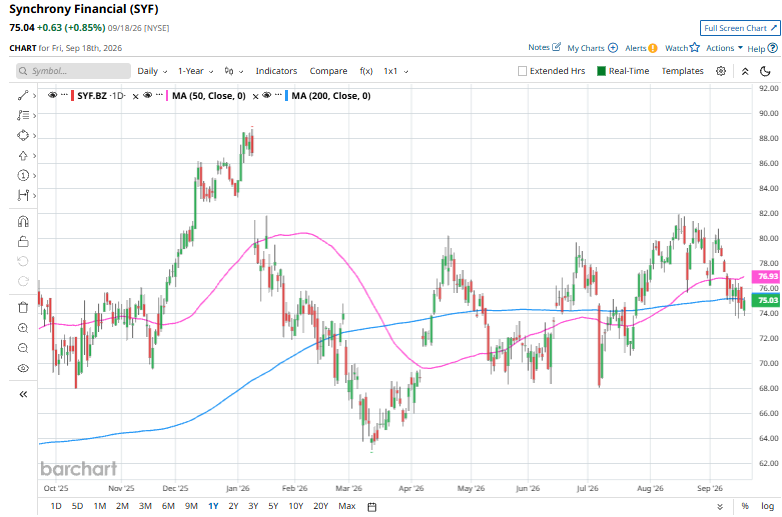
From a technical standpoint, SYF has recently dipped below its 50-day and 200-day moving averages, confirming a bearish trend,
On Aug. 20, SYF announced an enterprise collaboration with OpenAI to strengthen its role in the emerging AI-driven shopping and payments landscape. The partnership aims to integrate financing, rewards, and loyalty into AI-native shopping and checkout experiences, while Synchrony will also deploy OpenAI’s advanced models across its enterprise to accelerate product development, improve customer experiences, and drive technology innovation. SYF shares rose 3.6% in the next trading session as investors welcomed the news.
Still, SYF has held up better than rival American Express Company (AXP), which has fallen 15.8% YTD and 8.8% over the past 52 weeks
Wall Street analysts are moderately bullish on SYF’s prospects. The stock has a consensus “Moderate Buy” rating from the 23 analysts covering it, and the mean price target of $89.13 suggests a potential upside of 18.8% from the current price level.
On the date of publication, Kritika Sarmah did not have (either directly or indirectly) positions in any of the securities mentioned in this article. All information and data in this article is solely for informational purposes. For more information please view the Barchart Disclosure Policy here.