
- PRICING
- LIVE QUOTES
- LEARN
- HELP


EN
25 days in sight! Rocket Lab (RKLB.US) accelerates rocket launches to accelerate the ambition of “space AI infrastructure”
The Zhitong Finance App learned that the 97th Electron rocket launch mission of Rocket Lab (RKLB.US), which has the title of “SpaceX rival”, is scheduled to launch from New Zealand at 8:15 p.m. EST on Friday. After the 96th Electron mission is successful, if the 97th mission is completed as planned, the company will achieve four launches within 25 days to further verify the coordination capabilities between manufacturing, payload integration and launch site scheduling, laying an important foundation for large-scale AI data center deployment focusing on space orbit. For the space AI data center that Musk is increasingly looking forward to recently, Rocket Lab's clearest benefit path is to meet deployment requirements and supply the electricity and space systems required for orbital computation.
The positive significance of Rocket Lab's latest round of intensive launches is to transform the accumulation of reliability into continuous delivery capabilities and enhance the visibility of future revenue. The mission success rate of the company's cooperation with Synspect remains 100%, and there are still 15 exclusive launch schedules to provide support for continued contract implementation.
From the perspective of critical aerospace economics, Rocket Lab revealed that the average revenue for a single launch in the second quarter of 2026 was US$9.1 million, significantly higher than US$7.9 million in the same period last year; the average single cost fell from US$5 million to US$4.4 million. The combination of high-frequency delivery and improved single-task economy is expected to increase capacity utilization, dilute fixed costs, and promote order fulfillment. By the end of June, the company's total backlog of orders was approximately US$2,356 million, providing a foundation for joint growth in the launch and space systems business.
The reason why Rocket Lab is viewed by investors as an important challenger to SpaceX (SPCX.US), the “AI+ space exploration” leader founded by Musk, comes from a combination of small exclusive launches and the manufacture of medium-sized reusable rockets and satellites.
Electron's low-Earth orbital capacity is 300 kg. It uses a carbon composite arrow body, liquid oxygen and kerosene propellant, and a Rutherford engine supplied by an electric pump; the electric pump uses a battery and motor to drive the propellant pump, which is suitable for its miniaturized design. The matching Kick Stage orbital maneuverability stage helps customers obtain more accurate deployment tracks and more autonomous launch schedules. SpaceX's Falcon 9 uses Merlin gas generator cycle engines and reduces costs through first-stage reverse landing reuse and batch transportation; Starship further targets large-scale space transportation.
Electron's commercial value focuses on small satellite exclusive missions, rapid response, and accurate orbiting, while the core product Rocket Lab is promoting into the SpaceX mid-constellation launch market is Neutron.
The 97th rocket is ready to go, and Rocket Lab is speeding up the execution of the launch order
After another successful mission, Rocket Lab's 97th Electron rocket is already on the launch pad. This flight will be Rocket Lab's fourth launch in 25 days, and its 18th launch in 2026. This is why retail investors' sentiment about Rocket Lab quickly changed from “bearish” a week ago to an “overall bullish” sentiment on the Stocktwits platform.

In the middle of Sunday night EST, Rocket Lab (RKLB.US) stock rose about 2% during night trading in the US stock market. Earlier, the company said that its 97th Electron rocket is already scheduled to be launched this week, and only a few days have passed since the 96th mission was completed. RKLB shares rose nearly 3% last week, ending five consecutive weeks of decline.
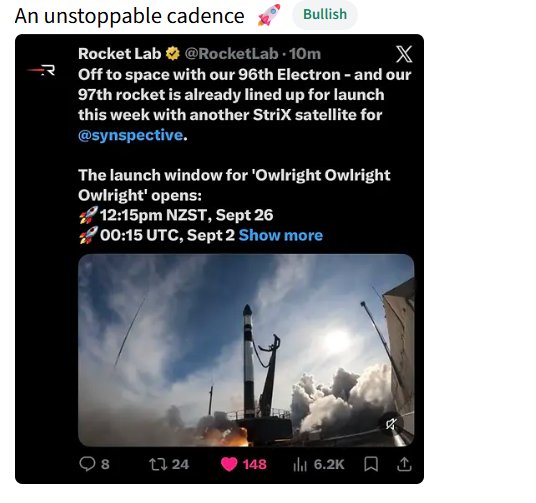
Rocket Lab management is already aiming for the fourth launch in 25 days. Rocket Lab said on X: “Our 96th Electron has already gone to space — the 97th rocket is also scheduled to launch better than this week and will be @synspective运送另一颗StriX卫星.” The “Owlright Owlright Owlright” mission is scheduled to take off from Rocket Lab's launch pad B of Launch Complex 1 in New Zealand. The launch window will open at 8:15 p.m. EST on Friday.
This mission will transport another synthetic aperture radar satellite to the Japanese Earth observation company Synthetic and launch it into near-Earth orbit 559 kilometers high. Following the September 2, September 11, and September 19 launches, this will be Rocket Lab's fourth Electron flight in 25 days. The recently completed “Owl By The Dozen” mission accurately deployed Synspective's 12th Strix satellite to a 572-kilometer high orbit. This is Electron's 96th flight and Rocket Lab's 17th launch in 2026.
In many years of cooperation with Synspective, Rocket Lab has maintained a 100% mission success rate. Rocket Lab has been the company's sole launch service provider since the first Strix exclusive launch mission was carried out in December 2020.
As of the end of this decade, another 15 Electron-exclusive missions have been scheduled in the launch mission list. These launches will help Synspect build a constellation of 30 satellites that can acquire images in dark and cloud-covered conditions for disaster response, infrastructure monitoring, and urban planning.
Synspective is also expanding its launch options. The company recently signed an agreement with Mitsubishi Heavy Industries to use Japan's H3 rocket to carry two more Strix satellites in 2027. This is the first time it has ordered a launch vehicle other than Electron.
While Electron maintains high-frequency emissions, Rocket Lab is also advancing Neutron research and development. It is a reusable medium launch vehicle for constellation deployments and national security missions. Rocket Lab said last week: “Neutron-related work is being carried out intensively on the east coast of Virginia.”
The rocket's reusable “Hungry Hippopotamus” fairing has been tested before flight at the company's assembly and integration center. Rocket Lab also installed a 10-meter test bench at launch complex No. 3 to test Neutron's second-stage thrust module directly on the launch mount. These tests will verify the interface between the rocket and the launch pad before starting full-arrow launch pad operations.
Additionally, an unidentified customer has booked five Neutron missions up to 2029, while Kepler Communications has booked a large-scale mission to deploy and launch an exclusive space AI data center as early as 2028. Neutron also plans to undertake satellite launch missions under the $397 million contract between Rocket Lab and the US Space Force.
Rocket Lab CEO Peter Baker said that at least half of the rocket's capacity will be reserved for Rocket Lab's own spacecraft and defense missions that require a short response time. However, project execution remains a key risk. Neutron still has to complete integration tests, full-process launch drills with propellant injection, and first-level static ignition tests.
The launch realized its performance, and the ambition of AI computing power in space orbit was to open up room for growth in the second phase
Neutron will expand the scale of missions Rocket Lab can undertake and strengthen the revenue chain of “manufacturing satellites — providing launch — operating missions”. Its reusable design has a low-Earth orbital capacity of 13 tons. Using liquid oxygen and methane propellants, the Archimedes engine uses an oxygen-rich graded combustion cycle; the “Hungry Hippo” fairing remains connected to the first stage, and it is planned to be recycled together with the first stage to reduce the operation process of recycling the fairing separately.
As the whole arrow test progresses, the many commercial launch orders that have been signed are expected to gradually be converted into higher value mission revenue. The US Space Force contract of approximately US$397 million covers the development, Neutron launch and operation of the Flaxite satellite, and includes additional purchase options, which can be described as reflecting the company's ability to generate revenue as an overall mission contractor. From an investment perspective, this business mix provides a broader basis for the market to assess the scale of its long-term revenue.
For space AI data centers, Rocket Lab's clearest benefit path is to take on deployment requirements and supply the electricity and space systems required for orbital computation, that is, participate in orbital computing power construction through launch services, solar systems, and satellite platforms. The rocket launch company launched a silicon-based solar array designed for gigawatt-scale orbital data centers in February this year, emphasizing lightweight, modular, radiation-resistant, and large-scale manufacturing; Peter Beck also clearly called space data centers the new frontier of computing infrastructure. More direct order contact comes from Kepler: The Neutron contract announced by the two parties in August plans to deploy multiple satellites as early as 2028 to expand the customer's optical communication, in-orbit computing, and payload capacity.
Based on this deduction, Electron can serve prototype verification and small satellite deployment suitable for its payload size. Neutron is expected to undertake large-scale constellation transportation, while the solar and satellite systems business shares equipment requirements in infrastructure construction. As a result, Rocket Lab has a real business foundation to become a supplier of rail computing power infrastructure, and its growth opportunities come from both “delivery” and “being able to supply electricity.”
Looking at the underlying physics and systems engineering, Musk and other tech giants are fully focusing on space AI data centers. The core is to use near-continuous solar power in suitable orbits to supply electricity, expand computing power construction space, and reduce dependence on terrestrial power grid access, land, and cooling water. Choosing an appropriate sun-synchronous orbit in the morning and sunset can obtain close to continuous sunlight and reduce energy storage requirements; however, low temperatures in space do not mean that the chip can automatically cool: the electricity consumed by computing equipment is almost eventually converted into heat. The vacuum environment lacks air convection, and waste heat must be transmitted to the radiator through a heat pipe or fluid circuit, and then discharged as thermal radiation.
According to a Google Project Suncatcher study, solar panels in suitable orbits can generate up to 8 times the power generation output of the ground. Therefore, current construction bottlenecks mainly focus on launch costs, heat dissipation, interconnection, and reliability: the electricity consumption of computing equipment is almost always converted into heat, and the vacuum environment cannot rely on convection from the surrounding air to dissipate heat; heat must be sent to the radiation plate through heat pipes or fluid circuits, and then radiated to space.
According to the Stefan-Boltzmann law, under ideal conditions with an emissivity of 0.9, a radiation surface of 300 kelvin, and ignoring external heat input, it takes about 2,400 square meters of effective radiation surface area to discharge 1 megawatt of waste heat. Large-scale distributed training also requires tens of Tbps of interstellar connectivity, low latency, and precise formation. At the same time, it is necessary to resolve chip and storage errors caused by radiation, in-orbit maintenance, and satellite-terrestrial data transmission. The key to the full commercialization of space AI data centers can be described as jointly optimizing the computing power, power supply, cooling, and communication that can be delivered per kilogram, and ultimately reducing the effective calculation cost per unit over the entire operating life.