
- PRICING
- LIVE QUOTES
- LEARN
- HELP


EN
IDC: Global earphone market shipments of 96.13 million units increased 5.4% year-on-year in the second quarter
The Zhitong Finance App learned that the International Data Corporation (IDC) released the global wearable device market quarterly tracking report for the second quarter of 2026. According to data, in the second quarter of 2026, the global earphone market shipped 96.13 million units, up 5.4% year on year, including 12.33 million open earphones, up 35.0% year on year. Although the growth rate led all categories, compared with the first quarter, the year-on-year growth rate of open shipments slowed down, and internal differentiation was severe: ear clip type +82.2%, earhook type +0.9%.
This set of data shows that manufacturers can no longer rely on a single hit or single selling point to win; they must answer four questions: What form to choose? What is the advantage of the faction? How is AI implemented? How is it legal to go to sea?
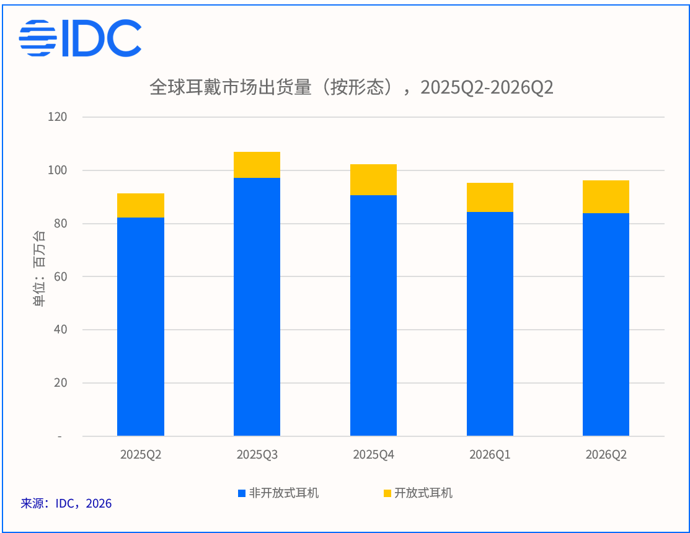
Future pattern differentiation -- the market says goodbye to general growth, manufacturers need to make morphological trade-offs
The ear-clip type continued to reap market dividends based on morphological advantages, with a year-on-year increase of 82.2% in the second quarter. The growth momentum of ear-hanging and neck-hanging models is gradually declining. Open earphones bid farewell to the general rise of all categories and shift to structured competition with morphological stratification and scene segmentation. The value differentiation of different types of products on the racetrack continues to show, and manufacturers need to adopt differentiated pattern layout strategies based on their own resources.
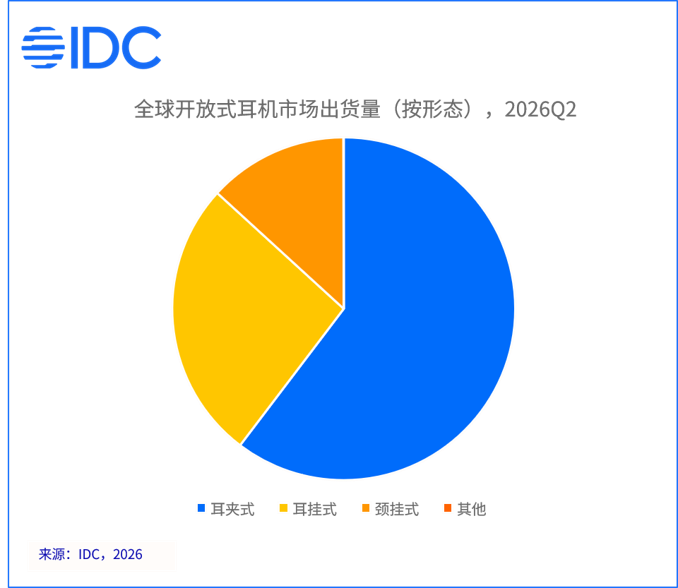
Ear-clip type: core engine for category growth, experience and fashion two-wheel drive
The ear-clip style continued to explode in the second quarter, with open internal shipments accounting for more than 60%, becoming the core engine driving overall open growth. The ear-clip type led both in terms of shipment scale and year-on-year growth rate. This is the result of multiple factors such as wearing experience, product positioning, and manufacturer supply strategies resonating together. At the wearing level, the ear clamping structure is naturally suitable for eyewear users, and the lightweight design reduces the burden of long-term wearing. At the level of product positioning, it breaks through audio tool attributes, superimposes fashion wear value, and rich color schemes and supporting accessories give products social attributes and support consumer premiums. On the supply side, mobile phone brands and audio manufacturers form a hierarchical layout. Leading mobile phone brands set brand benchmarks with high-end models, and affordable manufacturers rely on rapid design iterations and hardware parameter upgrades to expand multi-price product lines to reach a wider range of consumers.
Ear-hanging type: the share of the lower end shrinks, focusing on the advantages of sports scenes
Shipments of ear-hook products fell 5.1% year-on-year in the second quarter, and the share of low-priced products under $25 continued to shrink. A large number of low-priced earhook products that poured in during the early open circuit bonus period are being removed from the market. As consumer awareness matures, low prices alone can no longer continue to convert users, and market demand is shifting to a higher value range. However, ear-hook models have not completely lost their competitiveness. The larger fuselage space gives it unique advantages in terms of stability for sports wear, long battery life, noise reduction processing, and the use of an AI chip, and it will still have a differentiated foothold in the future.
Neckband style: growth is moderating, deepening niche special scenarios
Neckband models, on the other hand, entered a slow growth range. Shipments in the second quarter increased by only 0.9% year-on-year, and the number of manufacturers entering the racetrack was too small. Compared with ear clips and ear hooks, neck-hangers are not portable enough, and their competitiveness in mass market expansion is relatively weak. However, thanks to the bone conduction solution, local storage capacity, and stability brought by wearing it behind the head, it still has irreplaceable value in special sports scenes away from mobile phones, such as swimming.
IDC believes that open track dividends no longer benefit all forms; manufacturers should make trade-offs: the ear-clip type uses scale and premium, the ear-hook type carries advanced functions with a larger fuselage, explores value-added space for audio and AI interaction outside of sports scenes, protects the immediate needs of the niche, and builds competitiveness through scenario-based product combinations.
Faction game -- different manufacturers use their endowments to embark on a path of differentiation
In the second quarter of 2026, China was still the largest regional market for open earphones in the world, accounting for more than 60% of shipments. Chinese manufacturers dominate the global market with their first-mover advantage and supply chain capabilities. Follow up with international first-tier audio brands, focusing on conservative iteration in the high-end market. Emerging players, represented by Indian manufacturers, relied on extremely low prices to seize the sinking global market. The competitive characteristics of the racetrack camp are becoming more and more prominent. Manufacturers should build on their own resource endowments, clarify their differentiated positions, and open up room for growth with long-term competitiveness.
Track pioneers (represented by Shaoyin): This type of manufacturer entered the open circuit earlier and built core barriers in the fields of bone conduction technology and sound leakage control. Deeply involved in the professional sports scene in the early days, then gradually expanded all types of products such as earhooks and ear clips, and transformed into an all-scene popular audio brand.
Manufacturers can rely on established brand mentality to accelerate mass market penetration, continue to consolidate core acoustic technology to withstand the impact of latecomers, and also properly balance high-end technology positioning with mass pricing. In overseas markets, brand reputation accumulated by sports users can be used to broaden global growth space.
Popular audio vendors (represented by Rambler and Basis): Seize the young user market with cost-effective, full-price product matrices and trendy designs, achieve large-scale distribution through aircraft tactics, and actively implement various cloud AI functions in the Chinese market through cooperation with third-party big model companies to promote an intelligent experience based on open headsets.
Manufacturers should break out of simple price competition, create product differentiation highlights, and not create brand recognition that focuses on marketing and light quality. AI functions need to be based on actual usage requirements, avoid gimmicky design, and plan product plans in advance in scenarios where AI services are restricted in overseas markets.
Mobile phone ecosystem vendors: Accelerate the layout of high-end open tracks in 2026, and rely on their own operating systems to achieve multi-terminal ecological collaboration. Use cloud to collaborate with AI computing power to create a low-latency interactive experience, and use headsets as an entrance to the intelligent ecosystem to enhance the high-end value of the brand.
Vendors should moderately open up the ecosystem and improve cross-device adaptability. Take into account ecological advantages and the core acoustic experience of headphones to avoid focusing on ecology and light sound quality. When targeting overseas markets, it is possible to rely on the channel and user base of the brand's other overseas products to achieve ecological collaboration, reuse users, take into account AI compliance requirements in various regions, and help expand globally.
Foreign investors and emerging manufacturers: Brands such as Bose, Sony, and Sennheiser have been deeply involved in the high-end audio market for many years, and have entered the open market with deep acoustic tuning and audio coding technology. However, the overall pace of promotion of new products is relatively conservative, and the pace at which new products are introduced is slow. Indian manufacturers launched entry-level products at extremely low prices to quickly seize the sinking global market.
High-end international manufacturers need to speed up the iteration of localized products to better meet the needs of domestic user scenarios. Emerging low-cost manufacturers can moderately improve product quality and gradually shape brand value on the basis of volume.
AI implementation - from a marketing selling point to a productivity tool
Basic translation and office functions have been rapidly popularized through cloud computing power, but advanced scenarios such as low-latency call translation still rely on end-to-end NPU and hardware collaboration. Currently, most AI functions are still at the level of marketing selling points. Whoever can turn AI from a “gimmick” into a “stable and reliable productivity” can close the gap.
Carrier advantage: long-term wearing properties, laying the foundation for AI implementation
With a non-in-ear product form, open headphones can support users to wear them around the clock. They are natural hardware terminals for audio acquisition and sound output. In the Chinese market, AI has become the next growth engine for the open headphone category, and office and translation have become the core scenarios of commercialization at this stage.
Route differentiation: the cloud popularizes basic functions, and the end side supports advanced productivity
The industry has formed two clearly defined technical routes around the implementation of AI:
Cloud route: Affordable brands generally cooperate with third-party big model companies to achieve face-to-face translation and basic office AI capabilities using cloud computing power. The headphone only takes on sound pickup and voice generation. The hardware cost of this solution is controllable, and AI capabilities can be quickly turned into a premium selling point for the product, but the homogenization of functions is obvious, and the interactive experience is shallow.
Cloud collaboration route: Some mobile phone manufacturers and traditional technology vendors are developing high level productivity scenarios such as low latency call translation, putting forward strict requirements for voice pickup arrays, noise reduction algorithms, cloud collaboration and system adaptability. The relevant flagship headsets are equipped with high-performance NPU, introducing local computing power on the end side to support complex AI tasks, but the price of the product is too high, some products have insufficient acoustic accumulation, and there are shortcomings in the entertainment experience.
Capability shortcomings: Cloud has no functionality and experience, and cloud collaboration lacks scale
Each of the two routes has shortcomings: the cloud route “has functionality and lack experience”, and the end side route “lacks capacity and scale”. In the future, the industry will need to balance AI productivity capabilities, basic acoustic experience, and product pricing in order to truly transform AI from a “selling point” to “productivity.”
The new situation of going overseas - Chinese manufacturers dominate the world, but compliance and localization are must-answer questions
With their first-mover advantage and supply chain capabilities, Chinese manufacturers account for more than 60% of global open headphone shipments, but going overseas is not a simple way to sell goods. There are significant regional differences in overseas markets: European and American markets are popular, and users value brand and product quality; e-commerce channels in Southeast Asia are booming, young consumers are concentrated, and they prefer products with a sense of design; India competes for the sinking market with extremely low price products. At the same time, restrictions on regional data privacy regulations, language localization adaptation, and AI service restrictions require manufacturers to embed compliance and localization capabilities at the product definition stage — domestic AI solutions cannot be copied overseas, language coverage must be planned in advance, and data storage and processing must comply with local regulations. Going overseas is not “selling domestic products overseas,” but “redefining products for overseas markets.”
Future competition will no longer focus on the presence or absence of AI functions, but rather a comprehensive competition for cross-cloud collaboration capabilities, reliability of AI experiences in multiple scenarios, comprehensive acoustics, and local compliance and scenario adaptation capabilities for overseas markets.
Conclusions
Morphological trade-offs, acoustical skills, and the global implementation of AI form a comprehensive barrier to the next round of competition
Open earphones bid farewell to general dividends and enter a new stage of morphological stratification, faction game, AI implementation, and global compliance. After dividends ebb, competition is a comprehensive contest between morphological trade-offs, acoustics skills, and AI's ability to implement globally. Manufacturers need to combine their resource endowments to select track positioning, taking into account acoustic roots, scenario-based AI experience, and overseas local compliance in order to build a sustainable growth curve in a differentiated market.