
- PRICING
- LIVE QUOTES
- LEARN
- HELP


EN
How European Real Estate Expansion Will Impact KKR Stock Investors
- Realty Income Corporation formed a euro-denominated joint venture with KKR that now holds 54 stabilized European net lease assets across four countries, with KKR investing €528 million for a 49% stake while Realty Income keeps operational control.
- For KKR, the deal adds a sizable, income-generating real estate pool in Europe in addition to its growing private credit platform focused on AI infrastructure and investment-grade financing demand.
- The focus now shifts to how KKR's investment narrative could be shaped by this European net lease joint venture with Realty Income.
KKR Investment Narrative Recap
To own KKR, you need to be comfortable with an alternatives powerhouse that leans heavily on private credit, real estate and carried interest rather than plain vanilla fees. The key near term swing factor is how steadily fee paying assets and performance income hold up while analysts expect revenue to decline 13.9% annually over the next three years.
The biggest risk is that rapid expansion in private credit and asset based finance brings asset quality or liquidity issues that erode those earnings. The new European net lease joint venture with Realty Income looks additive, but not a game changer for KKR's overall earnings path or its main risk profile.
The most relevant update linked to this Realty Income deal is KKR's own emphasis on private credit and asset based finance as a core growth engine, with roughly US$300b in credit assets and demand for diversified, evergreen vehicles. This joint venture sits alongside that, giving KKR more income oriented European real estate exposure that can complement private lending.
For shareholders, a key consideration is the interplay between these income producing assets and KKR's push into financing AI infrastructure and investment grade private credit. Execution in these areas could influence how exposed overall results are to cyclicality in carried interest, while any deterioration in asset performance or fundraising momentum would feed directly into the firm's most important earnings catalysts and risks.
KKR Forecasts Behind the Realty Income JV Story
Forecasts for KKR are aggressive on profitability even as the analyst models bake in pressure on the top line. Consensus assumes revenue will decline 13.9% per year over the next three years, while profit margins are expected to rise from 9.3% today to 39.6% by 2028. Earnings are projected to increase from US$2.0b today to US$5.4b by 2028, which is an earnings increase of about US$3.4b over that period.
KKR's narrative projects US$13.7b revenue and US$5.4b earnings by 2028. This assumes a 13.9% yearly revenue decline and an earnings increase of about US$3.4b from US$2.0b today.
Analysts are effectively saying that if you buy into the KKR story, you are buying into a margin rebuild rather than a clean revenue expansion story. That has real implications when you layer on asset based finance, private credit and now income producing European real estate through the Realty Income joint venture. Each of these areas ties back to fee rates, cost discipline and how much of every extra dollar of revenue can realistically fall through to the bottom line.
The P/E assumptions make that trade off very clear. To line up with the consensus narrative, KKR would need to move from a P/E of 61.2x earnings today to 35.7x on the US$5.4b profit that analysts pencil in for 2028. This is still above the current 26.7x P/E cited for the wider US capital markets peer group. A lower multiple on a much higher earnings base is doing most of the work in the model, rather than a simple re rating of the stock.
For readers trying to tie this back to the Realty Income deal, think of the joint venture as one piece in a bigger puzzle. Net lease assets can add steadier rental income, which can support the profit margin ramp that analysts are baking into their KKR models. The same goes for private credit and asset based finance, which are meant to smooth earnings and make that 39.6% margin target less dependent on volatile carried interest and transaction fees.
On the risk side, the projections link directly to the earlier concerns around asset quality and liquidity. If KKR leans harder into private credit and real estate to support higher earnings, the balance sheet and underlying loan books take on more importance. Any deterioration in those portfolios, including the European net lease pool with Realty Income, would flow straight through to the earnings bridge from US$2.0b today to US$5.4b by 2028.
There is also a capital markets angle that investors tracking KKR should not ignore. The consensus framework assumes the stock trades on a P/E that is still richer than the broader US capital markets group in 2028. That gap often reflects expectations for better than average compounding in fee based and performance related income. If fundraising slows, competition compresses fees or exit markets stay quiet for longer, the premium multiple in those models becomes harder to justify.
Uncover why KKR's fair value indicates a 42% potential upside to its current price that could narrow quickly.
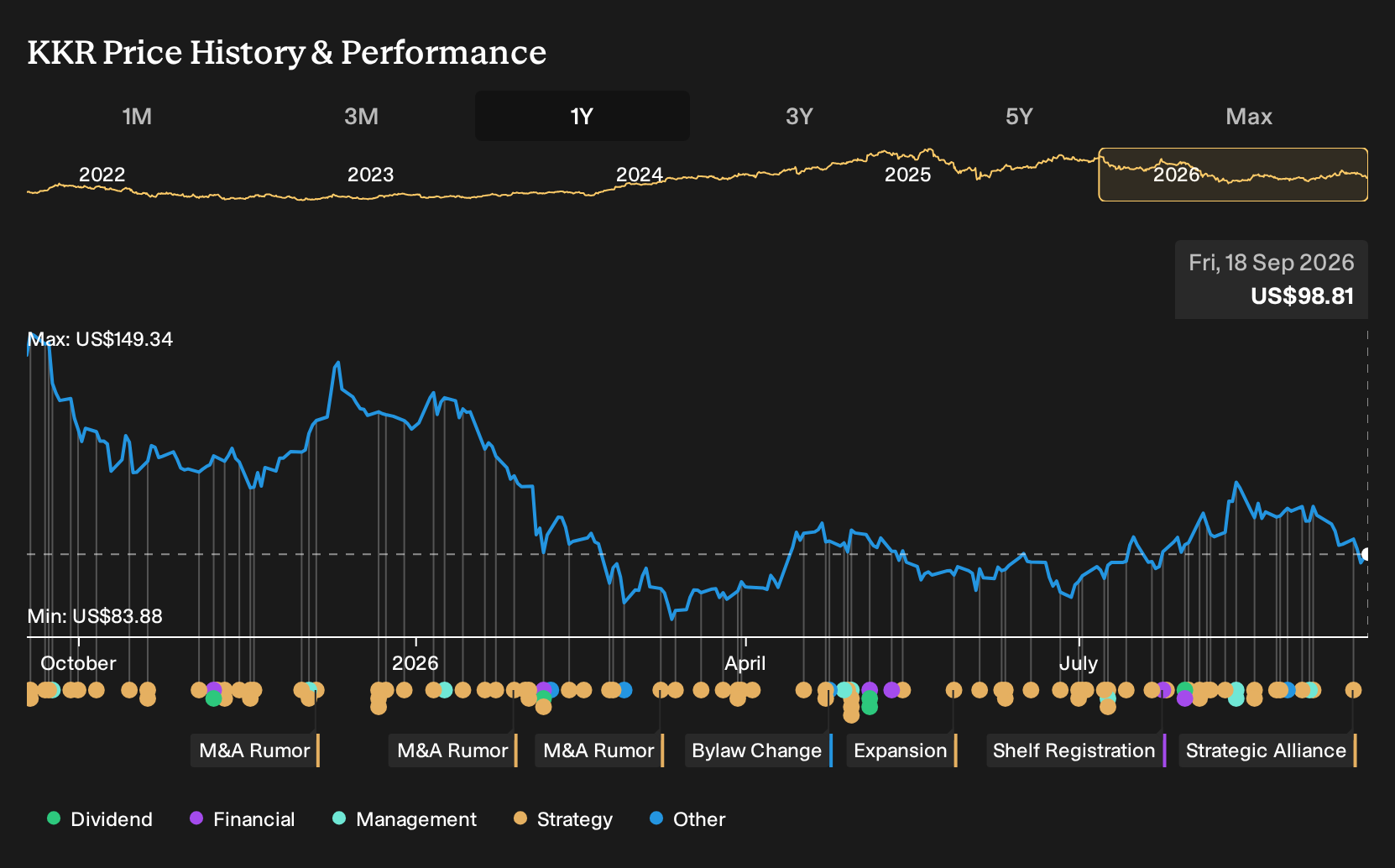
Exploring Other Perspectives
You might see the Realty Income joint venture as a helpful income anchor for KKR, yet the lowest analysts lean hard into a different catalyst. They focus on Global Atlantic and lower risk holdings, and still model revenue at about US$12.4b and earnings near US$6.0b by 2029. Their view was set before this news, so treat the joint venture as one more reason to revisit both the cautious and optimistic cases and decide which story fits your own expectations.
Explore 5 other KKR fair value estimates, including one that suggests as much as 37% downside from the current price!
Form Your Own Verdict
Don't just follow the ticker. Dig into the data and build a conviction that's truly your own.
- A great starting point for your KKR research is our analysis highlighting 3 key rewards and 1 important warning sign that could impact your investment decision.
- See our latest analysis for KKR. The report includes a comprehensive fundamental analysis summarized in a single visual, the Snowflake, making it easy to evaluate KKR's overall financial health at a glance.
Looking For More Investment Ideas Beyond KKR?
If this KKR and Realty Income story has you thinking about portfolio balance and risk, the next step is to widen the opportunity set. The Simply Wall St Screener lets you scan for other stocks that fit clear, disciplined criteria rather than chasing headlines.
- For investors who want income that aims to be more resilient, review 7 dividend fortresses where payouts and balance sheets are already doing the heavy lifting.
- If the priority is capital protection before upside, start with 30 resilient stocks with low risk scores and see which businesses score well on stability and financial strength.
- When you want quality that is not already crowded, work through 16 high quality undiscovered gems and assess which lesser known stocks deserve a spot on your watchlist.
This article by Simply Wall St is general in nature. We provide commentary based on historical data and analyst forecasts only using an unbiased methodology and our articles are not intended to be financial advice. It does not constitute a recommendation to buy or sell any stock, and does not take account of your objectives, or your financial situation. We aim to bring you long-term focused analysis driven by fundamental data. Note that our analysis may not factor in the latest price-sensitive company announcements or qualitative material. Simply Wall St has no position in any stocks mentioned.
Have feedback on this article? Concerned about the content? Get in touch with us directly. Alternatively, email editorial-team@simplywallst.com