
- PRICING
- LIVE QUOTES
- LEARN
- HELP


EN
Is Payward Partnership Altering The Investment Case For Nasdaq Stock?
- Nasdaq announced an expanded partnership with Payward, parent of Kraken, to advance the Nasdaq Equity Token framework and provide market surveillance technology across Payward's trading venues.
- The focus on issuer protections, regulatory compliance and tokenized equity infrastructure signals Nasdaq's push to embed its technology deeper into digital asset markets and future capital flows.
- The investment narrative for Nasdaq will now be tested against this expanded Payward collaboration around tokenized equities and market surveillance.
Nasdaq Investment Narrative Recap
To own Nasdaq, you need to be comfortable with a story where the group behaves less like a traditional exchange and more like a global markets technology utility. The expanded Payward partnership fits that view, since it leans on Nasdaq’s existing strengths in surveillance, market data and issuer services rather than creating a new line of business overnight.
The key near term swing factor is still execution across its broader technology and data platforms, including large client deals that can take time to finalize. The biggest risk remains reliance on complex partnerships and integrations, especially with a high debt load and slower forecast growth than the wider US market.
The Payward announcement is the clearest operational link to the tokenization theme that investors are watching. Nasdaq is not only working on the Nasdaq Equity Token framework with an expected launch target in the second quarter of 2027; it is also embedding its surveillance tools across crypto, equities, tokenized stocks, futures and options on Payward venues.
That pairing of infrastructure and monitoring matters for catalysts. It ties Digital Liquidity Networks and the firm’s existing surveillance franchise to a practical rollout path for tokenized equities, while concentrating execution risk in delivering always on systems and regulatory grade oversight. For you, the question is whether Nasdaq can convert that footprint into durable technology contracts and steady fee streams.
Nasdaq's current analyst script points to US$7.1b in revenue and US$2.5b in earnings by 2029, based on 7.9% yearly revenue growth and an earnings increase of about US$0.5b from US$2.0b today.
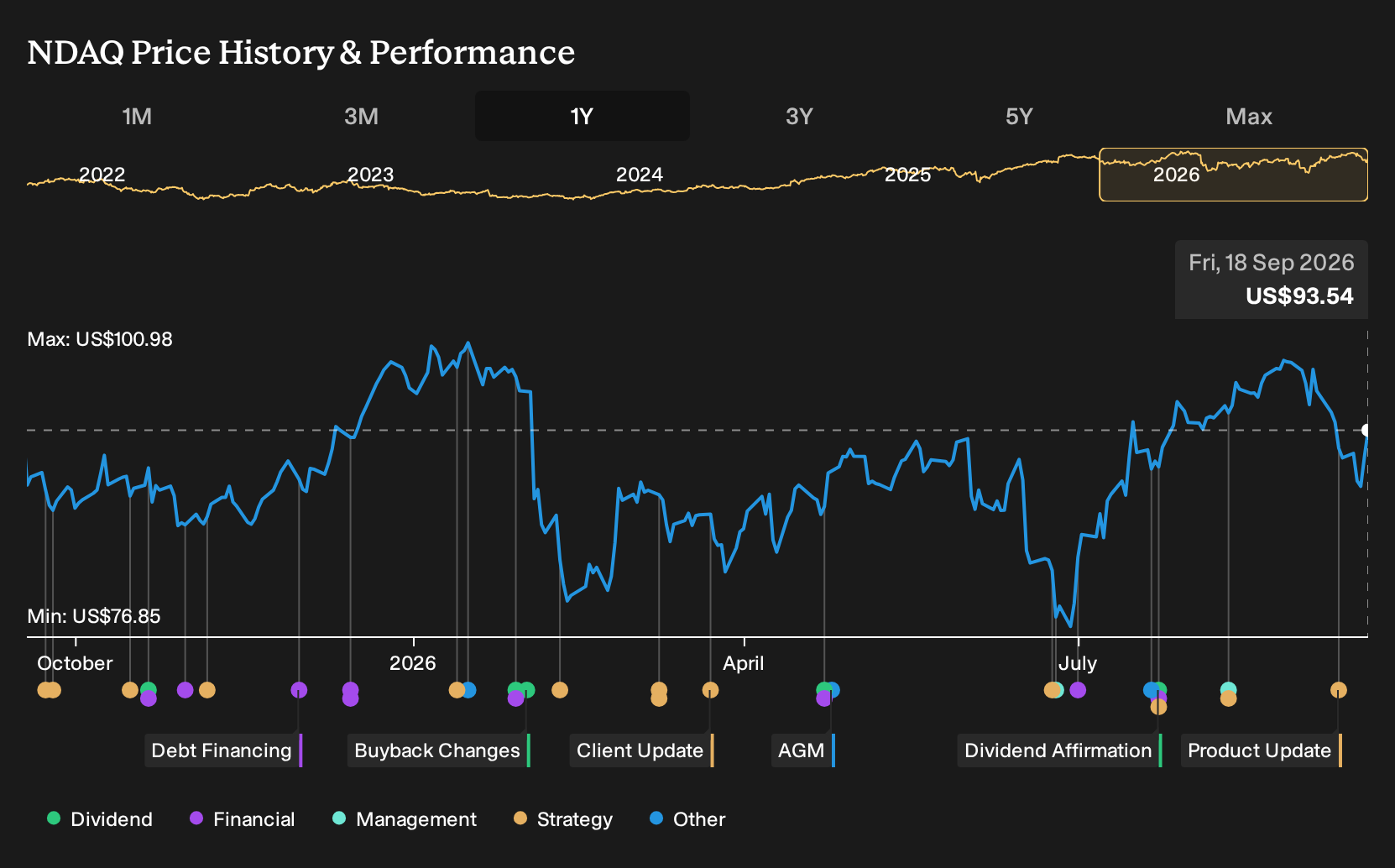
Uncover why Nasdaq's fair value indicates an 18% potential upside to its current price, which could narrow quickly.
Exploring Other Perspectives
Four fair value estimates from the Simply Wall St Community span roughly US$87.53 to US$110.07, so retail views on Nasdaq’s worth already differ widely. Those opinions were formed before the Payward expansion, tokenization roadmap and macro risks around client deal timing and regulation. You should therefore weigh several contrasting viewpoints before acting.
Explore 3 other Nasdaq fair value estimates, including one that suggests as much as 18% upside from the current price.
The Verdict Is Yours
Disagree with existing narratives? Extraordinary investment returns rarely come from following the herd, so go with your instincts.
- A great starting point for your Nasdaq research is our analysis highlighting 3 key rewards and 2 important warning signs that could impact your investment decision.
- See our latest analysis for Nasdaq. The report includes a comprehensive fundamental analysis summarized in a single visual, the Snowflake, making it easy to evaluate Nasdaq's overall financial health at a glance.
Looking for more Nasdaq investment ideas?
If this Nasdaq story has you thinking about how to position the rest of your portfolio, it can help to scan a wider field of opportunities that match different risk and income preferences.
- For investors hunting for quality at a discount, review a curated set of 33 high quality undervalued stocks that combine attractive pricing with stronger fundamentals.
- If capital preservation sits high on your list, filter for 30 resilient stocks with low risk scores that may better suit a steadier approach to market exposure.
- When balance sheet strength is your first checkpoint, narrow the universe with a list of solid balance sheet and fundamentals (23 results) to find businesses with more robust financial footing.
This article by Simply Wall St is general in nature. We provide commentary based on historical data and analyst forecasts only using an unbiased methodology and our articles are not intended to be financial advice. It does not constitute a recommendation to buy or sell any stock, and does not take account of your objectives, or your financial situation. We aim to bring you long-term focused analysis driven by fundamental data. Note that our analysis may not factor in the latest price-sensitive company announcements or qualitative material. Simply Wall St has no position in any stocks mentioned.
Have feedback on this article? Concerned about the content? Get in touch with us directly. Alternatively, email editorial-team@simplywallst.com