
- PRICING
- LIVE QUOTES
- LEARN
- HELP


EN
Will Conference Outlook Change Pfizer (PFE) Stock Narrative
- Pfizer recently presented at the Morgan Stanley 24th Annual Global Healthcare Conference in New York, with CEO Albert Bourla outlining how the business is handling debt, patent expiries, and future product opportunities.
- The discussion put a spotlight on how Pfizer balances a large dividend outlay and more than US$60b of acquisition driven debt with the need to fund its oncology, obesity, and vaccine pipelines.
- We will now look at how Pfizer's investment narrative could be affected by CEO comments on debt, pipeline and dividend trade offs.
Compare how Pfizer's situation stacks up against other healthcare giants by scanning a curated list of list of solid balance sheet and fundamentals (23 results) that are not juggling similar dividend and debt pressures.
Pfizer Investment Narrative Recap
To own Pfizer stock today, you need to believe the business can shift its earnings base away from a shrinking COVID franchise and toward oncology, obesity and vaccines, while keeping a heavy dividend and debt load in check. The Morgan Stanley conference matters because investors want clarity on how management sequences these priorities over the next few years.
The key near term swing factor is whether recently acquired and launched medicines can offset patent expiries and weaker COVID demand quickly enough to support cash flow. The biggest risk is that high leverage and a dividend that is not well covered by earnings restrict flexibility if pricing reforms or pipeline setbacks occur at the same time.
The most relevant thread for this conference is Pfizer's build out in oncology, highlighted by acquired Seagen assets and newer agents like Padcev. These portfolios already contribute revenue, so execution here is central to the story of replacing expiring products and servicing more than US$60b of acquisition related borrowings.
For you as a shareholder, the question is whether oncology and obesity programs, alongside productivity savings, can offset regulatory pricing pressure and a projected decline in revenue over the next three years. Conference commentary on how these franchises ramp, and how management prioritises capital between R&D, debt reduction and dividends, directly shapes how credible that operational plan appears.
Pfizer's narrative projects US$54.3b revenue and US$9.1b earnings by 2029. This builds on analyst assumptions of a 5.2% yearly revenue decline and requires earnings to more than double from US$4.3b today to reach that 2029 consensus level.
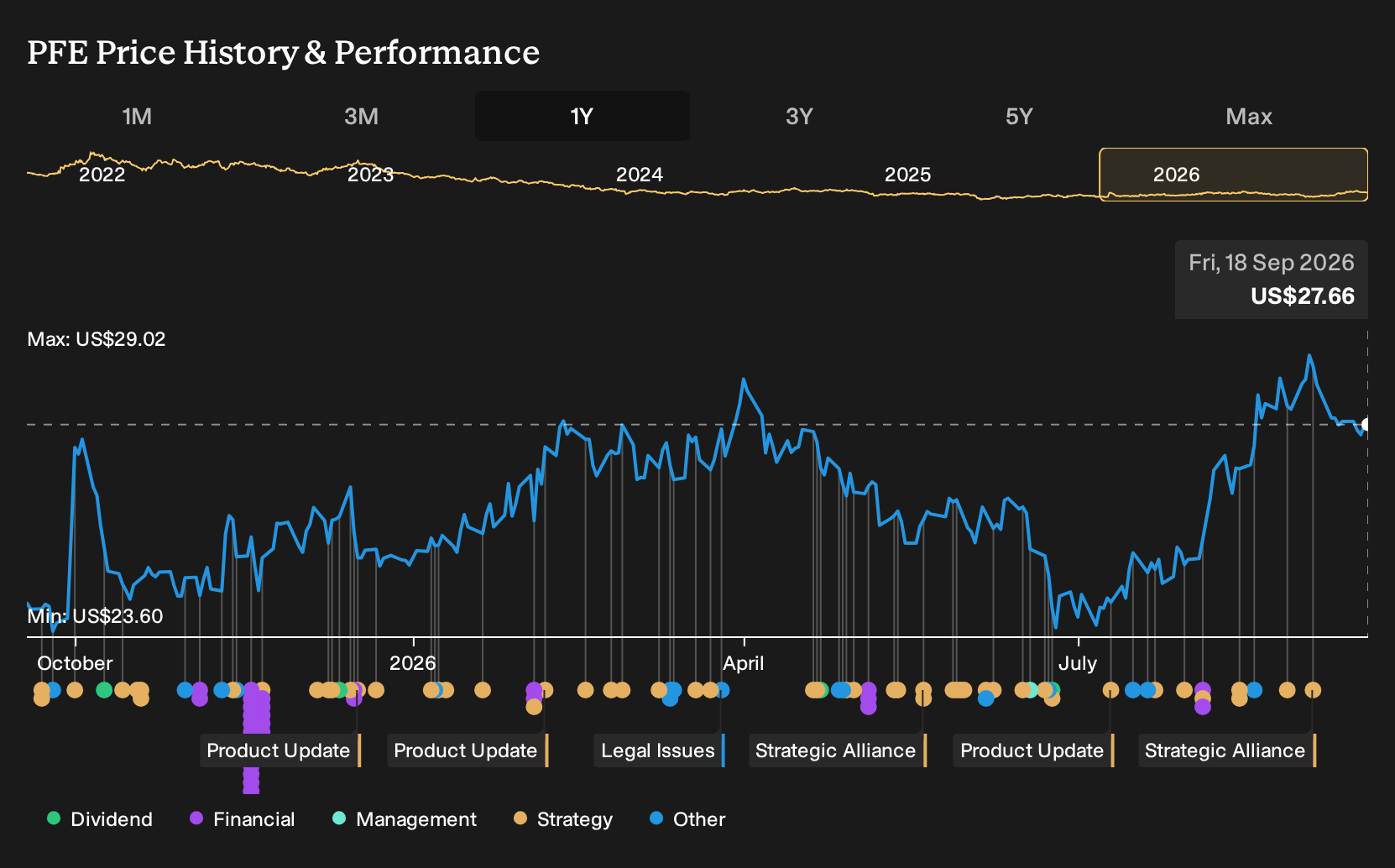
Uncover why Pfizer's fair value indicates a 4% potential upside to its current price, which could narrow quickly.
Exploring Other Perspectives
One alternate take on Pfizer leans heavily on oncology as the swing factor. The most optimistic analysts were modelling about US$57.5b of revenue and US$11.3b of earnings by 2029, well above the baseline. You can treat the Morgan Stanley conference as a real time test of whether that more upbeat story still holds or needs a reset.
Explore 12 other Pfizer fair value estimates, including one that suggests as much as 160% upside from the current price.
Form Your Own Verdict
Don't just follow the ticker. Dig into the data and build a conviction that's truly your own.
- A great starting point for your Pfizer research is our analysis highlighting 2 key rewards and 4 important warning signs that could impact your investment decision.
- See our latest analysis for Pfizer. The report includes a comprehensive fundamental analysis summarized in a single visual, the Snowflake, making it easy to evaluate Pfizer's overall financial health at a glance.
Looking for more Pfizer sized investment ideas?
If this Pfizer deep dive has sharpened your questions about income, value and balance sheet strength, it can help to compare it with other businesses that share some of the qualities you care about, without the same mix of debt and product transition risk.
- If you want income to do more of the heavy lifting in your portfolio, scan a curated set of 6 dividend fortresses that prioritise yield and resilience over hype.
- If your focus is on valuation and quality together, line up Pfizer against 33 high quality undervalued stocks that pair healthier balance sheets with robust fundamentals.
- If capital preservation comes first for you, stress test your ideas beside 30 resilient stocks with low risk scores that score well on risk metrics and financial strength.
This article by Simply Wall St is general in nature. We provide commentary based on historical data and analyst forecasts only using an unbiased methodology and our articles are not intended to be financial advice. It does not constitute a recommendation to buy or sell any stock, and does not take account of your objectives, or your financial situation. We aim to bring you long-term focused analysis driven by fundamental data. Note that our analysis may not factor in the latest price-sensitive company announcements or qualitative material. Simply Wall St has no position in any stocks mentioned.
Have feedback on this article? Concerned about the content? Get in touch with us directly. Alternatively, email editorial-team@simplywallst.com