
- PRICING
- LIVE QUOTES
- LEARN
- HELP


EN
Does Softer Housing Demand Change The Bull Case For Lennar Stock (LEN)?
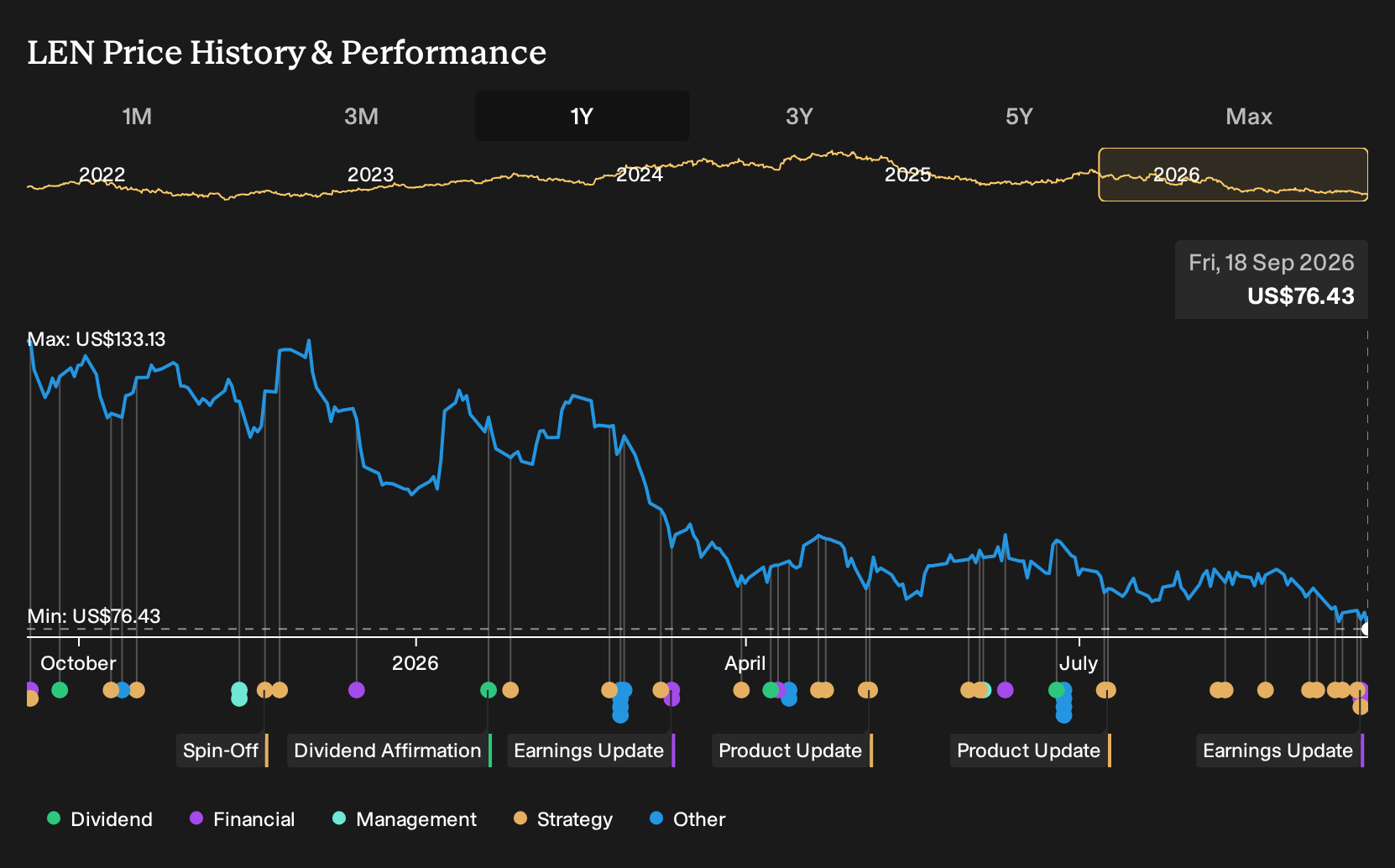
- Lennar reported weaker third quarter 2026 results, with revenue of US$8.0b and net income of US$283.88 million, and cut full year home delivery guidance amid higher mortgage rates and softer housing demand.
- The builder is relying on price cuts and heavier incentives to keep orders flowing, which pressures margins while it continues investing in new communities such as Cherokee Bend, The Farm, Amberwood and expanded amenities at Tuckers Cove.
- We will now explore how Lennar's softer quarter, including reduced home delivery guidance, could reshape the investment narrative around its asset light model.
See how Lennar's weaker quarter compares to other builders facing the same rate pressure by reviewing our hand picked list of 33 high quality undervalued stocks.
Lennar Investment Narrative Recap
To own Lennar, you need to believe its asset light, volume focused model can work through a tougher housing backdrop built on high mortgage rates and stretched buyers. The latest quarter pushes that belief. Revenue and net income for both Q3 and the first nine months are lower than a year ago, and earnings per share have almost halved.
The key short term catalyst is Lennar keeping production flowing while protecting margins, helped by quicker build times and tight inventory. The biggest current risk is that affordability and resale competition stay tough, which could force deeper incentives and keep profit margins under pressure even if deliveries meet guidance.
The most relevant recent move is Lennar’s updated guidance for the fourth quarter of 2026. Management is pointing to 19,500 to 20,500 new orders and 22,000 to 23,000 deliveries, alongside earlier full year delivery cuts to 80,000 to 81,000 homes. That gives you a concrete volume roadmap in a tougher market.
Those delivery targets sit next to an active capital return program. Lennar repurchased 3,000,000 shares for US$256 million in the latest tranche, completing 52,005,201 shares, or 19.29%, since 2022. For investors, execution against Q4 volume and margin guidance, while continuing to balance debt, dividends and buybacks, remains a central test of the current thesis.
Lennar Earnings and Revenue Assumptions
Lennar's narrative projects US$40.8b revenue and US$2.7b earnings by 2029. This is based on analysts modeling 8.5% yearly revenue growth and an earnings increase of about US$1.4b from current earnings of US$1.3b.
Discover how Lennar's fair value indicates a 10% potential upside to its current price that may not last much longer.
Exploring Other Perspectives
You are seeing one sharply different angle from the lowest Lennar analysts. They were already framing affordability as the main risk, with revenue reaching only about US$34.3b and earnings around US$1.2b by 2029. That is a much more cautious story than consensus, and the latest Q3 miss could prompt fresh revisions in either direction.
Explore 3 other Lennar fair value estimates, including one that suggests as much as 14% downside from the current price.
Reach Your Own Conclusion
Disagree with existing narratives? Extraordinary investment returns rarely come from following the herd, so go with your instincts.
- A great starting point for your Lennar research is our analysis highlighting 3 key rewards and 1 important warning sign that could impact your investment decision.
- See our latest analysis for Lennar. The report includes a comprehensive fundamental analysis summarized in a single visual, the Snowflake, making it easy to evaluate Lennar's overall financial health at a glance.
Looking for more investment ideas beyond Lennar?
If the Lennar story has sharpened your thinking about housing, it can be useful to cast a wider net and compare it with other companies that share some of the qualities you care about, whether that is value, resilience or income.
- For investors who prioritize resilient balance sheets and fundamentals, start with a list of solid balance sheet and fundamentals (23 results) to see which businesses currently line up with that profile.
- If your focus is on long term value opportunities, use the 33 high quality undervalued stocks to filter for companies where strong underlying metrics and pricing may be out of sync.
- Income focused readers can scan a 6 dividend fortresses that pairs higher yields with an emphasis on durability and cash coverage.
This article by Simply Wall St is general in nature. We provide commentary based on historical data and analyst forecasts only using an unbiased methodology and our articles are not intended to be financial advice. It does not constitute a recommendation to buy or sell any stock, and does not take account of your objectives, or your financial situation. We aim to bring you long-term focused analysis driven by fundamental data. Note that our analysis may not factor in the latest price-sensitive company announcements or qualitative material. Simply Wall St has no position in any stocks mentioned.
Have feedback on this article? Concerned about the content? Get in touch with us directly. Alternatively, email editorial-team@simplywallst.com