
- PRICING
- LIVE QUOTES
- LEARN
- HELP


EN
Earnings Beat Might Change The Case For Investing In Avnet Stock (AVT)
- Avnet has attracted fresh attention after solid quarterly results, expanding digital infrastructure and e-commerce investments at Farnell, and deeper exposure to cloud, AI, and industrial automation customers.
- The new EMUS Lab collaboration with The University of Hong Kong gives Avnet direct visibility into early AI hardware projects and real-world commercialization hurdles.
- This article examines how Avnet's investment narrative is shaped by its AI hardware collaboration and broader digital platform expansion.
Scan beyond Avnet to find other hardware and infrastructure suppliers benefiting from the same AI and automation buildout with our hand picked 89 AI infrastructure stocks.
Avnet Investment Narrative Recap
Being a shareholder in Avnet means buying into a distributor that is trying to turn scale, engineering support, and digital platforms into stickier customer relationships across cloud and industrial automation. The key near term swing factor is whether demand recovery, especially in EMEA and higher value sectors, can support operating margins without eroding profitability through heavier exposure to lower margin Asian volumes.
The biggest current risk is margin pressure colliding with already tight coverage of debt and working capital tied up in inventory. The recent attention around AI and automation does not materially change that near term equation. The story still hinges on disciplined cost control, inventory management, and mix, not headlines.
The EMUS Lab collaboration with The University of Hong Kong is the clearest operational link to the AI hardware theme that has pulled focus back onto Avnet. It connects the distributor directly to early stage projects that need design help, GPU access, manufacturability checks, and real world supply chain support as they move from prototype to something that can ship at scale.
For you as an investor, this matters mainly as a potential pipeline builder. If Avnet can convert those lab relationships into recurring component supply and engineering work, it would support the existing catalyst around higher value services and digital platforms rather than creating a new one. Execution risk remains around margins, capital intensity, and regional demand, even with this AI collaboration in place.
What The Avnet Consensus Is Pricing In
Avnet's consensus story from analysts is built around a company that grows into a much larger distributor while lifting profitability from today's levels. Revenue is assumed to rise by 10.3% a year for the next few years, helped by the same AI, cloud, and industrial demand that underpins interest in the EMUS Lab work. Analysts are also baking in an improvement in profit margins from 1.2% to 3.7% over roughly three years, which would rely on higher value services and better mix, not just more volume.
On earnings, the gap between today and the forecast is wide. Analysts expect earnings to move from US$334.4 million today to US$1.4b by 2029. That is roughly a 4x increase in profit, alongside a modest 0.91% annual rise in the share count. This means a lot of the story rests on higher earnings per share, not just financial engineering.
Valuation assumptions reflect that shift. The analyst framework implies Avnet would be earning US$1.4b on US$37.1b of revenue in 2029, then trading at a P/E multiple of 8.6x on those earnings compared with 22.9x today. The idea is that higher profitability and cash generation would do more of the heavy lifting than a lofty earnings multiple, even though the discount rate used in these models is close to 9.6%, which builds in a meaningful cost of capital.
Avnet's narrative projects US$37.1b revenue and US$1.4b earnings by 2029. This assumes 10.3% yearly revenue growth and roughly a 4x earnings increase from US$334.4 million today.
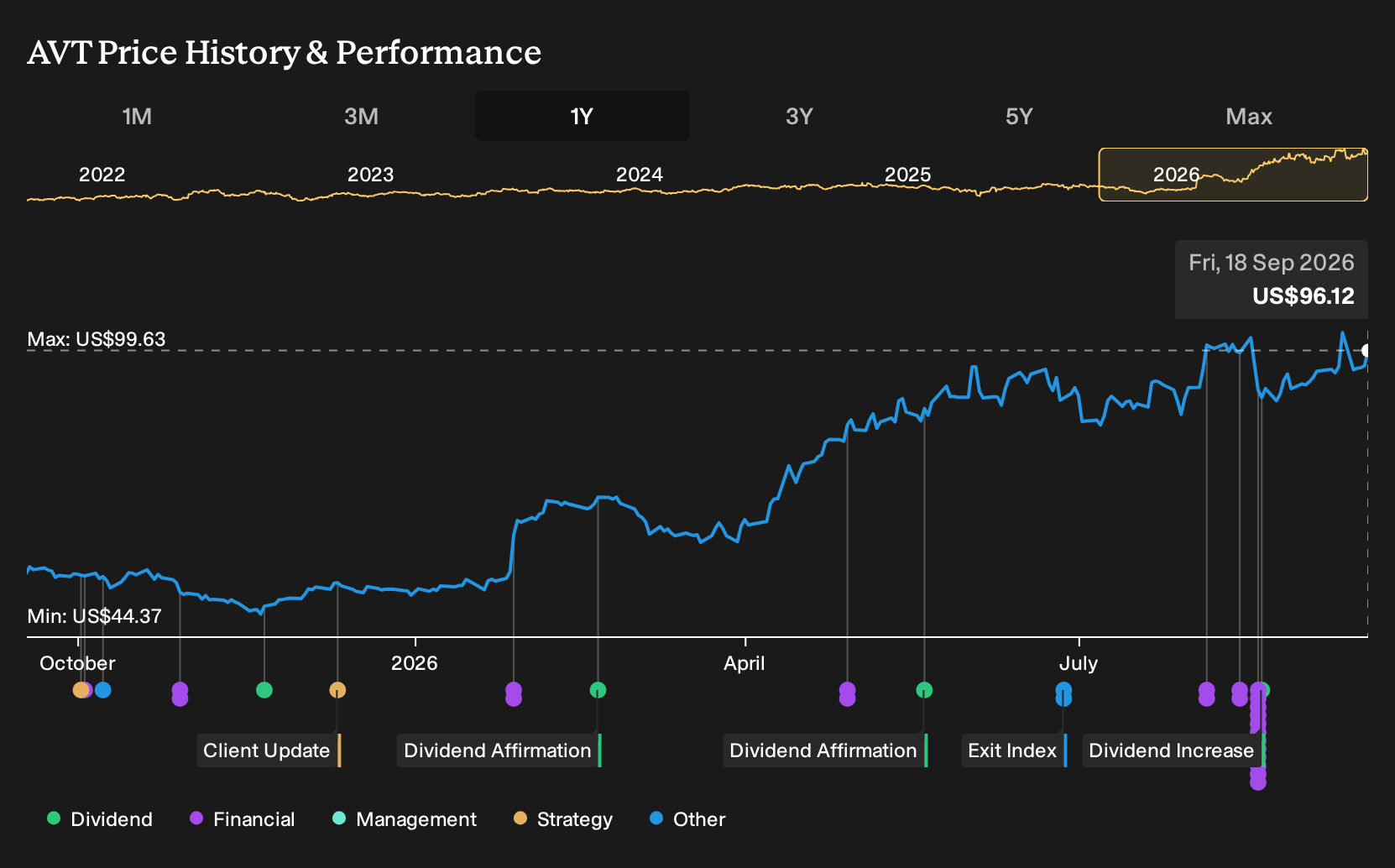
Discover why Avnet's fair value indicates an 11% potential upside to its current price, a gap that could narrow quickly.
Exploring Other Perspectives
One contrasting angle focuses on direct supply chain risk. The most bearish analysts worry that large manufacturers bypassing Avnet could keep pressure on the business even with the new EMUS Lab news. Before this update, they were still penciling in about US$37.5b of revenue and US$1.4b of earnings by 2029, while applying a much lower 6.5x P/E. That gap shows how widely views can differ. Use it as a cue to test several narratives rather than relying on a single story.
Explore 2 other Avnet fair value estimates, including one that suggests there could be as much as 75% downside from the current price.
Decide For Yourself
Disagree with existing narratives? Extraordinary investment returns rarely come from following the herd, so go with your instincts.
- A great starting point for your Avnet research is our analysis highlighting 3 key rewards and 3 important warning signs that could impact your investment decision.
- See our latest analysis for Avnet. The report includes a comprehensive fundamental analysis summarized in a single visual, the Snowflake, making it easy to evaluate Avnet's overall financial health at a glance.
Looking For More Investment Ideas Beyond Avnet?
If the Avnet story has sharpened your thinking about AI hardware, supply chains, and balance sheet risk, you can use that same lens to scan a broader watchlist. The Simply Wall St Screener lets you move from a single stock to a full set of candidates that fit your preferred mix of quality, income, and resilience.
- If durable balance sheets are your priority, you can start with companies that pair low leverage with solid fundamentals by checking the list of solid balance sheet and fundamentals (23 results).
- If you want income potential, you can review businesses that currently offer stronger yields and aim for staying power with the 6 dividend fortresses.
- If you prefer to hunt for under followed opportunities with healthy financial profiles, you can run a search using the 16 high quality undiscovered gems.
This article by Simply Wall St is general in nature. We provide commentary based on historical data and analyst forecasts only using an unbiased methodology and our articles are not intended to be financial advice. It does not constitute a recommendation to buy or sell any stock, and does not take account of your objectives, or your financial situation. We aim to bring you long-term focused analysis driven by fundamental data. Note that our analysis may not factor in the latest price-sensitive company announcements or qualitative material. Simply Wall St has no position in any stocks mentioned.
Have feedback on this article? Concerned about the content? Get in touch with us directly. Alternatively, email editorial-team@simplywallst.com