
- PRICING
- LIVE QUOTES
- LEARN
- HELP


EN
How Investors May Respond To Omega Healthcare Investors Stock Higher Rate Pressure
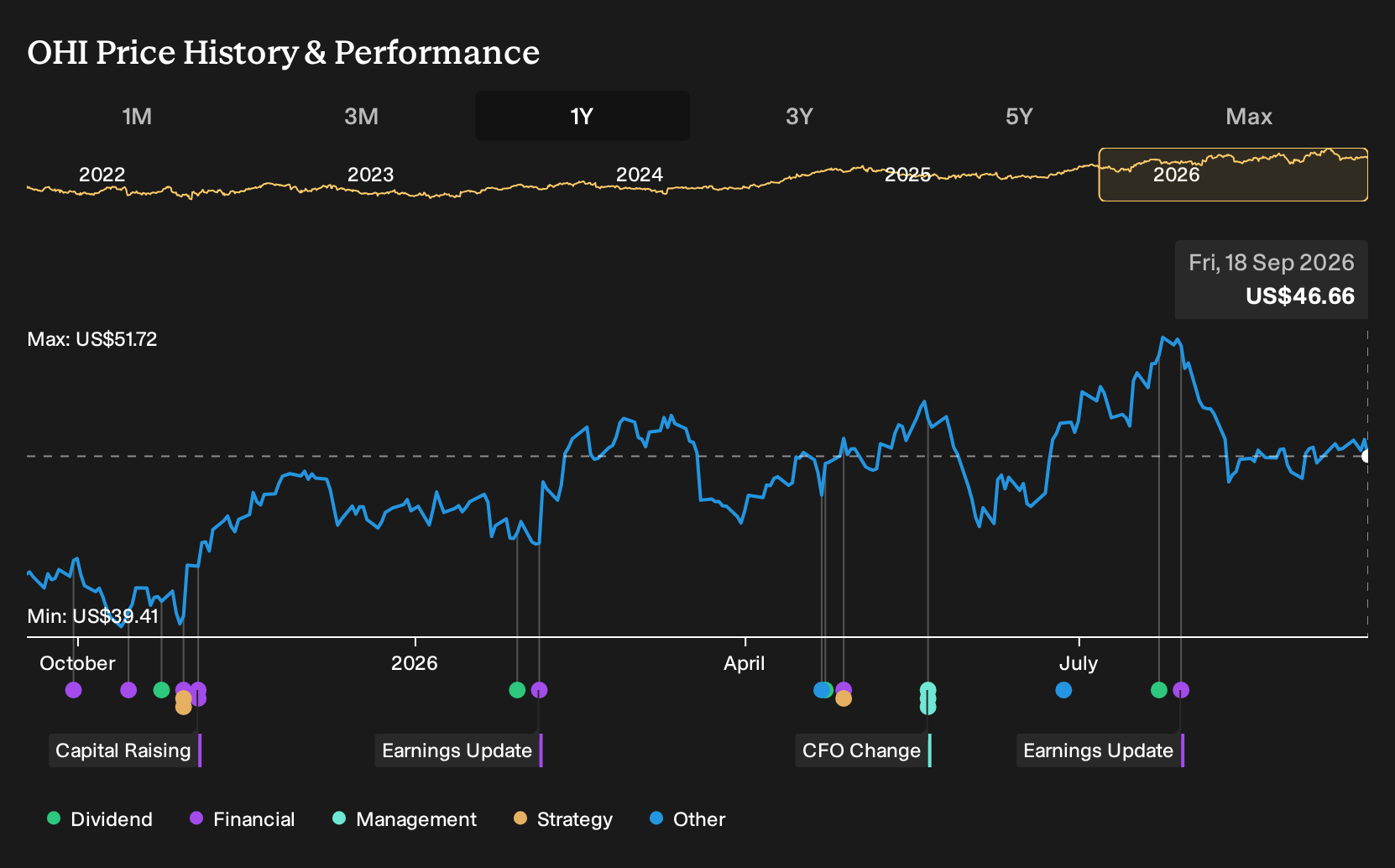
- Omega Healthcare Investors recently confirmed the timing of its third quarter 2026 earnings release and conference call, as investors digest a higher Federal Reserve policy rate in the 3.75% to 4.0% range.
- The combination of rising borrowing costs and a focus on long term care rent coverage puts Omega Healthcare Investors' dividend funding and tenant health under a sharper spotlight.
- We will now test how Omega Healthcare Investors' income focused investment narrative holds up when Federal Reserve policy keeps funding costs elevated.
Compare Omega Healthcare Investors with a hand picked group of income focused landlords by screening for 6 dividend fortresses that are structured to operate in a higher for longer interest rate environment.
Omega Healthcare Investors Investment Narrative Recap
To own Omega Healthcare Investors, you need to believe that aging demographics and long term care demand can offset pressure from higher funding costs and mixed tenant credit quality. The big near term swing factor is still tenant rent coverage. Elevated rates and high leverage keep payout capacity and refinancing terms in focus, and the Fed move itself does not radically change that setup.
The more immediate risk sits with operator health and any knock on impact from restructuring or bankruptcies like Genesis. A secondary concern is that earnings are expected to decline over the next few years, which can make dividend funding tighter if rent collections weaken or workout activity drags on cash flow.
The most relevant update today is Omega Healthcare Investors scheduling its third quarter 2026 earnings release for November 3, followed by a call on November 4. That is the next clean checkpoint for you to see how higher rates and tenant specific issues are feeding through to rent collections, bad debt expense, and leverage metrics.
This call also matters for dividend focused holders. Management commentary and guidance around tenant restructurings, U.K. exposure, and any acquisition or disposition activity will help you judge how sustainable the current 5.83% yield looks against expected earnings declines and a balance sheet that already relies heavily on external borrowing.
Omega Healthcare Investors' current analyst narrative points to revenue of US$1.2b and earnings of US$711.4m by 2029, based on an assumed yearly revenue decline of 1.7%. This compares with earnings today of US$842.0m, implying an earnings decrease of about US$131m by the 2029 forecast year.
Uncover how Omega Healthcare Investors' fair value indicates an 11% potential upside to its current price before that discount to Omega Healthcare Investors closes.
Exploring Other Perspectives
Two fair value estimates from the Simply Wall St Community span a wide band, from US$51.94 to US$89.65 per share, which shows how far opinions on Omega Healthcare Investors can stretch. Those views were formed before the latest Fed rate hike and upcoming earnings call. Revisit the range with tenant risk, U.K. exposure, and rent coverage in mind.
Explore another Omega Healthcare Investors fair value estimate, including one that suggests there may be as much as 92% upside from the current price!
Decide For Yourself
Don't just follow the ticker; dig into the data and build a conviction that's truly your own.
- A great starting point for your Omega Healthcare Investors research is our analysis highlighting 4 key rewards and 3 important warning signs that could impact your investment decision.
- See our latest analysis for Omega Healthcare Investors. The report includes a comprehensive fundamental analysis summarized in a single visual, the Snowflake, making it easy to evaluate Omega Healthcare Investors' overall financial health at a glance.
Looking for more Omega Healthcare Investors style income ideas?
Once you have formed a view on Omega Healthcare Investors, it can help to widen the lens and compare it with other businesses that share similar income, quality, or risk profiles. The Simply Wall St Screener lets you do that quickly by filtering for key traits instead of scrolling through tickers one by one.
- For investors who want income without ignoring resilience, start with companies that pair higher yields with stronger payout support by screening for 6 dividend fortresses.
- If you are hunting for quality at a sensible entry point, look at businesses that combine solid fundamentals with pricing that our models flag as potentially attractive using 33 high quality undervalued stocks.
- Readers who care most about capital preservation can narrow the field to companies with sturdier financial profiles and fewer red flags by filtering via the 30 resilient stocks with low risk scores.
This article by Simply Wall St is general in nature. We provide commentary based on historical data and analyst forecasts only using an unbiased methodology and our articles are not intended to be financial advice. It does not constitute a recommendation to buy or sell any stock, and does not take account of your objectives, or your financial situation. We aim to bring you long-term focused analysis driven by fundamental data. Note that our analysis may not factor in the latest price-sensitive company announcements or qualitative material. Simply Wall St has no position in any stocks mentioned.
Have feedback on this article? Concerned about the content? Get in touch with us directly. Alternatively, email editorial-team@simplywallst.com