
- PRICING
- LIVE QUOTES
- LEARN
- HELP


EN
Capital Spending Strain Might Change The Case For Investing In GATX (GATX)
- GATX has committed heavy capital over recent years to protect its competitive position, which has compressed free cash flow margins and coincided with a reported 3.8% return on invested capital. This points to pressure on the economics of recent projects.
- Thin cash reserves combined with low-return investments raise the risk that GATX may need to fund future spending on tough terms, which could matter more for long-term owners than any short-term earnings move.
- We will now explore how concerns about GATX's low 3.8% ROIC could reshape its investment narrative and risk profile for shareholders.
GATX Investment Narrative Recap
To own GATX today, you need to be comfortable with a rail leasing business that leans heavily on long asset lives, long contracts and disciplined capital allocation. The recent focus on defending GATX's moat with heavy spending, alongside a 3.8% ROIC, puts execution under the microscope. In the near term, the key swing factor is whether utilization and renewal activity can justify that investment load.
The biggest operational risk right now centers on funding those projects with limited cash and higher reliance on borrowing. Tougher financing terms could squeeze flexibility if European demand stays soft or remarketing gains weaken. If operating cash generation holds up, the recent ROIC news is more of a yellow flag than a thesis breaker.
The most relevant context around this ROIC discussion is GATX's pending Wells Fargo Rail transaction. Management is aiming to add scale in North America rail leasing, where utilization has been strong and renewal rates have recently been described as flattish. Integrating an acquired fleet while current returns sit at 3.8% increases the pressure on how effectively those extra cars are placed and priced.
Execution on this deal could influence several catalysts that investors watch, including operating leverage from a larger fleet, the stability of remarketing gains and the path of future free cash flow margins. Any integration hiccups, slower synergy realization or higher than expected financing costs would feed directly into already tight interest coverage and constrained free cash flow, which matters for both dividend safety and future investment capacity.
GATX analysts currently model revenues of US$2.7b and earnings of US$472.8m by 2029, which implies 12.8% yearly revenue growth and an earnings increase of about US$138m from current earnings of US$334.6m.
Uncover why GATX's fair value indicates a 23% potential upside to its current price that could close sooner than many investors expect.
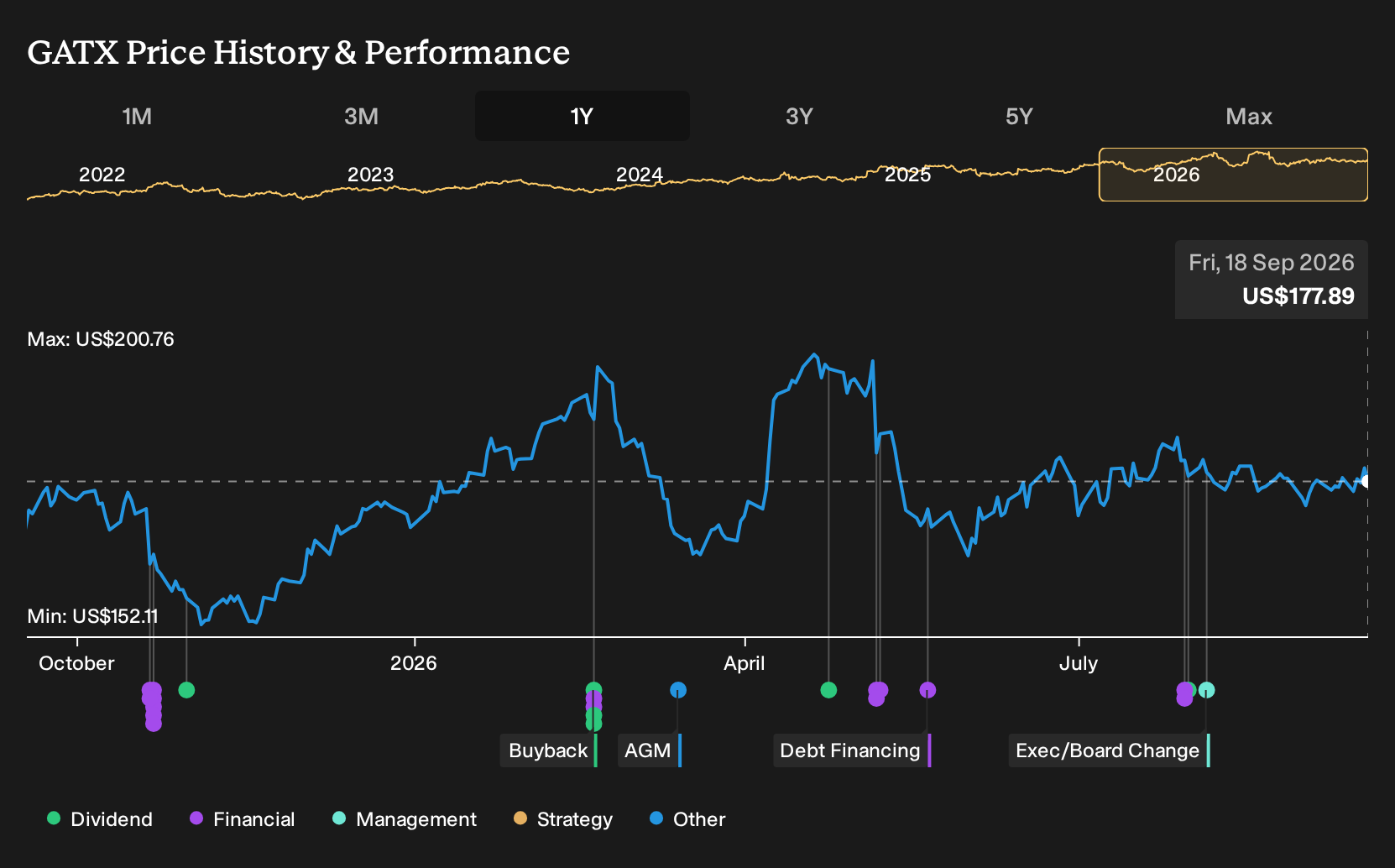
Exploring Other Perspectives
Two fair value views from the Simply Wall St Community span roughly US$50.65 to US$218 per share, which is a very wide range for GATX. That spread sits against risks such as weaker European utilization and lumpy remarketing gains. Use those contrasting opinions to test your own thesis across multiple angles.
Explore another GATX fair value estimate, including one that suggests as much as 23% upside from the current price.
Reach Your Own Conclusion
Don't just follow the ticker; dig into the data and build a conviction that's truly your own.
- A great starting point for your GATX research is our analysis highlighting 5 key rewards and 3 important warning signs that could impact your investment decision.
- See our latest analysis for GATX. The report includes a comprehensive fundamental analysis summarized in a single visual, the Snowflake, making it easy to evaluate GATX's overall financial health at a glance.
Looking for more GATX sized investment ideas?
If the GATX story has sharpened your thinking about capital returns and risk, use that same lens across the wider market with a few focused screeners on Simply Wall St.
- For investors who want potential upside without abandoning quality, scan a curated set of companies that combine pricing power with attractive entry points through the 33 high quality undervalued stocks.
- If capital preservation sits high on your priority list, concentrate on businesses with stronger balance sheets and robust fundamentals by running the list of solid balance sheet and fundamentals (23 results).
- When you want ideas that are less crowded yet still grounded in underlying strength, filter for under-followed opportunities using the 16 high quality undiscovered gems.
This article by Simply Wall St is general in nature. We provide commentary based on historical data and analyst forecasts only using an unbiased methodology and our articles are not intended to be financial advice. It does not constitute a recommendation to buy or sell any stock, and does not take account of your objectives, or your financial situation. We aim to bring you long-term focused analysis driven by fundamental data. Note that our analysis may not factor in the latest price-sensitive company announcements or qualitative material. Simply Wall St has no position in any stocks mentioned.
Have feedback on this article? Concerned about the content? Get in touch with us directly. Alternatively, email editorial-team@simplywallst.com