
- PRICING
- LIVE QUOTES
- LEARN
- HELP


EN
Should Snow Blower Launch Require Action From Toro (TTC) Investors?
- Toro recently launched its first full-size 24 inch Power Max HD two-stage snow blower and three larger upgraded models, each built with a 14 inch auger, heavy-duty frame and commercial-grade powertrain aimed at residential users ahead of winter.
- The move pushes Toro deeper into higher-spec home snow equipment, with all-metal controls, never-flat tires and a multi-light LED system that target reliability, uptime and ease of use. These features directly relate to warranty costs, dealer service load and product mix.
- We will now look at how Toro's upgraded Power Max HD series, and its all metal Quick Stick control, could influence the investment narrative.
Toro Investment Narrative Recap
To own Toro, you need to believe that the mix of professional turf equipment and a recovering residential arm can support steady earnings growth, even with modest revenue forecasts around 3.2% a year. The upgraded Power Max HD line fits that story by leaning into higher spec products aimed at reliability, which can matter for pricing power and warranty discipline more than for immediate volume.
The bigger tension short term sits between weather driven snow demand and consumer caution on big ticket gear. These launch details do not erase risks around low snowfall or dealer inventory hesitancy. They do, though, slightly strengthen Toro’s case that residential margins can improve once volumes stabilise, provided high debt levels remain manageable.
The snow blower launch is the clearest recent operational signal. Toro is putting more engineering focus into residential snow and ice equipment, with all metal controls, a 14 inch auger across the range and never flat tires that are designed to reduce downtime. That points squarely at uptime and ownership costs, not just raw clearing capacity.
For catalysts, this matters most where residential has been a drag. If higher spec models help dealers move product with fewer service headaches, that can support the existing narrative of segment margin recovery toward prior 8 to 10% levels when demand cooperates. The flip side is weather and macro risk remain unchanged, so execution on manufacturing costs and inventory discipline still does most of the heavy lifting.
What The New Snow Strategy Means For Toro's Targets
Toro's narrative projects US$5.2b revenue and US$546.9m earnings by 2029. That lines up with analyst assumptions of 3.8% yearly revenue growth and an earnings increase of about US$207.1m from the current US$339.8m.
For you as an investor, the question is how this heavier focus on higher spec residential gear, like the upgraded Power Max HD snow blowers, fits against those numbers. The snow products speak directly to two of the big moving parts in the model: profit margins that analysts see rising from 7.3% today to 10.5% in three years, and earnings that consensus expects to reach US$546.9m by 2029.
On the top line, the 3.8% forecast annual revenue growth and projected US$5.2b in sales by 2029 assume that professional turf, underground and residential equipment together can support that trajectory. The refreshed residential lineup, including snow, is one piece of that story rather than the whole driver. It is most relevant where snow and ice help keep dealers engaged through winter and support a full year product mix instead of a single season push.
On the earnings side, the step up from US$339.8m today to US$546.9m in a few years bakes in margin progress and some help from a shrinking share count. Analysts expect shares outstanding to fall by about 2.69% a year. Higher spec residential machines, with all metal controls and a commercial grade powertrain, aim to support that by putting more of the economics into uptime and lower service load instead of chasing bare bones entry price points.
Valuation expectations sit on top of those operating targets. The consensus view assumes Toro trades on a P/E of 22.5x those 2029 earnings, with the analysts' average price target at US$109.25 versus a current share price of US$94.78. That implies a 13.2% gap between the market price and the consensus target. For that to make sense to you, the snow blower initiative and adjacent launches need to look like credible support for both the 3.8% revenue growth path and the improvement from 7.3% to 10.5% margins, rather than one off marketing headlines.
Seen through that lens, the Power Max HD refresh is less about one product line and more about whether Toro can gradually shift its residential portfolio toward equipment that supports the higher profitability profile implied in the US$5.2b revenue and US$546.9m earnings forecasts. Your own view on snowfall variability, consumer willingness to fund premium features and dealer appetite for carrying higher priced units will drive whether those assumptions feel conservative, stretched or somewhere in between.
Uncover how Toro's fair value indicates a 17% potential upside to its current price that may not last much longer.
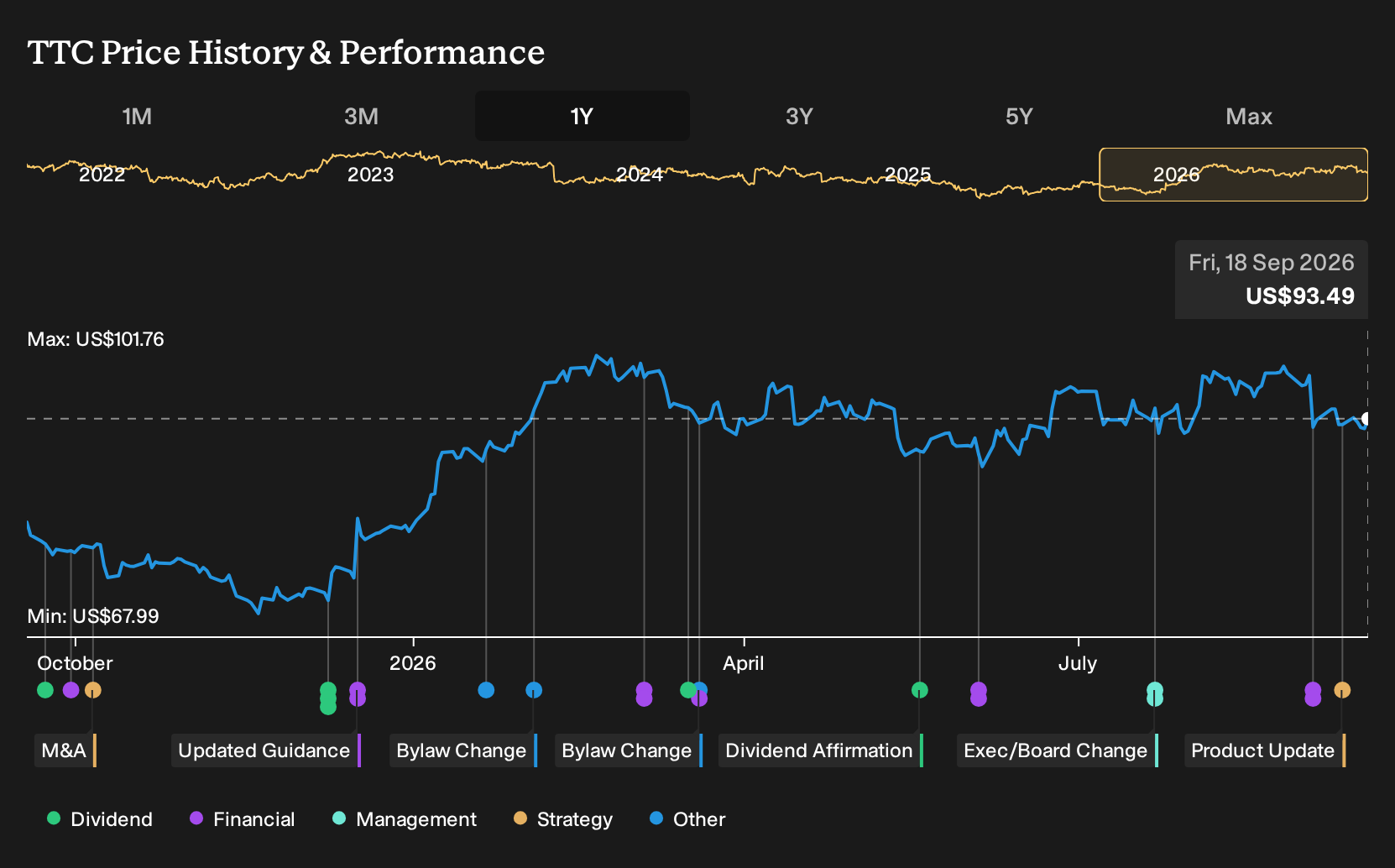
Exploring Other Perspectives
One alternate angle on Toro is margin risk rather than snow upside. The most cautious analysts already worked off similar revenue paths, at about 3.7% annual growth and around US$5.2b by 2029, yet only saw room for a lower 20.6x P/E. Those views predate the Power Max HD launch, so you can judge whether this new residential push nudges expectations higher or simply reinforces that cautious script.
Explore 2 other Toro fair value estimates, including one that suggests it could be worth just $108.75.
Form Your Own Verdict
Don't just follow the ticker; dig into the data and build a conviction that's truly your own.
- A great starting point for your Toro research is our analysis highlighting 4 key rewards and 1 important warning sign that could impact your investment decision.
- See our latest analysis for Toro. The report includes a comprehensive fundamental analysis summarized in a single visual, the Snowflake, making it easy to evaluate Toro's overall financial health at a glance.
Looking For More Investment Ideas Beyond Toro?
Once you have a view on Toro, it can help to compare it with other businesses that share similar financial traits or risk profiles. The Simply Wall St Screener gives you that broader context so you can pressure test your thesis rather than anchor on a single stock.
- If you want resilient balance sheets and cleaner fundamentals, start with a curated 30 resilient stocks with low risk scores that aim to limit unpleasant financial surprises.
- For those hunting for quality at a reasonable price, scan through a 33 high quality undervalued stocks that already combine earnings power with solid cash generation.
- Income focused investors can focus on cash returns by reviewing a 6 dividend fortresses that may help support portfolio yield.
This article by Simply Wall St is general in nature. We provide commentary based on historical data and analyst forecasts only using an unbiased methodology and our articles are not intended to be financial advice. It does not constitute a recommendation to buy or sell any stock, and does not take account of your objectives, or your financial situation. We aim to bring you long-term focused analysis driven by fundamental data. Note that our analysis may not factor in the latest price-sensitive company announcements or qualitative material. Simply Wall St has no position in any stocks mentioned.
Have feedback on this article? Concerned about the content? Get in touch with us directly. Alternatively, email editorial-team@simplywallst.com