
- PRICING
- LIVE QUOTES
- LEARN
- HELP


EN
The Federal Reserve released a signal to continue to raise interest rates, and the dollar recorded its biggest weekly gain in more than three months
The Zhitong Finance App learned that after the Federal Reserve hinted that it would continue to raise interest rates in the future, the US dollar strengthened significantly this week, recording the biggest weekly gain in more than three months. Strong US economic growth and the Federal Reserve's policy stance on continuing to fight inflation have provided important support for the US dollar.
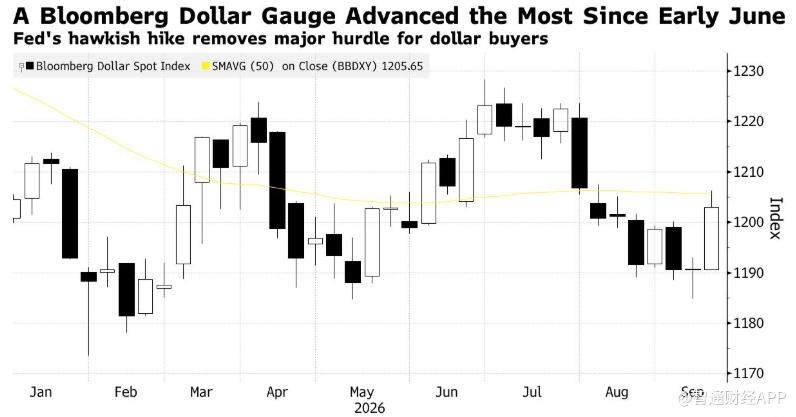
The Bloomberg Dollar Spot Index rose 1.1% cumulatively this week. This week, the Federal Reserve raised interest rates for the first time in more than three years, and sent a signal that monetary policy may be further tightened in the future. J.P. Morgan Chase, Standard Chartered Bank, and Brown Brothers Harriman believe that this policy action has eliminated an important factor that previously limited the further rise of the US dollar.
On the technical side, the Bloomberg Dollar Spot Index fluctuated around the 200-day moving average on Wednesday and Thursday, and closed slightly above this key technical position on Friday. Historical trends show that after the daily line of the US dollar index effectively breaks through the 200-day EMA, it may often usher in a further rise. In March and June of this year, the index both showed subsequent gains after breaking through the 200-day EMA.
The US dollar was expected to record its biggest weekly increase since the outbreak of the war in Iran in March, but as the yen recovered some of its losses on Friday, the dollar's increase narrowed. Earlier, there were reports that the Bank of Japan made an exchange rate inquiry. This move is usually viewed by the market as a precursor to possible official intervention in the foreign exchange market by the Japanese authorities.
Steve Englander, co-head of foreign exchange research at Standard Chartered Bank in New York and head of macroeconomic strategy in North America, said that the 25 basis point rate hike seems to have eliminated one of the main concerns that the market was unwilling to buy the US dollar before, that is, investors are worried that Federal Reserve Chairman Walsh may avoid raising interest rates due to President Trump's position.
Englander believes that this rate hike not only weakened the market's concerns about going long on the dollar, but also increased the risk of shorting the dollar. He predicted that with the US 10-year Treasury yield likely to rise to 5.5% in the next 12 months, the path of further strengthening of the US dollar has become more clear.
Notably, before the Federal Reserve's interest rate decision was announced this week, speculative foreign exchange investors, including asset managers and non-commercial traders, had cut their long positions in the US dollar for a period of time. According to data released by the US Commodity Futures Trading Commission (CFTC) on Friday and compiled by Bloomberg, the bullish position of the US dollar has declined for the seventh consecutive week in the week ending September 15.
Despite this, the market is still divided on whether the US dollar can break through this year's high. Elias Haddad, head of global market strategy at Brown Brothers Harriman, said that other major central banks are also tightening monetary policy, which limits the room for further monetary policy differentiation between the US and other economies, so it may be difficult for the US dollar to reach new cyclical highs.
Currently, the Bloomberg US Dollar Spot Index is still about 1.9% below the 2026 high set on June 24. Risk reversal indicators show that options traders expect the US dollar to strengthen moderately in the next month, but judging from the implicit increase in the options market, there is still a clear gap from driving the US dollar index to a high point in the new year.
However, the growth advantage of the US economy over other major economies may continue to support the US dollar. Haddad pointed out that the September S&P Global Purchasing Managers' Index (PMI) to be released next week is expected to show that the US economic growth performance is still ahead of the Eurozone, the United Kingdom and Japan.
Pat Locke, a foreign exchange analyst at J.P. Morgan Chase, believes that the US dollar was undervalued by about 2% to 4% before the Federal Reserve meeting this week, as measured by various indicators such as interest rate spreads. As the market begins to digest the possibility of further interest rate hikes by the Federal Reserve, the US dollar is “catching up” in valuation. Among them, the increase is particularly evident compared to low-yield currencies.