
- PRICING
- LIVE QUOTES
- LEARN
- HELP


EN
Will Board Vote Fight Change BHP Stock's Narrative
- BHP Group’s Board recently urged investors to vote against shareholder-nominated director candidate Stephen Mayne, after he raised concerns about the company’s use of hybrid AGMs and the effect on shareholder participation.
- The clash centers on whether BHP Group’s current AGM format gives smaller investors enough access to management, which directly touches on governance quality and how decisions on capital allocation are scrutinized.
- We will now explore how BHP Group’s investment narrative could be affected by Board resistance to Stephen Mayne’s director nomination.
BHP Group Investment Narrative Recap
To own BHP Group, you need to be comfortable with a mining giant whose fortunes are tightly linked to iron ore, copper and steelmaking coal demand, especially from China and broader Asian infrastructure and electrification trends. The big near term swing factor is how volumes and unit costs hold up while inflation and labour pressures threaten margins and key projects such as Jansen face execution risk.
The Stephen Mayne board nomination dispute looks more like a governance signal than an operational shock. Unless it escalates into broader board turnover or distracts management from large capital programs, the main short term catalyst for BHP Group still sits in project delivery and commodity price realisations. Concentration in Western Australian iron ore remains the biggest business risk.
The most relevant disclosure for this governance tussle is the Board’s recent Notice of Meeting and recommendation that shareholders vote against Mayne’s election. That filing reinforces that current directors see the existing mix of skills, tenure and independence, including 90% independent directors and four new appointments in three years, as sufficient for overseeing BHP Group’s project pipeline and capital allocation.
For you as a shareholder, the key link to catalysts is oversight of risk, not day to day pricing. A board that keeps tight control of execution on Jansen, inflation exposed cost bases and decarbonisation requirements can influence whether forecast earnings growth materialises. Any perceived weakening in governance around shareholder engagement or AGM access would sit more as a medium term trust issue than an immediate driver of cash flow.
BHP Group's current analyst narrative points to revenues of $56.1b and earnings of $13.3b by 2029, based on an assumed 1.3% yearly revenue growth rate and an earnings increase of about $3.1b from $10.2b today.
Uncover why BHP Group's fair value indicates that it is in line with its current price.
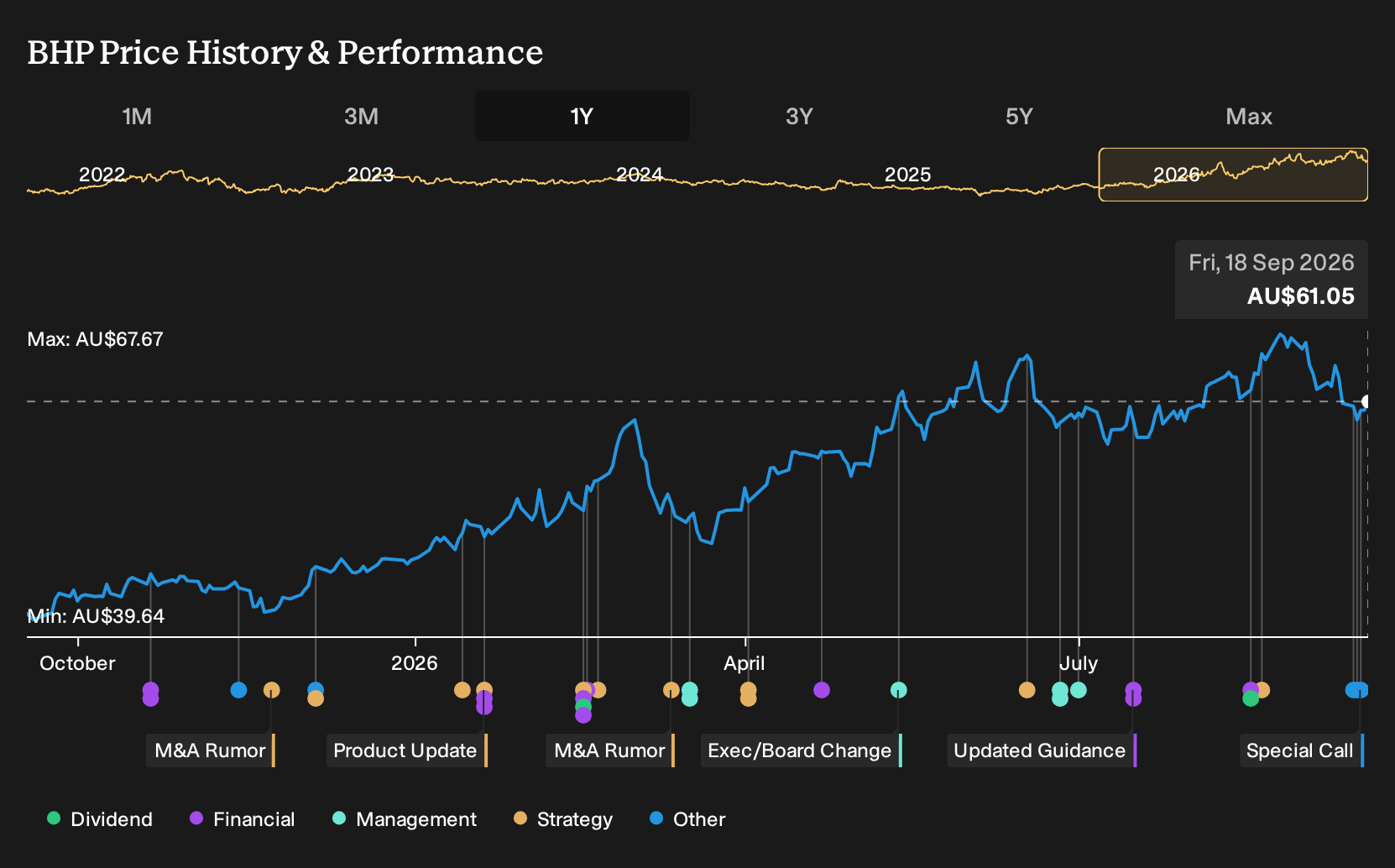
Exploring Other Perspectives
One alternate view puts governance at the center. You might worry that if the AGM access debate drags on, it could affect how confidently BHP Group funds big copper and potash projects. The most pessimistic analysts were already working off revenue of about $52.5b and earnings near $11.7b for 2029, so this new dispute could prompt them to revisit those assumptions.
Explore 15 other BHP Group fair value estimates, including one that suggests as much as 48% downside from the current price!
Reach Your Own Conclusion
Disagree with existing narratives? Extraordinary investment returns rarely come from following the herd, so go with your instincts.
- A great starting point for your BHP Group research is our analysis highlighting 1 key reward and 1 important warning sign that could impact your investment decision.
- See our latest analysis for BHP Group. The report includes a comprehensive fundamental analysis summarized in a single visual, the Snowflake, making it easy to evaluate BHP Group's overall financial health at a glance.
Looking for more BHP Group sized investment ideas?
Once you have a view on BHP Group, it helps to widen the lens and compare it with other potential holdings using the Simply Wall St Screener. That way you can cross check your thesis against companies with different risk profiles, income potential and balance sheet strength.
- If capital preservation comes first for you, start by reviewing a curated 7 resilient stocks with low risk scores that aims to keep drawdowns in check while still giving you equity exposure.
- For investors who care most about quality at a reasonable price, scan through a focused 5 high quality undervalued stocks that blends strong cash generation with more modest valuations.
- Income oriented portfolios can benefit from screening for reliable payers, so consider using a targeted 3 dividend fortresses that concentrates on yields from 5% and higher.
This article by Simply Wall St is general in nature. We provide commentary based on historical data and analyst forecasts only using an unbiased methodology and our articles are not intended to be financial advice. It does not constitute a recommendation to buy or sell any stock, and does not take account of your objectives, or your financial situation. We aim to bring you long-term focused analysis driven by fundamental data. Note that our analysis may not factor in the latest price-sensitive company announcements or qualitative material. Simply Wall St has no position in any stocks mentioned.
Have feedback on this article? Concerned about the content? Get in touch with us directly. Alternatively, email editorial-team@simplywallst.com