
- PRICING
- LIVE QUOTES
- LEARN
- HELP


EN
Corning Stock: The $2 Billion Dilution Scare Is Fading. Here’s What Matters Now.
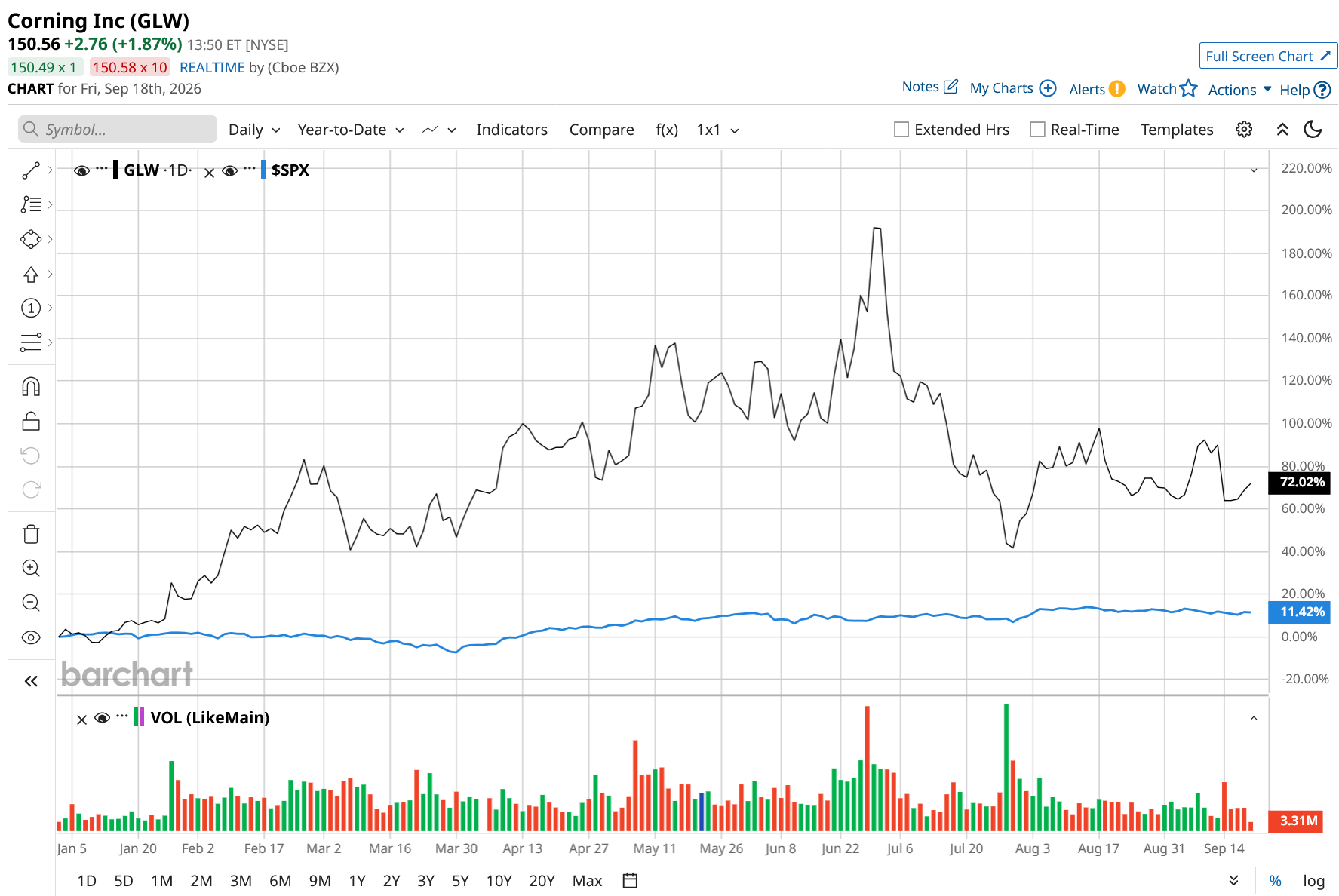
Corning (GLW) stock took a sharp hit this week after the company opened the door to a potential $2 billion equity offering that could dilute existing shareholders. The stock dropped 13.7% on Sept. 14, marking its worst one-day decline in years. At the same time, Corning is expanding its capacity and signing major deals with some of the world's biggest tech companies, including Nvidia (NVDA) and Amazon (AMZN). Its latest Verizon (VZ) agreement alone covers over 80 million miles of optical fiber and connectivity products through 2032. Corning shares have since recovered, shifting attention away from dilution fear to whether the capital raise was a sensible decision, how much stock Corning actually sells, how quickly Optical Communications grows, and whether new capacity generates the returns management expects.
Let’s find out more on what matters for investors now.
Corning Is Raising Money at a Very Different Point in Its Story
Last week, Corning announced that it had entered into an at-the-market equity distribution agreement that permits it to sell common stock worth up to $2 billion over time. What investors need to understand is that the company did not specify a fixed number of shares that will be issued or whether it will be immediate. Actual dilution will depend on how much Corning eventually sells.
While the dilution issue is real, the company needs additional capital without increasing its debt. The company is already planning substantial investments in optical communications capacity as customer demand accelerates. Just days before announcing the equity program, the company secured a major deal with Verizon Communications that will supply more than 80 million miles of high-density fiber and connectivity products over 2027–2032. Meanwhile, management expects full-year capital spending to reach around $2 billion, with a larger share of that investment coming in the second half of the year as Corning expands its Optical Communications capacity.
Essentially, Corning is betting that customer demand will remain strong long enough for the expanded factories and infrastructure investments to generate attractive returns over the next several years. The company has even set ambitious targets. Its internal Springboard plan strategy expects its growth investments to push the business into a much larger revenue bracket over the coming years. The company sees annualized sales reaching $20 billion by 2026 and potentially doubling to $40 billion by 2030. Even under its more cautious projections, sales could reach $27 billion in 2028 and $35 billion in 2030.
This year, AI investors already had an issue with companies spending aggressively without generating any meaningful returns. And Corning is borrowing money and causing dilution while asking investors to trust that today's capital spending will result in substantially higher revenue many years from now. This is probably why many investors dumped GLW stock, as they seem highly sensitive to AI capital-allocation decisions.
Nonetheless, while investors fear dilution risk, Corning is not raising capital to shore up a stagnant business. Its Optical Communications sales jumped 32% year-over-year (YoY) in Q2 to $2.07 billion, while Enterprise Networks sales surged 65%. The company is also seeing strong GenAI-related demand and expanding its manufacturing capacity to keep up. Corning’s Q2 core sales rose 17% to $4.74 billion, while core earnings per share (EPS) increased 30% to $0.78. Besides Verizon, major commitments from Nvidia and Amazon further strengthen the long-term opportunity.
Corning’s next few quarters will offer investors a clear idea whether the trade-off might be worth it.
The Next Few Quarters Will Tell the Real Story
The company has already guided strong Q3 growth, as its Optical Communications business is benefiting from AI-related demand and major customer commitments. The Verizon agreement also gives it a significant long-duration demand signal. Investors should watch if the company's expanding optical business can grow earnings and free cash flow fast enough to make the dilution worthwhile.
For 2026, analysts expect Corning’s earnings to increase by 30.1% YoY to $3.28 per share, followed by $4.35 in 2027, representing another 32.7% increase. Revenue is expected to reach $19.26 billion in 2026, up 17.4%, and $22.95 billion in 2027, up 19.2%. However, at 34x forward 2027 earnings, Corning stock is trading at a premium. So, while analysts expect substantial earnings and revenue growth, investors are already paying a significant premium for that growth.
All in all, Corning is asking investors to accept some dilution today, while Corning gets more money to expand a business that could generate much more revenue in the future. It is for investors to decide whether they are willing to take the risk that the future growth will be large enough to justify the dilution.
Earlier this year, CNBC's “Mad Money” host Jim Cramer had described Corning as one of the stocks he was most excited about, citing its exposure to the data center buildout. However, more recently, he grouped Corning along with Ciena (CIEN) among the stocks he has moved away from for now but could return to later, while remaining constructive on the companies’ long-term fiber-optics AI opportunity.
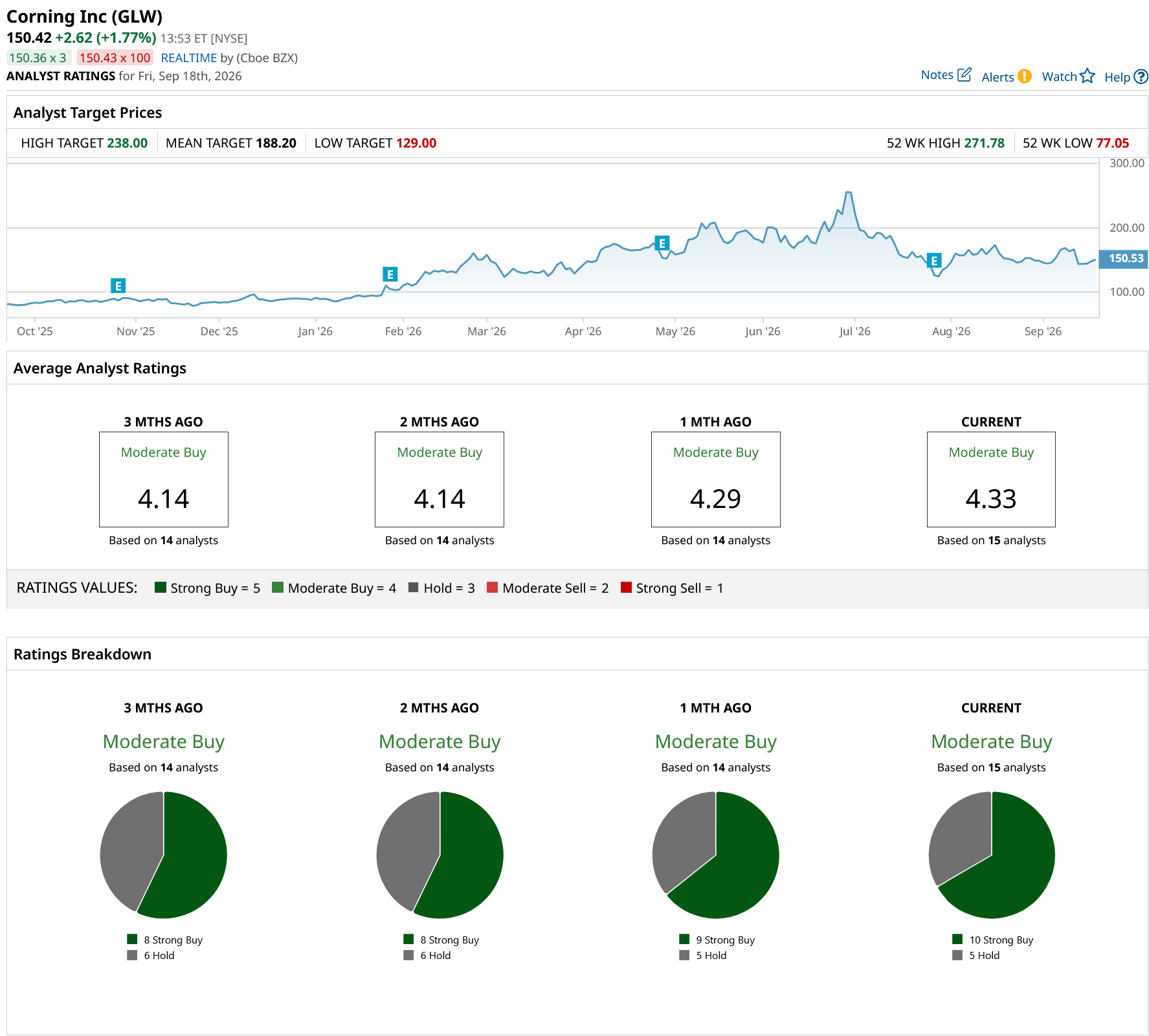
On Wall Street, GLW stock holds a consensus “Moderate Buy” rating. Of the 15 analysts who cover GLW, 10 rate it a “Strong Buy,” and five say it is a “Hold.” Even after that selloff, Corning shares are still up about 72% year-to-date (YTD), highlighting just how strong the rally has been this year. Analysts still expect the stock to climb 25% based on its average target price of $188.20. Furthermore, its high price estimate of $238 suggests a potential upside of 58% from current levels.
On the date of publication, Sushree Mohanty did not have (either directly or indirectly) positions in any of the securities mentioned in this article. All information and data in this article is solely for informational purposes. For more information please view the Barchart Disclosure Policy here.