
- PRICING
- LIVE QUOTES
- LEARN
- HELP


EN
Should Virtual Crash Testing Require Action From Autoliv (ALV) Investors?
- Autoliv reported progress on its Human Body Model Safety Suite, a virtual crash testing platform that is now being evaluated by Toyota for vehicle safety development.
- The use of detailed digital human models and integrated analysis tools indicates rising demand for earlier, software-driven safety engineering in Autoliv's core customer base.
- We will now examine how Autoliv's investment narrative could shift as virtual safety testing gains traction with Toyota using its HBM platform.
Scan hand-picked safety and mobility specialists pushing virtual engineering forward with the 95 robotics and automation stocks that sit closest to Autoliv's Human Body Model story.
Autoliv Investment Narrative Recap
To own Autoliv, you need to believe that tighter safety rules and higher safety content per vehicle keep supporting demand for its airbags and seatbelts, even if global light vehicle production stays soft. The Human Body Model Safety Suite fits that story by pushing the firm further into software supported safety engineering rather than just hardware supply.
The key near term swing factor still looks like pricing power and cost recovery with automakers, not HBM adoption. The biggest risk remains pressure on margins from tariffs, slower build schedules, and OEM bargaining power, especially in China. This Toyota news helps the longer term narrative, but it does not radically change near term earnings drivers.
The most relevant fresh datapoint is Autoliv presenting at Morgan Stanley's Laguna Conference on 16 September 2026. That forum gives management a chance to explain how virtual testing, including the HBM Safety Suite, sits alongside traditional products and where they see content opportunities per vehicle.
For you, the conference matters as a checkpoint on execution. Management can address how software centric offerings might influence margins, capital needs, and contract discussions with large OEMs, and how that lines up with risks around vehicle production, tariffs, and pricing pressure. It is a useful setting to test whether the operational story now matches the virtual testing headlines.
What The Current Autoliv Forecasts Assume
Analysts frame the Autoliv story around steady, model driven progress rather than a dramatic reset. The current consensus points to revenue expanding by 2.9% a year over the coming three years, with profit margins moving from 6.5% today to 7.7% by around 2029 as efficiency work and mix shifts filter through. That backdrop shapes how investors might think about the Human Body Model opportunity and whether software heavy offerings eventually show up in the income statement in a visible way.
On earnings, the same group of forecasters expects profit of US$923.2 million by about June 2029, compared with US$709.0 million today. That is an increase of roughly US$214 million in absolute terms. A few analysts sit above that line and model US$1.0b of earnings, which highlights that views differ on how far margin work and new safety content, including virtual testing capabilities, can stretch the bottom line.
Valuation work in the consensus fold then assumes those 2029 earnings are priced at a P/E of 12.7x, lower than the current 13.5x multiple and below the 20.2x level cited for the wider US auto components group. Revenues in those models reach US$12.0b, with the same US$923.2 million earnings figure used as the anchor. Analysts are effectively treating future Autoliv as a somewhat cheaper stock on a slightly higher margin base. This is a useful reference point when weighing whether virtual safety testing and HBM driven contracts can justify a stronger or weaker multiple over time.
Alongside these income statement and valuation assumptions, consensus estimates build in a 2.53% yearly reduction in shares outstanding for the next three years. That shrinking share count can lift earnings per share even if operating profit grows more slowly. For investors tracking the Human Body Model Safety Suite, it also matters because buybacks and capital allocation choices can influence how much financial headroom Autoliv has to fund software tools, compute infrastructure, and technical talent that underpin virtual crash testing.
Autoliv's narrative projects US$12.0b revenue and US$923.2 million earnings by 2029. This rests on 2.9% yearly revenue growth and an earnings increase of about US$214 million from US$709.0 million today.
Uncover why Autoliv's fair value indicates a 13% potential upside to its current price before that discount to Autoliv's story narrows.
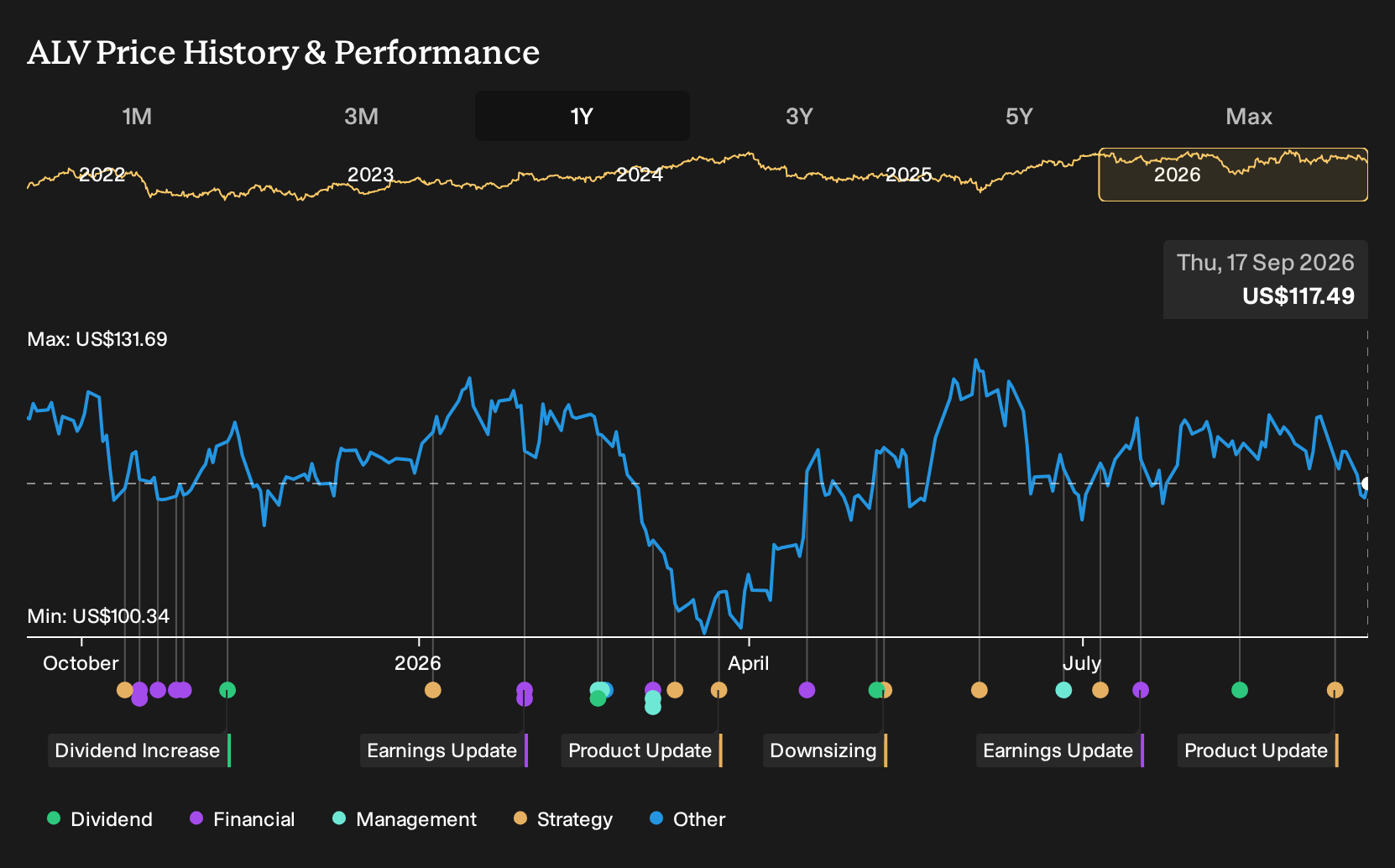
Exploring Other Perspectives
Four fair value estimates from the Simply Wall St Community span from US$103 to about US$207.7, so retail opinions on Autoliv are wide apart. That spread sits alongside real tension between tariff risk, softer vehicle production, and fresh catalysts, such as the HBM Safety Suite rollout with Toyota. Explore the full range before deciding how this story fits your portfolio.
Explore 3 other Autoliv fair value estimates, including one that suggests up to 12% downside from the current price.
Reach Your Own Conclusion
Disagree with existing narratives? Extraordinary investment results rarely come from following the herd, so consider trusting your own analysis.
- A great starting point for your Autoliv research is our analysis highlighting 3 key rewards and 2 important warning signs that could impact your investment decision.
- See our latest analysis for Autoliv. The report includes a comprehensive fundamental analysis summarized in a single visual, the Snowflake, making it easy to evaluate Autoliv's overall financial health at a glance.
Looking For More Ideas Beyond Autoliv?
Once the Autoliv story is clear in your mind, it can help to widen the lens and compare it with other opportunities that share similar qualities or offer very different risk and reward profiles. The Simply Wall St Screener is built for that kind of side by side work so you can pressure test your thesis rather than rely on a single stock.
- If you prefer stability and capital preservation over drama in your portfolio, then scan a set of 30 resilient stocks with low risk scores that may align better with that mindset.
- If strong finances matter most to you, filter for companies using a list of solid balance sheet and fundamentals (23 results) and see how they stack up against Autoliv on resilience.
- If you want something with a bit more hidden potential, then run through a 16 high quality undiscovered gems that might not yet be on the broader market's radar.
This article by Simply Wall St is general in nature. We provide commentary based on historical data and analyst forecasts only using an unbiased methodology and our articles are not intended to be financial advice. It does not constitute a recommendation to buy or sell any stock, and does not take account of your objectives, or your financial situation. We aim to bring you long-term focused analysis driven by fundamental data. Note that our analysis may not factor in the latest price-sensitive company announcements or qualitative material. Simply Wall St has no position in any stocks mentioned.
Have feedback on this article? Concerned about the content? Get in touch with us directly. Alternatively, email editorial-team@simplywallst.com