
- PRICING
- LIVE QUOTES
- LEARN
- HELP


EN
Attacks on key pipelines have triggered a chain reaction and Saudi Aramco will “zero” European crude oil quotas next month
The Zhitong Finance App learned that people familiar with the matter revealed that Saudi Aramco has told at least two European refining customers that the company will not distribute any crude oil to them next month after Saudi Arabia's key pipeline to the Red Sea is attacked. According to people familiar with the matter, European customers usually obtain Saudi crude oil through so-called fixed-term contracts, which guarantees a stable monthly supply flow. However, these crude oil deliveries will not take place next month. People familiar with the matter also said that the decision applies to all European buyers.
Saudi Aramco did not immediately respond to requests for comment outside of normal business hours.
Saudi Arabia's east-west oil pipeline was forced to shut down after being attacked by drones last week. A person familiar with the matter said on Wednesday that the pipeline is expected to partially resume operation within a few days and fully resume operation within six weeks.
European refineries usually pick up Saudi crude oil from the Egyptian Mediterranean port of Sidi Kerir, which is connected to the Red Sea via a pipeline. The shutdown of the oil pipeline has triggered panic buying by some Saudi Aramco customers. Poland's Oren Petroleum has issued more than 10 tenders since last Friday to compete to lock in alternative supplies.
The International Energy Agency said in its monthly oil market report that the OECD European countries imported 577,000 b/d of crude oil from Saudi Arabia in June.
Why is this pipeline so important?
Global oil supply has been strained for months due to the stalemate in the Strait of Hormuz, and the closure of Saudi Arabia's east-west pipeline has hit the market again. The pipeline spans the Arabian Peninsula, with a total length of about 1,200 kilometers, connecting the large oil fields in eastern Saudi Arabia to the port of Yanbu on the Red Sea coast.
Before the war broke out at the end of February, the east-west oil pipeline only transported 2.8 million barrels of crude oil per day, far below its daily transportation capacity of 7 million barrels. However, after the suspension of shipping in the Strait of Hormuz, Saudi Aramco quickly raised the oil transportation volume to the maximum level of pipeline transportation.
Since some crude oil was shipped to the Saudi domestic market, exports from Yanbu Port failed to fully cover Saudi exports of about 7 million barrels per day before the war. However, Saudi oil exports rebounded to 4.7 million b/d in June, equivalent to 5% of global supply. Yanbu exports are essential to limit the rise in oil prices.
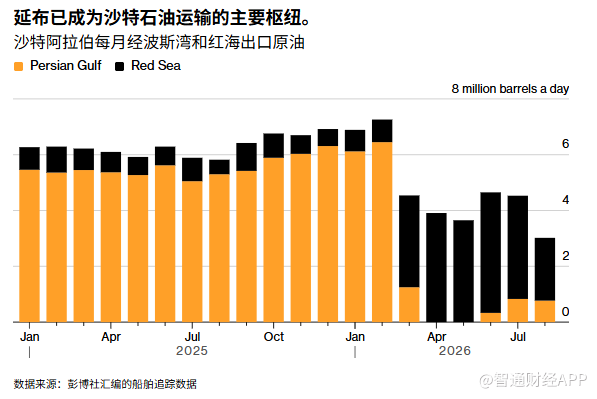
While the pipeline is out of service, Saudi Arabia can still rely on Yanbu Port's inventory for shipment and export. However, Nicholas Dell, an oil analyst at energy consulting agency Energy Aspects, pointed out that Yanbu Port inventories are close to historic lows, and Saudi Arabia is unlikely to completely empty the oil storage tanks, which may further squeeze Yanbu port exports.
Dell also warned that tension at the port of Yanbu could have a ripple effect, leading to further delays and cancellations at the Egyptian port of Sidi Kerir. Saudi Arabia usually transports crude oil to Sidi Keril via the Suez Canal for customers to pick up the goods.