
- PRICING
- LIVE QUOTES
- LEARN
- HELP


EN
General Mills (GIS) Stock Looks In Line On Fresh Sugar Lawsuit
General Mills has seen its share price slide in recent years, and a fresh legal dispute over alleged sugar price fixing now puts a sharper focus on what investors are actually paying for its sales. With the stock under pressure, the key issue is how the current market value lines up with the revenue the business is generating.
- The share price has fallen 35.7% over the past 3 years, which puts extra weight on whether the current valuation is still grounded in the scale and stability of General Mills' sales base.
- The new lawsuit against major sugar suppliers could influence future input costs and pricing power for General Mills, which may affect how much investors are willing to pay for each dollar of the company's revenue.
- The analysts covering General Mills have run their own numbers. See what analysts think General Mills's shares could be worth.
For investors, the debate is whether General Mills' current share price is justified by its sales when judged against the Fair Ratio benchmark.
If you are weighing General Mills against alternatives with a similar focus on what investors pay for each dollar of revenue, it can help to compare it with 29 high quality undervalued stocks.
Is General Mills Fairly Priced on Sales?
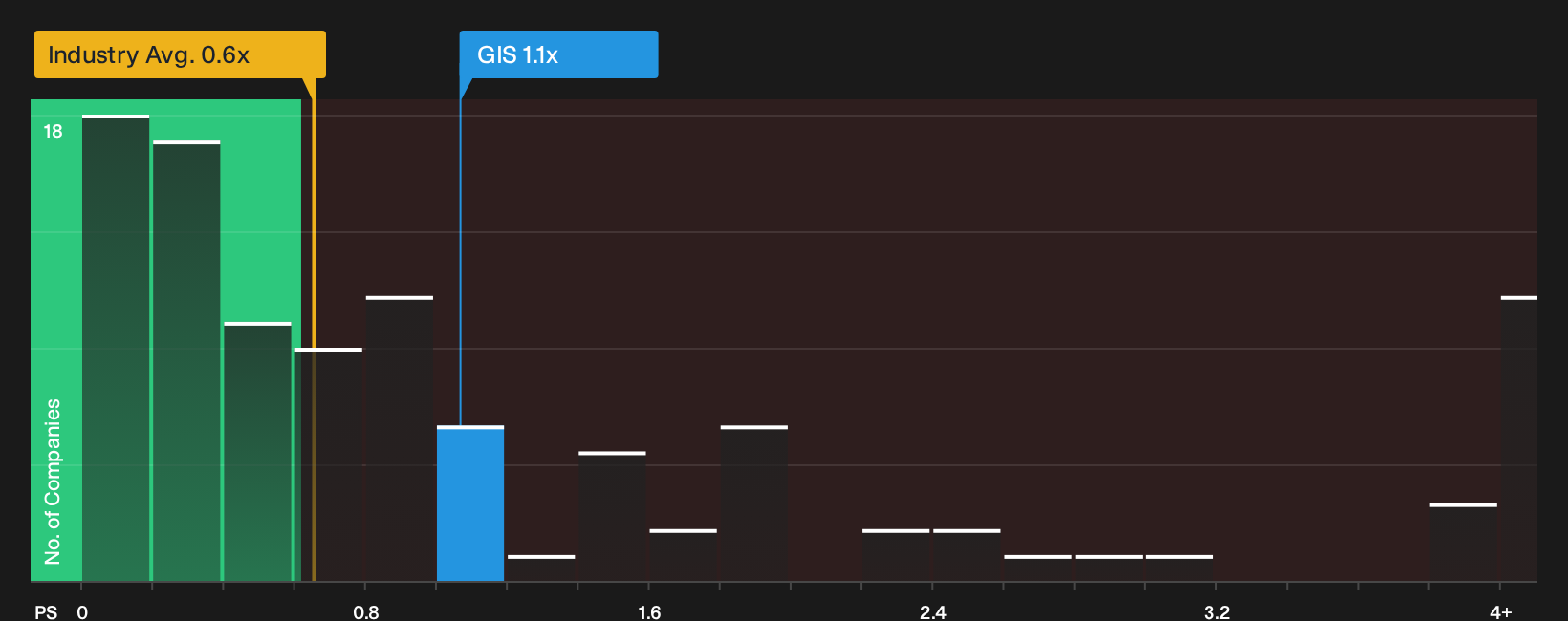
The P/S ratio fits General Mills because revenue offers a cleaner anchor than earnings when legal costs or accounting items can muddy the P/E picture. General Mills currently trades on a P/S multiple of 1.1x, which is slightly below the peer group average of 1.2x and above the wider food industry average of 0.6x. On the Fair Ratio framework, which weights factors such as margins, scale, risks and sector norms, the present P/S sits close to the level suggested by those fundamentals.
Because of the fresh lawsuit against sugar suppliers, some investors may expect a steeper discount to peers to compensate for possible input cost swings. Yet the current P/S still prices General Mills roughly in line with what that tailored model implies. That leaves the stock trading in a band where the multiple neither clearly rewards you for the headline risks nor clearly assumes a best case outcome, so you need to judge whether the revenue quality and legal overhang make that alignment with the Fair Ratio attractive enough. Explore the numbers behind General Mills's P/S valuation.
The General Mills Narrative: What Would Justify Today's Price?
Simply Wall St Narratives pick up where the valuation puzzle for General Mills leaves off. They spell out which paths for revenue growth, margins and earnings would need to play out for the stock to be worth meaningfully more or less than today’s price on the Community page. Rather than focusing on a single multiple or model output, each Narrative lays out its own set of assumptions behind a fair value view, so you can later compare those expectations with the actual results as they are reported.
Community views on General Mills are split between those who see reinvestment as a patient reset and those who focus on rising cost pressure.
Bull case: roughly fairly valued
"General Mills plans a sizable step-up in investment for fiscal '26, including at least 5% through Holistic Margin Management savings and $100 million in additional cost savings…"
Discover why this Narrative puts General Mills at roughly fairly valued.
Bear case: 18% overvalued
"The heavy emphasis on remarkability investments, including a double digit increase in media spend and higher SG&A, risks locking General Mills into structurally higher overhead…"
Explore why this Narrative puts General Mills at 18% overvalued.
Before you act on General Mills' valuation, there is one more piece to check
General Mills' pricing picture only tells part of the story, because separate fundamental checks have highlighted specific red flags that investors may want to weigh alongside the numbers. Take a closer look at 2 warning signs (1 major) before settling on a valuation.
This article by Simply Wall St is general in nature. We provide commentary based on historical data and analyst forecasts only using an unbiased methodology and our articles are not intended to be financial advice. It does not constitute a recommendation to buy or sell any stock, and does not take account of your objectives, or your financial situation. We aim to bring you long-term focused analysis driven by fundamental data. Note that our analysis may not factor in the latest price-sensitive company announcements or qualitative material. Simply Wall St has no position in any stocks mentioned.
Have feedback on this article? Concerned about the content? Get in touch with us directly. Alternatively, email editorial-team@simplywallst.com