
- PRICING
- LIVE QUOTES
- LEARN
- HELP


EN
Barclays: The Bank of England's slowdown in downsizing is expected to ease the pressure on the repurchase market and British Treasury bonds
The Zhitong Finance App learned that the Bank of England kept the benchmark interest rate unchanged at 3.75% as scheduled on Thursday, but at the same time warned that if inflationary pressure intensifies due to the Middle East conflict, it may be necessary to raise interest rates. Meanwhile, the Bank of England made major adjustments to its quantitative austerity (QT) plan, announced that it would abandon the sale of long-term treasury bonds, and plans to gradually reduce its debt portfolio of 488 billion pounds (about 650 billion US dollars) by 2034.
According to the proposal, which has yet to be finalized, the Bank of England will keep £120 billion of treasury bonds due in 2049 or later to match future note issuance. Another 222 billion pounds of treasury bonds due before 2035 will naturally mature, and the remaining 146 billion pounds of bonds due between 2035 and 2049 will be sold at a rate of 20 billion pounds per year, and may be sold directly to the government through the Debt Management Office (DMO). All planned QT auctions will be suspended until next April to finalize the terms of the sale to DMO. The move is aimed at avoiding competition with government bond issuances, thereby easing short-term pressure on UK Treasury yields.
Barclays strategists said that the Bank of England's plan to slow down the pace of bond sales will ease the pressure faced by repurchase operations, and will also provide support for pressured ultra-long-term British treasury bonds. Strategist Moyeen Islam wrote in a report that this move “has created a very favorable environment for long-term British Treasury spreads and the long yield curve because the market is actually in short supply of bonds, and it is unlikely that this shortage will be mitigated in the foreseeable future.” The Bank of England has also “in fact reduced some of the operational pressure faced by its repurchase operation.”
The Bank of England's short-term repurchase tool uses British Treasury bonds as collateral to provide the market with British pound liquidity. The scale of these operations has previously grown faster than the Bank of England's recovery of reserves through an asset purchase tool, which holds bonds purchased by the Bank of England during the quantitative easing program.
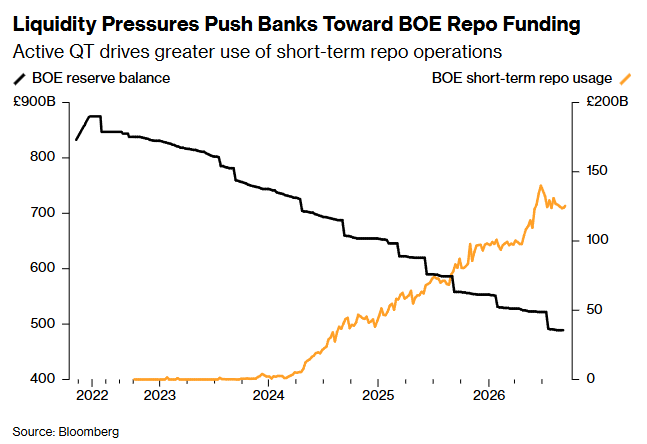
Active quantitative tightening (QT) drives increased usage of short-term repurchase operations
The Bank of England is slowing down the pace of balance sheet reduction, which should allow both short-term and long-term repurchase operations to grow at a more gradual rate, thus giving the Bank of England greater control over the process of moving the banking system closer to an equilibrium reserve level.
Meanwhile, some British treasury bonds are likely to become increasingly scarce. According to Barclays calculations, of the Bank of England's historical holdings, there are still 7 treasury bonds due from 2029 to 2034. Of these, 30% to 50% of the stock balance of 6 are held by asset purchase instruments. Due to the limited prospects for additional supply, the number of bonds available for trading or borrowing is likely to decrease further over time, making these treasury bonds more expensive and more in demand in the repurchase market.
Some longer-term treasury bonds held by asset purchase instruments may be candidate bonds for the DMO tender program. The plan mitigates market mismatches by selling non-benchmark treasury bonds and takes advantage of lower yields. Moyeen Islam said that the new system still has some “details” to be further resolved, including how DMO will dispose of the British Treasury bonds it has received. He said that the minutes of the September meeting “implicitly mentioned the Monetary Policy Committee (MPC) to discuss DMO's 'ability to cancel bonds', but this matter requires negotiations with the market before it can be implemented.”