
- PRICING
- LIVE QUOTES
- LEARN
- HELP


EN
Did Fund Close Momentum Just Shift Morgan Stanley (MS) Stock Narrative?
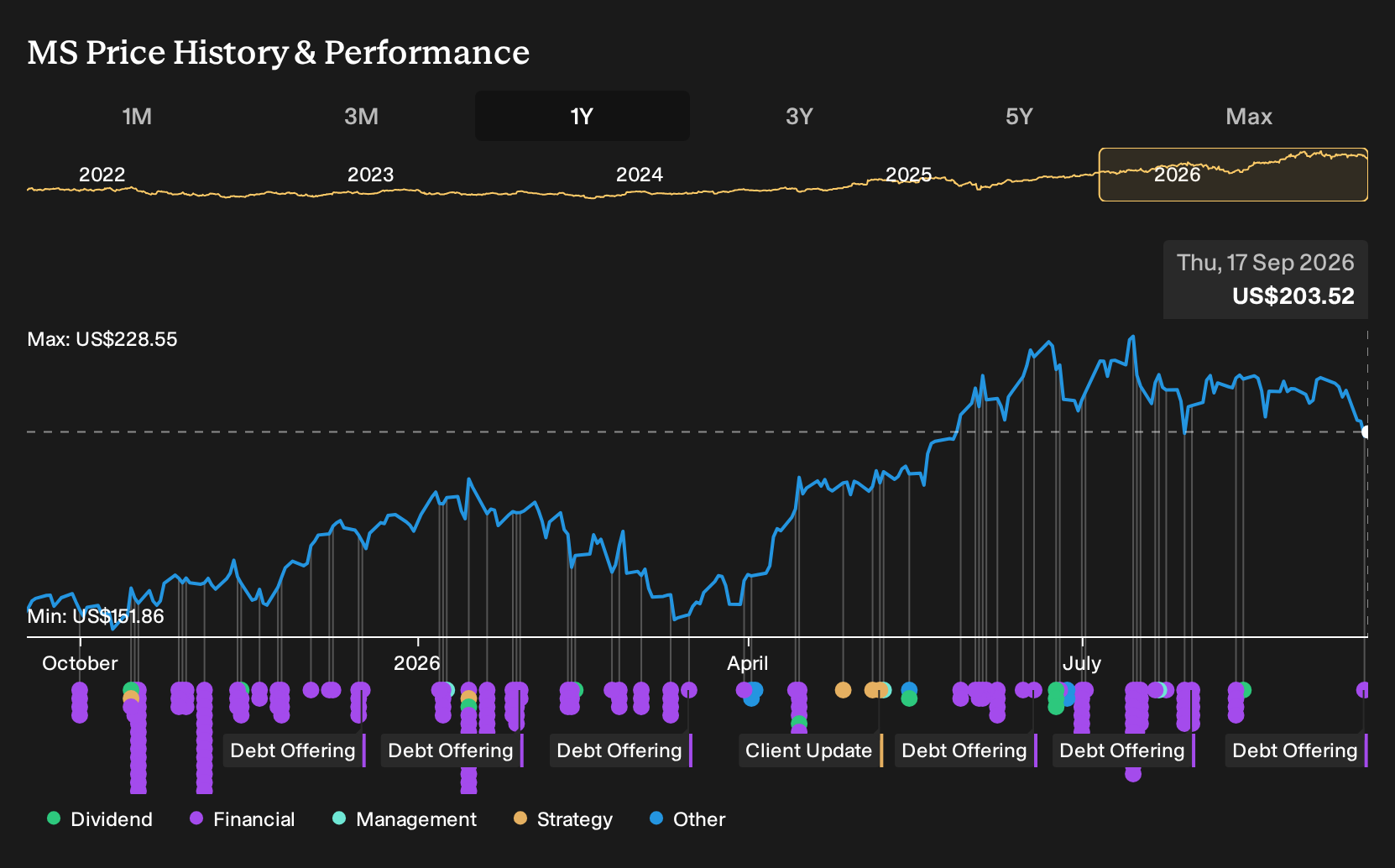
- Morgan Stanley recently priced 4.750% unsecured global medium term notes due November 26, 2027, while also advancing its ETF and private markets platforms through fund conversions and the oversubscribed North Haven Growth & Innovation Fund at about $1.3b in commitments.
- These moves highlight Morgan Stanley’s focus on fee based wealth and asset management, using its balance sheet and capital markets access to deepen recurring revenue streams and client relationships.
- We will look at how Morgan Stanley’s investment narrative is influenced by the oversubscribed North Haven Growth & Innovation Fund close.
Scan how Morgan Stanley’s fee based pivot compares with other capital rich wealth and asset managers by reviewing our curated set of list of solid balance sheet and fundamentals (23 results) today.
Morgan Stanley Investment Narrative Recap
To own Morgan Stanley, you need to believe its tilt toward fee based wealth and asset management can keep translating global client assets into recurring revenue, even as markets swing and competition from low fee products intensifies. The near term focus sits on the upcoming October earnings report and what it says about net new assets, margins and client activity.
The biggest risk is that heavier regulation, digital competitors and pressure on fees weigh on profitability at the same time. The new 4.750% unsecured notes do not materially change this near term setup. They mostly speak to funding flexibility rather than altering the core earnings story.
The most relevant update here is Morgan Stanley Investment Management’s oversubscribed North Haven Growth & Innovation Fund, which closed with about US$1.3b in commitments. That span across Investment Management, Institutional Securities and Wealth Management shows how management is trying to use the platform to deepen private market relationships and fee pools.
For you, the key question is execution. Can Morgan Stanley turn these private growth relationships and ETF conversions into stickier advisory and asset management revenue while containing costs and regulatory spend? If it does, that supports the fee based narrative. If not, the reliance on wealth and asset management becomes a concentration risk rather than a strength.
Morgan Stanley Analyst Assumptions And Valuation Setup
Morgan Stanley's narrative projects US$89.6b revenue and US$20.1b earnings by 2029. This implies 4.8% yearly revenue growth and an earnings increase of about US$0.6b from US$19.5b today.
Analysts are effectively tying the fee based pivot to a slow grind in top line expansion alongside some pressure on profitability. Revenue is modeled to grow by 4.8% a year over the next three years, while profit margins are expected to compress from 25.1% today to 22.4% by 2029. That mix points to a business leaning on higher client volumes and more assets under management rather than materially richer pricing.
The earnings bridge captures that tension. Consensus points to earnings of about US$20.1b by 2029 versus US$19.5b today, with a wide spread between the most optimistic forecast at US$25.0b and the most cautious at US$17.4b. For you, that range underlines how differently analysts are reading the same fee based story and the same regulatory and technology overhangs.
Valuation assumptions then stack on top of those operating forecasts. To line up with the consensus target, the stock would need to trade on a P/E of 23.3x those 2029 earnings compared with about 17.2x today, using a discount rate around 9.3%. On those inputs, analysts cluster around a price target of US$236.62, with the current share price of US$214.20 sitting below both the average and the US$262.00 high case and above the US$184.00 low case.
For an investor weighing Morgan Stanley, the practical question is how comfortable you are with each moving part in that chain. The model bakes in steady mid single digit revenue growth, modest earnings uplift, some margin slippage, and a higher future P/E than today, even as the forecast multiple remains below the broader US capital markets peer group. Any personal thesis needs to test those levers one by one rather than treating the consensus target as a single number to react to.
Uncover how Morgan Stanley's fair value indicates a 16% potential upside to its current price before the discount begins to narrow.
Exploring Other Perspectives
You also have a more cautious storyline to consider. The lowest Morgan Stanley analysts lean into ETF and passive migration as a headwind. They were penciling in revenue of about US$86.8b and earnings of US$17.3b by 2029, before this bond issue and the US$1.3b fund close, which could eventually shift those views.
Explore 3 other Morgan Stanley fair value estimates, including one that suggests it could be worth just $207.58.
Reach Your Own Conclusion
Don't just follow the ticker. Dig into the data and build a conviction that's truly your own.
- A great starting point for your Morgan Stanley research is our analysis highlighting 3 key rewards and 2 important warning signs that could impact your investment decision.
- See our latest analysis for Morgan Stanley. The report includes a comprehensive fundamental analysis summarized in a single visual, the Snowflake, making it easy to evaluate Morgan Stanley's overall financial health at a glance.
Looking for more investment ideas beyond Morgan Stanley?
Once you have a view on Morgan Stanley, it can help to widen the lens and compare its setup with other listed businesses that align with your risk tolerance and income goals.
- For investors who care most about quality and value, scan a curated mix of resilient companies trading below their estimated worth through 29 high quality undervalued stocks.
- If you are building a portfolio around income, focus on cash generators that pair higher yields with balance sheet strength using the targeted list of 6 dividend fortresses.
- When capital preservation comes first, concentrate on businesses with steadier profiles and lower risk scores by running through the tailored universe in 30 resilient stocks with low risk scores.
This article by Simply Wall St is general in nature. We provide commentary based on historical data and analyst forecasts only using an unbiased methodology and our articles are not intended to be financial advice. It does not constitute a recommendation to buy or sell any stock, and does not take account of your objectives, or your financial situation. We aim to bring you long-term focused analysis driven by fundamental data. Note that our analysis may not factor in the latest price-sensitive company announcements or qualitative material. Simply Wall St has no position in any stocks mentioned.
Have feedback on this article? Concerned about the content? Get in touch with us directly. Alternatively, email editorial-team@simplywallst.com