
- PRICING
- LIVE QUOTES
- LEARN
- HELP


EN
The Bank of Japan raised interest rates, but the yen made a U-turn and fell! Ueda Kazuo says “not enough hawks” strategist warns of decline or continuation
The Zhitong Finance App learned that the Bank of Japan raised interest rates by 25 basis points as scheduled on Friday, raising the benchmark interest rate to 1.25%, the highest level in 31 years. However, this interest rate hike, which was widely anticipated by the market, failed to boost the yen; on the contrary, the yen weakened. As of press time, USD/JPY was reported at 157.83. The strategist believes that Bank of Japan Governor Kazuo Ueda's remarks at the press conference disappointed investors who expected him to make more hawkish remarks.
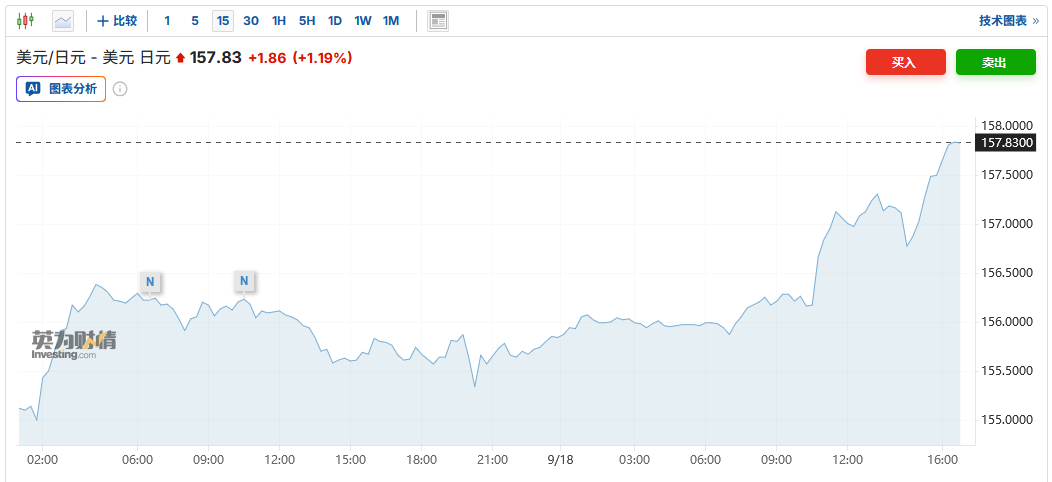
According to reports, regarding interest rate hikes of 50 basis points or continuous interest rate hikes, Kazuo Ueda said at a press conference: “This depends on how the price situation evolves. There are all kinds of possibilities, and we shouldn't rule out any options.” “We are at a stage where we need to take a close look at all the data. But that doesn't mean you can move slowly. We will carefully analyze the data and act in a timely manner if necessary.” He added, “As for the future pace of interest rate hikes, we don't have any preconceived ideas, such as once every three months. We will decide at every policy meeting how best to ensure that underlying inflation remains stable at 2%.”
Kazuo Ueda also said, “As we raise interest rates, financial conditions are becoming less relaxed... It is important to avoid excessive tightening of financial conditions or triggering drastic adjustments in asset prices due to excessive interest rate hikes.”
Many strategists believe that Ueda's remarks that Kazuo are not hawkish enough will drag down the yen. Gerald Gan, Chief Investment Officer of Reed Capital, said, “It appears [Kazuo Ueda] is trying to calm market sentiment. But my opinion remains unchanged, that the yen will continue to be weak in the short term.” “The differences between the Bank of Japan and the Federal Reserve over forward-looking guidance are also increasingly becoming a cause of concern for the stability of the yen in the coming weeks.”
Hiroshi Namioka, chief strategist at T&D Asset Management, said, “It seems difficult for the market to interpret Kazuo Ueda's remarks. Although the yen initially strengthened against the US dollar after he mentioned the 'policy stage' (policy stage), today's yen has weakened again.” “Kazuo Ueda's remarks may indicate that the Bank of Japan is becoming more cautious about prices deviating from their target upward. But the bank didn't state this very clearly, so the market appears to be reacting with uncertainty. Kazuo Ueda also said that prices may deviate either upward or downward, so it cannot be assumed that the Bank of Japan has turned more hawkish.”
Jumpei Tanaka, head of investment strategy at Patek Asset Management in Japan, said, “The statement 'the stage of policy implementation has changed' gives the impression that the Bank of Japan has already adjusted its interest rate hike policy to a higher level. As long-term bond yields rise rapidly, I think this information is critical to dispel market concerns that the Bank of Japan is 'falling behind the curve'.” “Considering that the yen is under structural pressure, and market estimates show that the pace of interest rate hikes between the Federal Reserve and the Bank of Japan will not be much different until the middle of next year, it is unlikely that the results of this Bank of Japan meeting alone will trigger a continuous upward trend in the yen.”
Jumpei Tanaka also stated, “That being said, trading is expected to be relatively light during the long weekend in Japan, and investors are also wary of possible coordinated intervention by Japan and the US. As a result, USD/JPY may continue to fluctuate and lack a clear direction.”
Chidu Narayana, chief strategist at Wells Fargo Asia Pacific, said, “Kazuo Ueda's press conference sent some hawkish signals, but these signals were insufficient to support aggressive hawkish expectations in the market. We still expect the Bank of Japan to continue to raise interest rates, including by 50 basis points in the first half of 2027, but we don't think a quick rate hike is likely. In the short term, the Bank of Japan lacks a hawkish enough stance. Coupled with a strong rebound in the US dollar, this should keep the dollar high against the yen and put pressure on Japan's front-end yield.”
Shriya Samarth, head of interest rates for Europe, Middle East and Africa at Stonex Financial, said: “I think this conveys a lot of conflicting messages — acknowledging that policy priorities have changed, and on the other hand, showing a reluctance to commit to dealing with the risk of rising inflation. It reminds me of the ECB's “wait-and-see” (wait-and-see) strategy for over a decade. In the current environment where credibility is a scarce resource, this approach would not be considered hawkish enough. The ECB has learned the lesson and made a shift, and Japan is actually also vulnerable to Middle Eastern oil imports. Similar to the European Union, I think Japan should adopt the same approach.” “Personally, I don't agree with this; I think there are too many balance considerations here — Ueda and Kazuo have always protected economic growth better than inflation.”
However, there are also strategists who are more optimistic about the situation before Japan. Masahiro Yamaguchi, head of investment research at SMBC Trust Bank, said, “Considering the risk that the press conference could cause a sharp weakening of the yen, I have the impression that Governor Ueda handled it very well. Other than the fact that two members opposed interest rate hikes, the Bank of Japan's position seems to have remained largely unchanged from before. Kazuo Ueda's explanation is consistent with the Bank of Japan speeding up the pace of interest rate hikes to once every three months, so there is no need to change expectations of another rate hike in December this year. In this sense, I don't expect the yen to continue to depreciate.” “The impact on bonds and stocks is also likely to be limited. As far as the bond market is concerned, the next focus will be on evaluating the government's fiscal position after the cabinet reshuffle.”
In addition to Ueda's remarks, two members of the Bank of Japan's monetary policy committee voted against interest rate hikes on Friday, raising concerns that the central bank is “not hawkish enough.” According to reports, among the nine policy committee members, Asada Unichiro and Sato Ayano voted against it. Asada Unichiro's reason is that the CPI increase excluding fresh food was less than 2%, and “the economic situation is not necessarily strong”; Sato Ayano believes that the economic and price situation has not accelerated significantly, and “it is inappropriate to raise interest rates at this time.”
In response, Masahiko Loo, senior fixed income strategist at State Street Investment Management, said, “The market should not overreact to the objections of the two members. The two members are from the more dovish members of the committee, and most members still firmly support Kazuo Ueda's path of policy normalization. More importantly, Kazuo Ueda's refusal to rule out the possibility of future policy action further reinforces the message that action is still possible at every meeting.”
“For the foreign exchange market, USD/JPY is still a trading logic of 'selling on a high risk', especially when it is close to the 160 level. The medium-term trend will be determined more by the three major structural forces — domestic yields rise as the Bank of Japan promotes policy normalization; changes in institutional capital flows as Japanese assets become attractive again; and AI-related investments continue to flow into Japan.” “Together, these factors support the gradual reallocation of capital to Japan and further reinforce the broader 'Japan Is Back' (Japan Is Back) narrative.”
For the yen, the important threshold of 1 US dollar to 160 yen has returned to the eyes of investors. If investors decide that it will be difficult for the Bank of Japan to keep up with the Federal Reserve's pace of austerity, the dollar may rise again to 160 against the yen. Given that the 25 basis point rate hike has been largely digested by the market before, and the Bank of Japan's communication is interpreted as being dovish, this risk will be particularly prominent.
The latest round of decline in yen has also brought intervention risks back into focus. Japan and the US carried out their first coordinated purchase of yen since 1998 this summer. Officials emphasized the speed and degree of disorderly exchange rate changes rather than any specific point, but once again, the exchange rate closer to 160 may test their tolerance. Astris Advisory Japan's head of strategy said, “If the yen is under pressure again and falls below 160 yen per dollar, we should expect Japan and the US to interfere again in the foreign exchange market.”