
- PRICING
- LIVE QUOTES
- LEARN
- HELP


EN
IDC: Shipments in China's PC display market fell 2.2% year on year in the first half of 2026, 14.3 million units
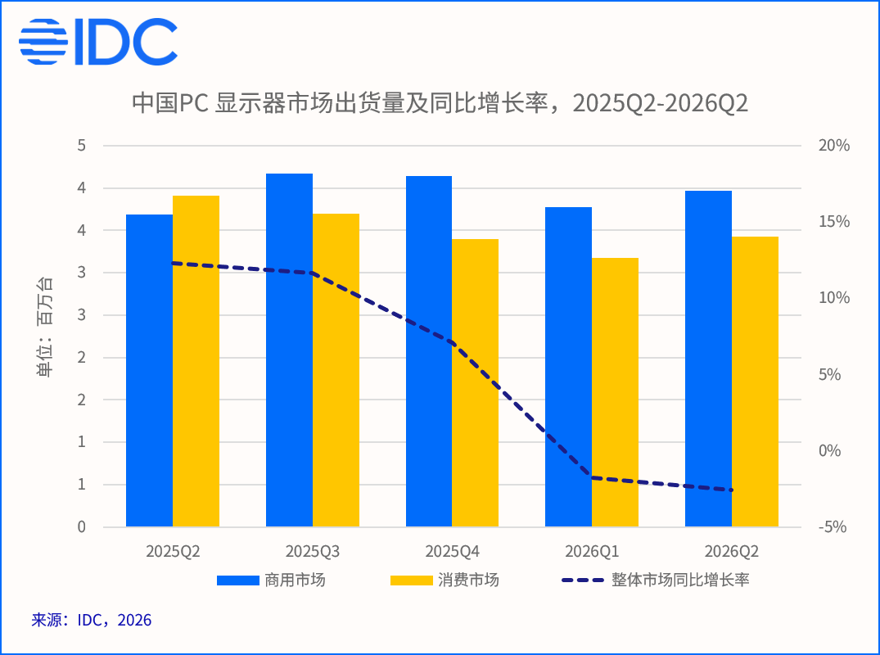
The Zhitong Finance App learned that China's PC display market quarterly tracking report for the second quarter of 2026 released by International Data Corporation (IDC) shows that in the first half of 2026, China's PC display market shipped 14.3 million units, down 2.2% year on year; of these, commercial market shipments were 7.7 million units, up 5.7% year on year, and consumer market shipments were 6.6 million units, down 10.1% year on year. The overall decline in PC displays in China appears to be limited, but the market structure is already significantly divided.
The “slight decline” in the general market overshadows an even more critical fact: the growth rate difference between commercial and consumer use has exceeded 15 percentage points, and the market is moving from a “general rise and fall” to a stage of “structural differentiation.” At the same time, price increases for display driver chips and power supply chips continue to drive up the cost of the whole machine, but competition in the terminal market is fierce, and there is a lot of resistance to downward price increases, putting pressure on manufacturers' profits.
Commercial markets: How long can growth last?
Commercial monitors remain strongly correlated with the desktop market. The 5.7% increase in commercial displays in the first half of 2026 was mainly due to demand released by the government and centralized procurement of desktops from large enterprises. SMEs are less willing to buy, and SME display shipments fell 5.4% year on year in the first half of the year. Desktop procurement has a pre-demand effect, and the drive on displays will gradually narrow; in addition, several manufacturers announced monitor price increases in August, which will disrupt the pace of commercial display shipments in the second half of the year.
Internal demand in the commercial industry is also divided, and manufacturers need to adjust their strategies in a timely manner to focus on vertical segmentation. There is strong demand for high-end displays in practical training and scientific research scenarios in universities and vocational colleges, and the expansion of production capacity in the high-end manufacturing industry will continue to bring batch purchase orders. Enterprises should avoid homogenous competition in the general market and explore incremental opportunities for business pain points in various industries.
Consumer market: Why can't price reduction promotions drive demand?
Consumer display shipments fell 10.1% year-on-year in the first half of 2026. On the one hand, last year's national compensation policy released some market demand ahead of schedule; on the other hand, price increases and supply constraints for video cards and memory devices curbed consumers' willingness to buy installed equipment and displays. Consumer demand continued to shrink even during the big promotion period when manufacturers boosted sales through product upgrades and price reduction promotions.
Experiential consumption has become a new consumption choice for today's young people. Manufacturers need to reduce their reliance on price promotions, switch to experiential marketing, build diverse usage scenarios such as home use, video, and e-sports, and rely on scenario value to drive product sales; at the same time, strengthen differentiated selling points such as eye protection, color accuracy, and dual models, reduce the resource bias for low-end models moderately, and guide users to upgrade and migrate to middle and high-end price levels.
E-sports market: mid-to-high-end volume, low-end contraction
As the focus of competition in the industry, e-sports displays are growing under pressure in a sluggish market environment. Affected by the increase in the price of display driver chips, the cost of the whole machine has risen. In order to guarantee profits, speed up the layout of middle and high-end products, and simultaneously shrink the supply of low-end products. OLED, mini LED and dual-mode displays ushered in a centralized new product release cycle, driving domestic e-sports display shipments to increase slightly by 1.0% year-on-year in the first half of 2026, with a market share of 38.6%.
E-sports products are being iterated rapidly. The product side should anchor the core specifications of qHD & 240Hz and above to consolidate the basic e-sports business market; focus on the three major directions of OLED, Mini LED, and dual-mode displays to create a benchmark product. The channel side strictly controls low-end e-sports inventory, prevents the risk of price inversion, and promptly removes inefficient SKUs. The marketing level enhances parameter experience perception and conveys actual game value brought by high-brush and dual-mode technology to users.
Cost pressure: terminal price increases are blocked, how can enterprises respond?
Higher prices for graphics cards and storage will continue to suppress demand for displays, and rising prices for display drivers and power chips will further raise overall machine costs. However, competition in the terminal market is fierce, and there is a lot of resistance from price increases downward. It is difficult for the industry to replicate the general rise in PC products, and it is very easy for low-end products to reverse prices.
Manufacturers need to rely on product structure upgrades to hedge against rising costs, use mid-range and high-end products to dilute cost pressure; simultaneously complete SKU optimization, reduce low-margin and inefficient models, reduce production and inventory risks, and lock in supply chain production capacity in advance to mitigate the business impact caused by component price increases.
High-end market: OLED displays, mini LED displays, multi-mode displays are breakthroughs
As high-end panel production capacity continues to be released, high-end displays have ushered in a development window, and OLED, mini LED, and multi-mode displays have become the core breakthroughs for brands to seize the high-end market. According to IDC data, OLED products accounted for more than 50% of the price range above 2,000 yuan in the first half of the year. IDC predicts that China's OLED display shipments will double in 2026.
Manufacturers should continue to iterate on high-end product lines, improve high-end channel experience construction, enhance image quality color content output online, set up real machine experience scenarios offline, carry out user product value education, transform technical advantages such as color performance, functional characteristics, and multi-mode switching into a perceptible user experience, support high-end product pricing, hedge against cost pressure, and expand profit margins.
Structural differentiation and new changes in the market pattern
The fragmentation of the market structure will eventually be reflected in the manufacturer pattern. Both commercial and consumer trends, rising costs are squeezing low-end products, and the accelerated penetration of the middle and high-end markets are causing different manufacturers to embark on different strategic paths. Some continue to maintain the full-price basic market, some use commercial channels to increase sales quickly, some rely on cost advantages to enjoy the cost-effective market, and others bet on high-end and ecological collaboration. The change in the share of China's top five PC display manufacturers in the first half of 2026 is a direct reflection of this strategic field.
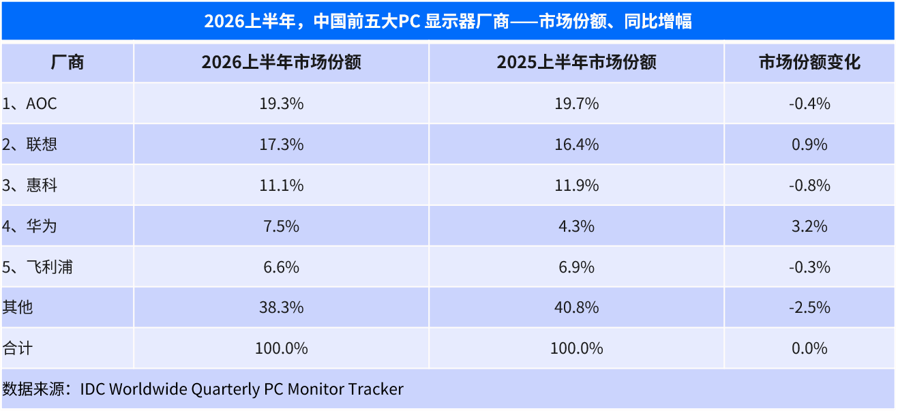
AOC ranked first in domestic display shipments, and overall performance was steady. It has a complete product layout at full price, actively optimizes the product structure during the downturn of the market, and has greatly increased shipments at prices above 1,500 yuan to promote middle and high-end penetration; at the same time, it is deeply involved in e-sports event marketing, and has a high brand awareness among e-sports user groups.
Lenovo ranked second. Relying on the channel synergy of bundled desktops, commercial displays achieved significant growth in the first half of the year, but the consumer side was under pressure. Inventory digestion in the second quarter was dominated by inventory digestion, and shipments faced challenges. Its Savior and Raiku Combatant series continued to lay out the e-sports channel.
Huike is in third place. It has an outstanding cost advantage, has performed well in cost-effective e-sports hits, and high-brush products continue to grow; however, target users are highly price sensitive, and rising costs will put pressure on subsequent shipments.
Huawei's market share increased to fourth place, benefiting from desktop purchases from the government and large enterprises driving monitor shipments. The share increased by 3.2%. The number of new consumer products also boosted overall shipment growth.
Philips ranked fifth, and is deeply involved in the middle and high-end office market, focusing on eye protection and color accuracy. Its e-sports sub-brand EVNIA E-Wei focuses on the middle and high-end racing tracks, but competition in the industry is fierce and has not yet led to an increase in overall e-sports monitor shipments.
For small and medium-sized manufacturers, there is no need to pursue full price range coverage, and can still explore incremental space by deepening the segmentation of the circuit, optimizing the channel structure, and implementing accurate price cards. Enterprises should avoid low-end internal volume, either polish the cost performance ratio in vertical fields, or create differentiated product selling points.
IDC summary and outlook
In the first half of 2026, China's PC display market showed significant structural differentiation: weak consumer demand combined with rising costs, increasing pressure on low-end products; rising cost rigidity continued to drive product structure upgrades, and high-end categories such as OLED and dual-mode displays accelerated penetration. This means that in the past, the way manufacturers relied on low prices and passively waited to collect dividends was unsustainable, and required active adjustments at the three levels of business resources, product matrices, and marketing logic.
Redeploy business resources. The commercial business side abandons passive waiting for collection dividends, actively expands industry segments, and explores new demand in vertical fields; the consumer market abandons the price reduction model and relies on scenario-based experience and core selling point marketing to cope with demand contraction and avoid ineffective price internal volumes.
Optimize product matrices and strengthen supply chain risk management. Continue to streamline low-end SKUs, tilt resources towards high-potential products such as QHD & 240Hz+ e-sports, dual-mode, OLED, and mini‑LED, gradually eliminate low-end SKUs with low gross profit and low turnover efficiency, shrink the supply of low-end products, strictly control the production schedule and inventory scale of low-end products, and prevent operating losses caused by price inversion. In response to the price increase of upstream components such as display driver ICs and video card storage, do a good job of risk management and control in the supply chain, and actively introduce domestic accessories to avoid the passive impact caused by rising costs and supply shortages.
Shift to value marketing and clarify the differentiated positioning of a series of products. Promote the shift of marketing logic from price competition to value transmission. E-sports products reinforce user awareness education on high-brush and new technology, and the consumer side focuses on outputting the actual use value of functions such as eye protection, color accuracy, and dual mode. The commercial market focuses on product quality and after-sales service capabilities, breaking out of the competitive dilemma of individual product price comparison. Small and medium-sized manufacturers also need to find their own track positions, avoid full-dimensional head-on competition with leading manufacturers, deeply cultivate vertical segmentation, and rely on segmented tracks to achieve incremental breakthroughs.