
- PRICING
- LIVE QUOTES
- LEARN
- HELP


EN
How Investors May Respond To Transocean (RIG) New Equatorial Guinea Contract
- Transocean announced that its Deepwater Conqueror drillship secured a two well contract in Equatorial Guinea, an estimated 170 day campaign expected to start in 2027 and add about US$80 million to backlog, excluding extra services and mobilization payments.
- The new Equatorial Guinea work follows a recent ultra deepwater award in India. This shows Transocean continuing to line up multi country, multi year activity for its high specification fleet and adding further visibility on future rig utilization.
- We will now look at how this added US$80 million contract backlog could influence Transocean's broader investment narrative and risk profile.
Scan beyond Transocean and its new ultra deepwater work by comparing it with our hand picked 16 high quality undiscovered gems that also pair strong fundamentals with under the radar contract momentum.
Transocean Investment Narrative Recap
To own Transocean, you need to be comfortable with a story built on high spec offshore rigs, a large contract backlog and meaningful leverage. The key near term swing factor is still how efficiently that backlog turns into cash to manage debt and fund any reactivations. This new US$80 million award nudges visibility higher but does not transform that picture.
The biggest operational risk remains weaker dayrates or utilization, which would make the balance sheet harder to support and slow any improvement in earnings quality. The Equatorial Guinea work slightly supports utilization into 2027, yet it does not remove exposure to rig oversupply, customer budget cuts or energy transition pressures.
The most relevant recent data point around this contract is Transocean’s existing multiyear backlog, previously cited at roughly US$7b. The Deepwater Conqueror award adds a modest slice to that figure and follows directly after its current U.S. Gulf work. This tightens the utilization story for a single high spec asset rather than changing the entire fleet profile.
For you as an investor, the contract sits alongside the earlier deepwater win with Oil and Natural Gas Corporation in India. Together, these awards reinforce that Transocean is still securing international work for premium rigs. They support the potential for balance sheet improvement if cash conversion stays disciplined, while the familiar risks around debt, customer concentration and future offshore demand remain very much in play.
Transocean's current earnings are a loss of US$2.8b, and analysts project revenue of US$3.7b and earnings of US$253.3 million by 2029. This outlook assumes revenue declines of 3.5% each year and an earnings swing of roughly US$3.1b from today's loss to the 2029 consensus profit.
Uncover why Transocean's fair value indicates a potential upside of 16% to its current price before that discount starts to close.
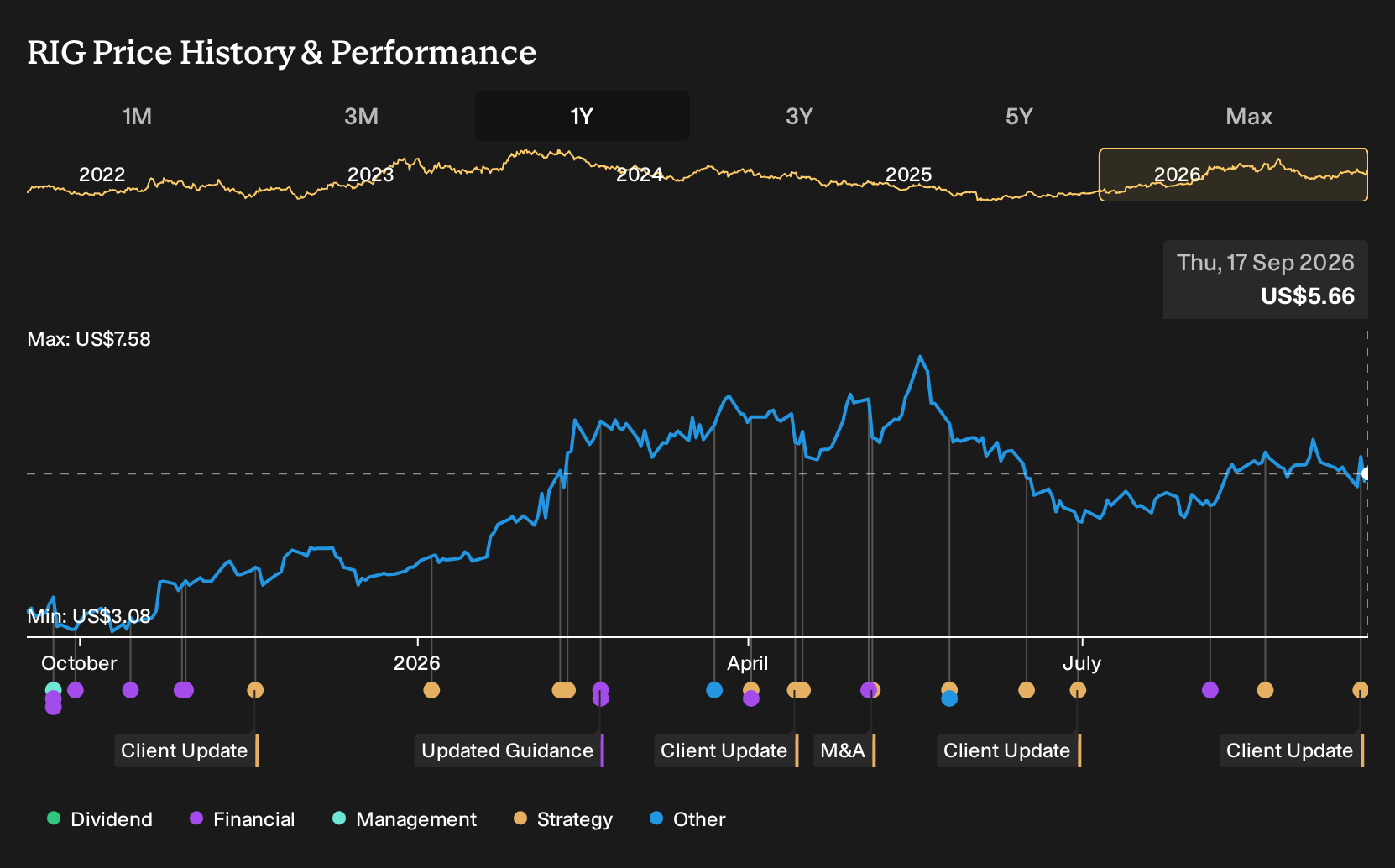
Exploring Other Perspectives
One alternate view focuses on renewables risk. On that score, the lowest Transocean analysts were already projecting revenue of about US$3.5b and earnings near US$276.0 million by 2029, yet still saw fair value closer to US$4.50. That is a far more cautious narrative. This new Equatorial Guinea contract could push those expectations around, so it makes sense to compare both camps before deciding where you lean.
Explore 4 other Transocean fair value estimates, including one that suggests it could be worth just $6.55.
Form Your Own Verdict
Don't just follow the ticker. Dig into the data and build a conviction that's truly your own.
- A great starting point for your Transocean research is our analysis highlighting 2 key rewards and 1 important warning sign that could impact your investment decision.
- See our latest analysis for Transocean. The report includes a comprehensive fundamental analysis summarized in a single visual, the Snowflake, making it easy to evaluate Transocean's overall financial health at a glance.
Looking For More Ideas Beyond Transocean?
If the Transocean story has you thinking about position sizing, balance sheets and contract visibility, it can help to compare it with other businesses that share some of those traits but sit in very different niches.
- If you want high potential with more measured risk than a typical micro cap, check out 7 elite penny stocks with strong financials that already carry solid financial footing.
- For those who care most about valuation and fundamentals, scan our 29 high quality undervalued stocks with strong cash generation and healthier balance sheets.
- If resilience and capital discipline matter most to you, filter through the list of solid balance sheet and fundamentals (23 results) that might complement a position in a more cyclical offshore driller.
This article by Simply Wall St is general in nature. We provide commentary based on historical data and analyst forecasts only using an unbiased methodology and our articles are not intended to be financial advice. It does not constitute a recommendation to buy or sell any stock, and does not take account of your objectives, or your financial situation. We aim to bring you long-term focused analysis driven by fundamental data. Note that our analysis may not factor in the latest price-sensitive company announcements or qualitative material. Simply Wall St has no position in any stocks mentioned.
Have feedback on this article? Concerned about the content? Get in touch with us directly. Alternatively, email editorial-team@simplywallst.com