
- PRICING
- LIVE QUOTES
- LEARN
- HELP


EN
The Bank of Japan raised interest rates as scheduled, but the yen fell! Even after the fastest contraction since 1990, the market still chanted “not enough hawks”
The Zhitong Finance App learned that on September 18, the Bank of Japan followed the pace of the Federal Reserve's interest rate hike and announced an interest rate hike of 25 basis points to 1.25%, as expected by the market. Earlier, the Federal Reserve raised interest rates for the first time in about three years on September 16, raising the federal funds rate target range by 25 basis points to 3.75% — 4.00%; the ECB also raised interest rates by 25 basis points on September 10, raising the deposit mechanism interest rate to 2.50%. The Bank of England announced on September 17 that it would maintain an interest rate of 3.75%, but three of the nine members advocated raising interest rates. Together, these show that concerns about inflation are converging among countries, and there are still differences in the exact pace of tightening.
The yen fell instead after the Bank of Japan raised interest rates. The key point is that the tightening that the market had previously anticipated exceeded the signal released by this resolution, that is, the implementation of the interest rate hike already anticipated by the market may not bring new impetus to appreciation. The 25 basis point rate hike has already been basically included in the price. The two votes against it and the lack of additional hawkish guidance weakened the market's judgment on the Bank of Japan's successive quick actions. Meanwhile, the Federal Reserve also raised interest rates by 25 basis points this week. Based on the policy interest rates of both sides, the spread between the US and Japan is still 2.50-2.75 percentage points, the same as before the two sides raised interest rates this week.
If US interest rate expectations continue to rise and Japan fails to keep up with the pace of tightening, the dollar may still be supported against the yen. Thus, the 160-point trend of the dollar against the yen is a conditional upward scenario proposed by strategists; the precedent of joint intervention between the US and Japan, as well as the concerns of officials about the speed of depreciation and disorderly fluctuations, will also affect investors' desire to establish short yen positions. The core of the market's next transactions is changes in future interest rate paths and exchange rate intervention expectations between the two countries.
High energy prices are an important common background for this round of policy adjustments. The Bank of England recorded that the Brent oil price reached 106 US dollars per barrel on September 14, and is wary that energy shocks will continue to spread to wider prices. Inflation concerns and austerity expectations are also driving the repricing of long-term bonds — on September 15, the yield on 10-year US bonds, the “anchor of global asset pricing,” once rose to 5.041%, a record high since 2007; Japan's 10-year Treasury yield hit a 30-year high of 3.036%; and the UK's 30-year yield once reached 5.96% this week, the highest since 1998. However, after the Bank of England adjusted treasury bond sales arrangements on the 17th, the UK's 30-year yield has fallen back to about 5.74%.
Oil prices have made this policy game more complicated. J.P. Morgan said on September 17 that the Iran conflict continues to be delayed, making it difficult to establish a clear oil market benchmark scenario; the bank's estimated fair value of Brent crude oil in September was about 90 US dollars per barrel, which is significantly lower than the current market price of about 106 US dollars. The latter includes concerns about further supply disruptions.
Compared to central banks in other developed regions, the Bank of Japan seems to need to simultaneously assess the impact of energy price increases on inflation and actual purchasing power: the longer the impact continues, the greater the risk of transmission to other commodity, service prices, and wages; however, for Japan, which relies on energy imports, the increase in import costs may also reduce corporate profits and residents' consumption capacity. This duality helps to understand why the Bank of Japan is raising interest rates while remaining cautious about the subsequent pace.
There were two votes against the Bank of Japan's interest rate hike, and the yen continued to decline
After the Bank of Japan raised interest rates as scheduled, the yen continued to decline against the US dollar, and the two negative votes questioned the prospects for further tightening monetary policy. The yen fell 0.7% to 157.09 yen per dollar after the Bank of Japan's decision was issued. Although all economists surveyed by Bloomberg expected the Bank of Japan to take this action, the vote was 7 to 2, and Policy Committee members Asada Unichiro and Sato Ayano voted against it.
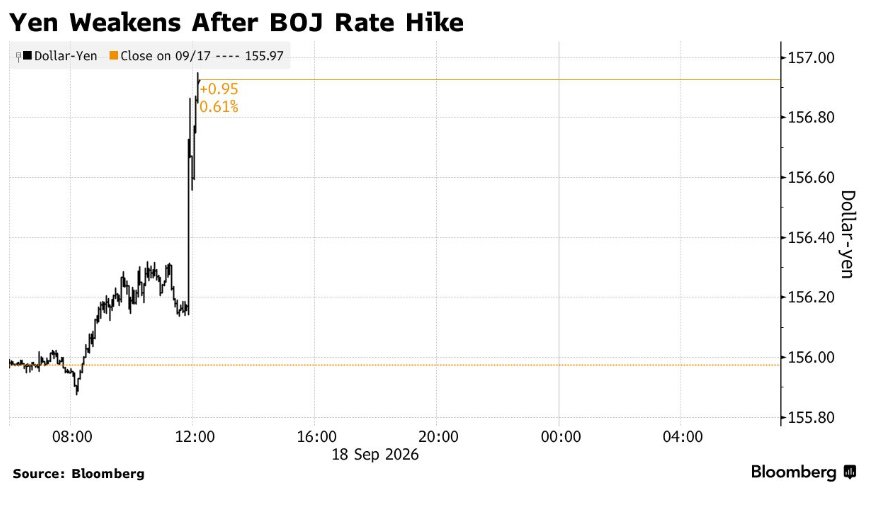
Qidu Narayanan, Asia Pacific chief strategist at Wells Fargo Bank, said that this result “is not hawkish enough for the market; it should push the dollar higher against the yen and the short-term yield of the yen lower.” “There were two votes against this meeting. Although they came from the two most dovish members of the committee, this did not support the market's expectations that the Bank of Japan would quickly raise interest rates one after another.”
Prior to the Bank of Japan's current rate hike, the Federal Reserve's hawkish rate hike earlier this week had already weakened the yen, partially reversing the strong gains of the yen earlier this month. Factors driving the yen's rise previously included market expectations that the Bank of Japan would speed up policy tightening, liquidate arbitrage deals funded in yen, and speculation that Japan's pension funds might divert more capital into domestic assets.
Traders will be watching Bank of Japan Governor Kazuo Ueda's press conference after the announcement of the resolution to find clues about the speed and extent of further tightening the policy. The press conference usually starts at 3:30 p.m. Tokyo time.
Masahiko Loo, senior fixed income strategist at State Street Investment Management, said, “I expect his wording to remain neutral to slightly hawkish, and emphasizes that given the resilience of economic growth, the risk of inflation persists, and the policy interest rate still has an easing effect even if it reaches 1.25%, it is possible to adjust interest rates at every subsequent meeting.”
The strategist said that if investors decide that it will be difficult for the Bank of Japan to keep up with the Federal Reserve's pace of austerity, the dollar may rise to 160 against the yen. Given that the 25 basis point rate hike has already been largely digested by the market, this risk will be particularly prominent if the Bank of Japan's subsequent communication is interpreted as being dovish.
The latest round of declines has also brought intervention risks back into focus. Japan and the US carried out their first coordinated purchase of yen since 1998 this summer. Officials emphasized the speed and degree of disorderly exchange rate changes, rather than any specific point, but once again, the exchange rate is approaching 160, which may test their tolerance.
Neil Newman, head of strategy at Astris Advisory Japan, said, “If the yen is under pressure again and falls below 160 yen per dollar, we should expect Japan and the US to interfere again in the foreign exchange market.”
According to data from Japan's Ministry of Finance, in the month ending August 26, Japan spent a record 15.4 trillion yen, or about 98.3 billion US dollars, to interfere in the foreign exchange market. Since then, US Treasury Secretary Scott Bessent has continued to send signals supporting the strengthening of the yen, which may further discourage traders from re-establishing short positions in the yen.
The Bank of Japan raised interest rates at the fastest pace since 1990 after US Treasury Secretary Bezent called
The Bank of Japan raised the benchmark interest rate to the fastest rate hike in 36 years to deal with rising inflation risks and Washington's unusually clear appeal for further policy normalization.
At the end of the two-day meeting, the Bank of Japan raised the policy interest rate by 25 basis points to 1.25% on Friday, according to a statement from the Bank of Japan. All economists surveyed by Bloomberg expected this action. The voting results were 7 to 2. Policy Committee members Asada Unichiro and Sato Ayano voted against it.
This action has been fully anticipated before, and the yen weakened to 156.95 yen per dollar against the US dollar after the announcement. There was no clear sign in the statement that the wording had become more hawkish, thus failing to fuel bullish bets on the yen.
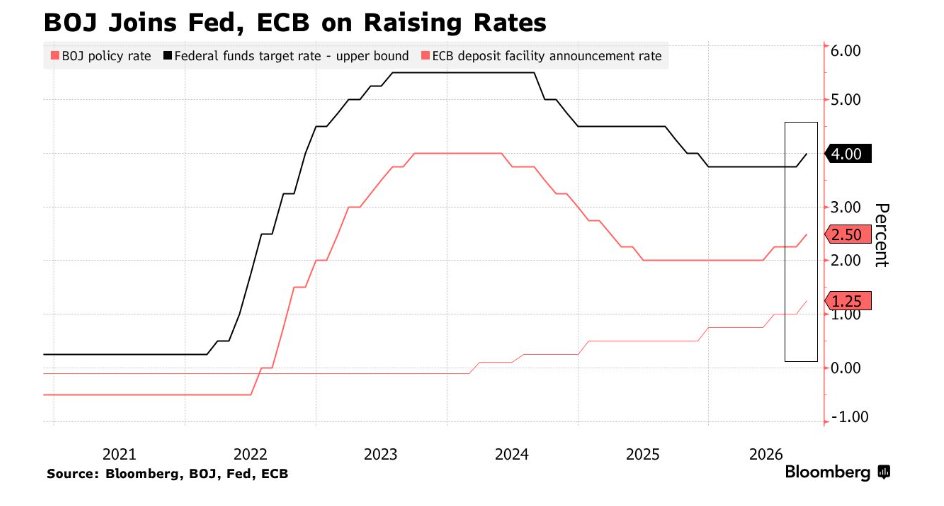
As shown in the chart above, the Bank of Japan joined the Federal Reserve and the European Central Bank in raising interest rates.
This action is only three months since the Bank of Japan last raised interest rates, which is the shortest interval between two rate hikes since 1990. Back then, the Bank of Japan quickly tightened its policy, which played an important role in the bursting of Japan's asset bubble. This was Kazuo Ueda's sixth interest rate hike during his tenure as governor, making him the governor of the Bank of Japan with the most rate hikes in at least half a century. Prior to this rate hike, US Treasury Secretary Scott Bessent put pressure on Japan to raise interest rates one after another.
As the authorities of various countries dealt with the impact of the war in Iran, the global monetary policy background changed, and the Bank of Japan also accelerated the pace of interest rate hikes. The Federal Reserve raised interest rates for the first time in three years on Wednesday, and is initially expected to raise interest rates again later this year, highlighting this change. The ECB raised interest rates for the second time this year last week.
Japan's interest rate hike marks the first time that the Bank of Japan, the Federal Reserve, and the European Central Bank raised borrowing costs in the same month. These simultaneous actions also highlight that the Bank of Japan has largely changed its long-standing absence from the mainstream of global monetary policy.
There were few surprises with this rate hike. A series of statements made by Bezent before have helped solidify the market's expectations for this action.
Although the yen weakened against the US dollar soon after the announcement of the resolution, it was still stronger than the July level. The US and Japan implemented a coordinated intervention at the end of July to help the yen move further away from the 163.99 yen per dollar level set on July 23, the lowest level in about 40 years.
The Bank of Japan has reiterated that it will continue to raise interest rates if its outlook on the economy and prices is realized. The policy interest rate reached 1.25%, which will enter the lower end of the neutral interest rate range estimated by the bank for the first time. Neutral interest rates are considered to be interest rates that neither stimulate nor inhibit the economy.
Before the policy committee meeting was held, Bezent made several statements supporting the Bank of Japan's actions, boosting expectations of interest rate hikes. By the beginning of September, the market had almost completely digested this action. According to the US Treasury Department, during a face-to-face meeting with Kazuo Ueda in North Carolina last month, Bezent “expressed strong support” for Japan to take decisive measures to deal with the weakening yen.
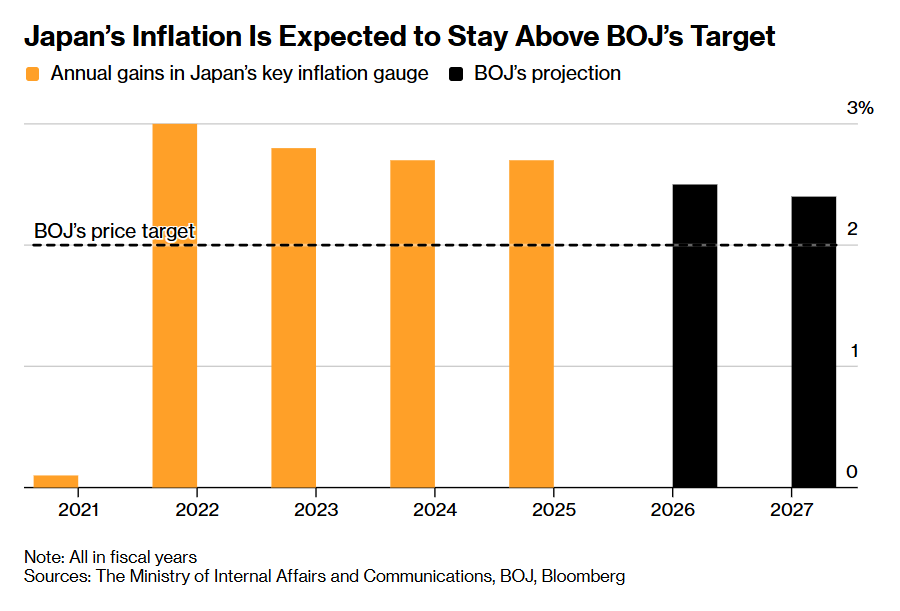
The chart above shows that the market unanimously expects Japan's inflation rate to continue to exceed the Bank of Japan's target. Note: All are calculated on a fiscal year basis.
As of 2025, one of Japan's key inflation indicators has remained above 2% for the fourth year in a row, and the Bank of Japan expects the inflation rate to continue higher than the target in the next few years. Data released earlier on Friday showed a slight slowdown in core inflation in August, partly due to data distortions caused by subsidies. Analysts expect price growth to accelerate to close to 3% by early next year.
At a press conference that usually starts at 3:30 p.m., Kazuo Ueda will explain the considerations behind Friday's decision and interest rate trends over the next few months.