
- PRICING
- LIVE QUOTES
- LEARN
- HELP


EN
Interpretation of IPOs | “Standing in the Light” vs. fierce competition, what is the success of optical module company Najun Technology?
Under the wave of AI computing power, optical modules are one of the most decisive links in this industry chain. When Nvidia's GPUs are robbed, the data torrent between data centers must be carried by optical modules — according to Goldman Sachs estimates, the global optical module market is expected to reach 148 billion US dollars by 2028.
In this context, Nazhen Technology (09856), an optical communications entity under the Hisense Group, passed a hearing on the Hong Kong Stock Exchange and launched a Hong Kong stock offering from September 14 to September 17, with joint sponsorship from Citigroup and CITIC Securities. The Zhitong Finance App learned that NaZhen Technology plans to sell about 172 million H shares globally, with a sale price of HK$32.96 per share, 100 shares per lot, and an entry fee of about HK$3329.24. It is expected to be listed on the main board of the Hong Kong Stock Exchange on September 22. In addition, according to market information, Nazin Technology has been loaned HK$15.545 billion in margin loans from brokerage firms, which has overbought 26.42 times over the amount of publicly raised HK$567 million.
In this IPO, Najun Technology introduced 24 cornerstone investors, including Chunhua Investment Fund, GBAHIL, CFTC Paragon SP, HK BVF I LPF, Oriental Asset Management, Guangfa Fund, E-Fangda, Zhaoyi Innovation, and Qianhai International Fund Management Co., Ltd., with a total subscription amount of about US$340 million.
The digital optical module “runs wild” and the optical chip “climbs the hill”
According to the prospectus, Najun Technology is a mature supplier of optical communication and optical connectivity products. It is committed to R&D, manufacturing and sales of optical modules, optical chips and optical network terminals to provide services to domestic and foreign customers. This company from Qingdao ranks fifth in the world in terms of global optical module revenue in 2025, with a market share of 4.0%, and third in terms of China's optical module revenue, with a market share of 10.1%. It is also one of the few manufacturers in the world that also has R&D and mass production capabilities for optical modules and optical chips. The company's predecessor can be traced back to Ligent Tech, which was co-founded by Hisense Group and returning scientist Huang Weiping's team in 2002. It completed a closed loop of capabilities from optical module packaging to optical chip design and manufacturing in more than 20 years.
Looking back on its financial trajectory, in 2023-2025, Nazhen Technology's revenue increased from 4.239 billion yuan to 8.355 billion yuan, with a three-year compound growth rate of 40.4%. Under the aura, there were sharp fluctuations on the profit side: net profit fell from 216 million yuan in 2023 to 89 million yuan in 2024, and rebounded to 873 million yuan in 2025. It is worth noting that the net profit of 883 million yuan in 2025 includes one-time income of 353 million yuan from the sale of joint ventures.
The company's gross margin was also affected by fluctuations on the profit side, falling from 20.6% in 2023 to 17.4% in 2024, rebounding to 20.0% in 2025, and rising further to 24.2% in the first half of 2026 — the driving factors behind this V-shaped curve stem from an increase in the share of high-margin digital optical modules and an increase in revenue contributions to overseas markets.
Judging from the business structure, Najin Technology's growth engine has changed. Digital optical module revenue soared from 1,056 billion yuan in 2023 to 2,776 billion yuan in 2024 and 5.469 billion yuan in 2025, accounting for a share of total revenue rising from 24.9% to 65.5%; in the first half of 2026, this ratio further rose to 69.4%, with revenue reaching 3,745 billion yuan, an increase of 36.6% over the previous year. Behind this curve is the high demand for high-speed optical modules for AI training and inference. The company has mass-produced 800G optical modules and delivered 1.6T products. LPO optical modules have been mass-produced, NPO and CPO technologies are being developed, 3.2T products are already in progress, and the pace of product iteration has kept up with the world's first tier.
At the same time, the business that once started is taking a back seat. FTTx Telecom's optical module revenue shrunk from 1,108 billion yuan in 2023 to 602 million yuan in 2025, accounting for a share of 26.1% to 7.2%; the share of optical network terminal revenue also fell from 32.8% to 21.4%. In between progress and retreat, the company actually completed an identity transformation from a “telecom access equipment vendor” to an “AI computing power supplier.”
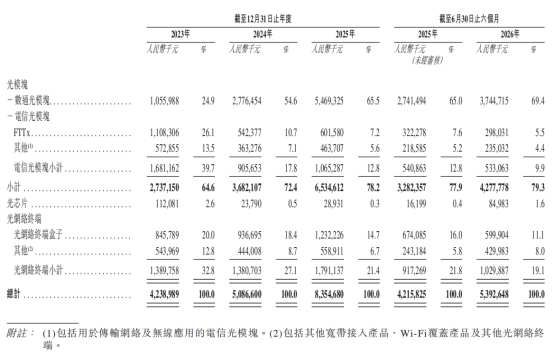
Looking at the industry landscape, this transformation is necessary. On the digital optical module circuit, Zhongji Xuchuang and Xinyisheng firmly occupy the top two in the world. After Tianfu Communications, Guangxun Technology's 4.0% global share means that it must rely on product iteration speed and cost efficiency in the gap between major manufacturers to seize market share, and the company's dependence on the AI capital expenditure cycle will increase dramatically.
Furthermore, optical chips, which have been repeatedly mentioned by the company, are the most imaginative part of the business. As the link with the highest technical barrier in the optical module industry chain, optical chips are regarded as the core strategic asset of Najun Technology. However, at the time of implementation, this business has been losing money in the past few years: foreign sales revenue has shrunk from 112 million yuan in 2023 to 29 million yuan in 2025, accounting for only 0.3%. The turning point came in 2026. As 75mWCW-DFB chips switched from internal use to large-scale foreign sales, optical chip revenue rebounded to 85 million yuan in the first half of the year, and gross margin was also drastically corrected.
However, at present, the optical chip sector's contribution to foreign market-based sales is limited. Facing leading overseas chip manufacturers, high-end EML and other chip products are still dependent on external procurement, and large-scale commercialization of self-developed high-end chips will still take time.
“Standing in the light” is not at ease
If you compare the GPU to the heart of AI computing power, the optical module transports blood to blood vessels all over the body. Looking at it now, the demand for blood vessels is expanding at a rate that exceeds everyone's expectations at the beginning of the year. The optical module, a component hidden in a server cabinet, is becoming the definitive seller in the AI era.
Recently, Goldman Sachs released a research report on the optical module industry, and adjusted the global shipment forecast from 2026 to 2028 across the board. The increase is quite impressive: overall shipment volume is predicted to increase by 21%, 31%, and 31%; 800G and above products will increase by 31%, 39%, 36%, and 29%; 1.6T and above products will increase by 29%, 61%, and 50%.
Goldman Sachs expects the global optical module market to be US$68 billion in 2026, US$131 billion in 2027, and US$148 billion in 2028. Among them, the 800G and above market segments will expand at a compound annual growth rate of 69%, from 45 billion US dollars this year to 130 billion US dollars in 2028. In terms of shipment volume, 800G products are expected to be shipped in 2026, and 1.6T is expected to be shipped at 33 million units. By 2027, 1.6T will double to 71 million units, while 3.2T will be sold to 23 million and 68 million units in 2027 and 2028, respectively.
However, behind the boom, the competitive environment in the industry is becoming more and more intense. Participants in high-speed optical module circuits continue to expand production, product prices gradually decline as technology matures. Multiple LPO, NPO, CPO, and XPO technology paths are parallel on the technology route, and there is uncertainty about the choice of technology routes.
As a result, there are still two major details that need to be carefully looked at when it comes to the future of Najun Technology. On the one hand, the company's R&D expenditure rate fell from 13.1% in 2023 to 7.9% in 2025, and only 5.9% in the first half of 2026. However, in an industry where optical module technology is rapidly iterated on a cycle of 18 to 24 months, there is clearly a positive correlation between R&D intensity and the iterative advantage of “leading technology” in the 3.2T and even CPO arms races, and it is worth paying close attention.
Furthermore, the company's customer concentration is rising steadily: the revenue share of the top five customers rose from 55.8% in 2023 to 70.2% in 2025, reaching 71.8% in the first half of 2026. Major customer orders support rapid revenue growth, and also link bargaining power to the risk of single customer fluctuations. Furthermore, there is a high degree of overlap between Najun Technology's customers and suppliers. The controlling shareholder Hisense Group itself is an important supplier to the company, and accounts for nearly half of the revenue from “suppliers, that is, customers” in some years, so the company's ability to “walk independently” also takes time to test.
Overall, this optical communications manufacturer is one of the few targets on the current racetrack covering the entire industry chain. Its growth is highly tied to the boom in AI computing power. It has both technical barriers and production capacity advantages, but also faces multiple challenges such as industry cycles and technology iteration. Ultimately, its long-term value will depend on the efficiency of technology implementation, depth of customer expansion, and ability to cope with risks.