
- PRICING
- LIVE QUOTES
- LEARN
- HELP


EN
From “higher and longer” to “normalized longer”: the impact of oil prices is compounded by the AI bond issuance frenzy, and the financial market ushered in a “new normal” of 5% US bond yields
The impact of the Middle East geopolitical conflict on energy transportation is being transmitted to global long-term financing costs through inflation expectations and monetary policy tightening expectations. This is why the recent yield on 10-year US Treasury bonds, which have the title of “the anchor of global asset pricing,” and the yield on longer-term treasury bonds has continued to rise to historic highs in the past 20 years. After seizing Moka Port and Perim Island, the Houthis further controlled the Greater and Minor Hanish Islands, expanding their influence on the Mander Strait and Red Sea transportation routes; at the same time, the Saudi East-West oil pipeline, which undertook transportation tasks to bypass the Strait of Hormuz, was attacked and stopped. Reuters revealed on September 17 that three pumping stations in the pipeline were damaged. Previously, about 4 million to 5 million barrels of crude oil were transported every day.
However, the latest state of supply in the energy market is not a complete cessation of transportation in the two major straits, and international oil prices continue to rise unilaterally. As expectations for the resumption of some Saudi oil shipments improved, Brent and WTI crude oil closed at $104.82 and $101.91 respectively on September 17, falling for the second day in a row, but still above $100 per barrel. For the global bond market, the key is not only the rise and fall of oil prices on the same day, but also how long high energy costs will last, and whether they will further spread to transportation, production, and consumer prices.
The implementation of the Federal Reserve's interest rate hike can ease the market's doubts about its determination to fight inflation, yet it cannot alone reverse the structural repricing of global long-term bonds. On September 16, the Federal Reserve raised interest rates by 25 basis points, raising the federal funds rate target range to 3.75% to 4.00%, implementing the first rate hike since 2023; the day before, the 10-year US Treasury yield, which is the “anchor of global asset pricing,” had hit a new high since 2007, and Japan's 10-year Treasury yield also rose to a 30-year high of about 3.04%.
Long-term pressure is also reflected in Japan's 30-year treasury bonds approaching an all-time high, and British 30-year treasury yields rising to the highest level since 1998. Judging from the pricing mechanism, the central bank can influence future inflation and short-term interest rate expectations through interest rate hikes, but long-term yields also include compensation required by investors to bear maturity risks; therefore, “re-tightening policies” and “maintaining high long-term bond yields” can coexist; the former does not mean that the latter will inevitably continue to rise in a disorderly manner.
High yields may become the new normal. The root cause is that the global bond market is shifting from “chasing scarce safe assets with abundant savings” to “increasing bond supply to seek more price-oriented buyers.” Government deficits and debt refinancing expand supply, and the central bank's reduction in bond holdings makes more securities need to be absorbed by private investors; ECB Executive Director Schnabel summarized this change as a shift from a “global savings surplus” to a “global bond surplus,” and pointed out that the increase in the supply of government bonds is reducing the convenience benefits brought about by their scarcity.
The total amount of US Treasury bonds has exceeded 40 trillion US dollars, and the continued need for fiscal financing forms an important background for this change. Private buyers who pay more attention to price need to obtain compensation for holding long-term bonds through higher yields, and changes in the pension system have also weakened some traditional long-term purchases. Understood from this, the “new normal of high yield” does not predict that yields will only rise or fall, but rather means that the liquidity easing environment that has been close to zero interest rates for a long time after the COVID-19 pandemic is no longer suitable as the default benchmark for all asset valuations; long-term bonds once again provide a more attractive starting point for earnings, and the stock market needs to rely more on operating profits and cash flow to support value than the period of strong liquidity brought about by global central banks “opening and releasing water” after the COVID-19 pandemic.
The wave of AI bond issuance joins capital competition: How the boom in AI computing power investment affects the long-term yield curve
AI infrastructure construction is transforming tech giants from investors who mainly rely on operating cash flow to important financiers in the global bond market. According to statistics from a study released by Vanguard on August 19, Google's parent company Alphabet and the five largest hyperscale cloud vendors of Amazon, Meta, Microsoft, and Oracle issued an average of about 35 billion US dollars in debt every year from 2020 to 2024, increasing to 93 billion US dollars in 2025, and reaching about 132 billion US dollars by 2026; the annual AI-related debt issuance forecast covering a wider ecosystem of chip companies, data center developers, and utilities reached about 300 billion to 570 billion US dollars. It is worth noting that the latter is a full-year forecast range, not a completed issuance amount.
The specific deal also shows that the financing period is being extended to the long term: Alphabet announced the $25 billion note issuance in August, including long-term bonds maturing in 2056 and 2066. The ECB's August 31 study further indicates that large US technology companies already account for nearly 10% of the total amount of new Euro non-financial corporate bonds issued. As a result, AI capital expenditure is not only a growing theme in the stock market, but is also becoming a new supply that the global fixed income market needs to absorb continuously.
The link between AI bond issuance and the long-term yield of US bonds is mainly marginal capital allocation competition. Instead, for every dollar a technology company borrows, it will inevitably withdraw 1 dollar from the US Treasury bond market. Derived from the asset allocation mechanism, for investors who can adjust their holdings between treasury bonds and high-rated corporate bonds, technology enterprise long-term bonds provide credit spreads and new allocation options; when the government and enterprises simultaneously expand long-term financing, the market needs to attract capital to take on new supply through yield and interest rate spread adjustments.
However, the credit risk, collateral functions, and regulatory uses of the two types of bond-type assets are different, and the replacement is not complete; institutional investors recently interviewed by the media also agreed that the direct crowding out of the capital pool of the US bond market is limited, and that monetary policy and inflation expectations are still important drivers. More direct evidence first appears within credit bonds — statistics show that the yield and interest spreads of newly issued bonds by some large technology companies are higher than old securities with similar risk characteristics from the same issuer, reflecting the need for additional price compensation for centralized supply.
Therefore, the AI financing wave can be viewed as a structural incremental factor supporting long-term capital requirements, and cannot be singled out as the full reason why US debt has broken through 5%. Growth investment opportunities and higher capital costs associated with AI computing power and AI application themes may coexist for a long time, and technology companies that can turn capital expenditure into profit and cash flow will be more capable of supporting their own valuations.
Why do high treasury yields seem to be becoming the new normal? From “higher and longer” to “normalized longer”, global long-term bonds are being repriced
Borrowing costs for governments around the world have been rising as investors demand more compensation before they are willing to hold longer-term debt. The rise in US bond yields even prompted Treasury Secretary Scott Bessent to announce an increase in the scale of long-term treasury repurchases — but this intervention failed to stop the 10-year US Treasury yield from breaking 5% and hitting its highest level in nearly two decades.
Investors' withdrawal from long-term sovereign bonds was driven by a range of concerns. These include widening fiscal deficits and high inflation against the backdrop of rising energy costs due to the trade war initiated by President Donald Trump and the Middle East conflict. At the same time, technology companies are issuing huge debts to build artificial intelligence infrastructure, forcing governments to compete with them for investors' attention.
Although the Fed's interest rate hike in September eased some of the market's doubts about the central bank's determination to contain inflation, the structural factors driving bond sell-offs have not disappeared, and yields are still high. Average bond yields in G7 countries have reached their highest level since 2000.
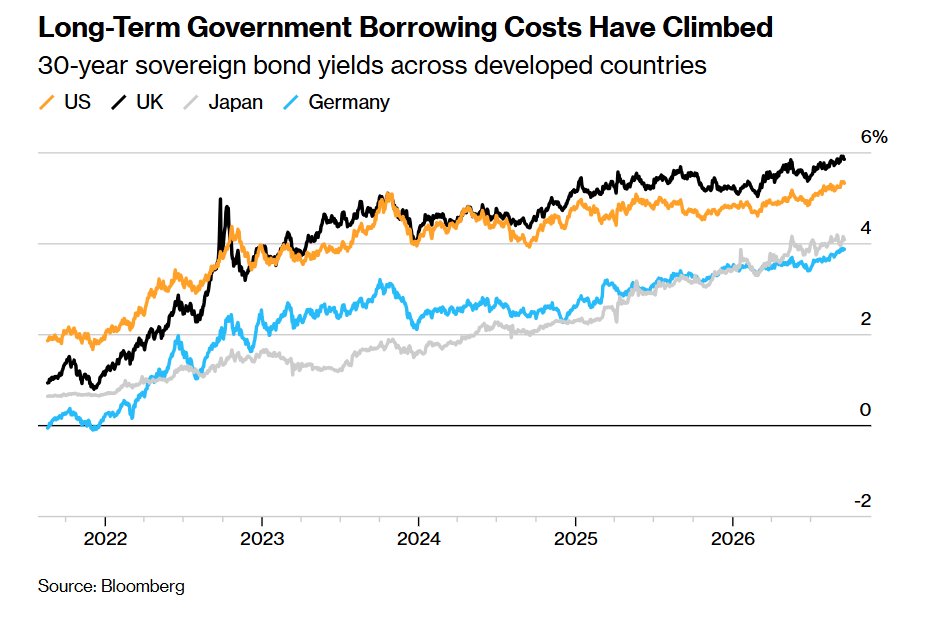
As shown in the chart above, the cost of long-term government borrowing has risen sharply — the yield on 30-year sovereign bonds in developed countries is shown in the chart.
What's special about long-term bonds?
Bonds issued by wealthy countries are widely regarded as the safest securities in the world because the governments of these countries are highly likely to repay the principal and interest to investors. The government usually locks in financing costs for a longer period of time, such as 30 years. Some countries even issue bonds that expire after a century.
But that doesn't mean that these bonds are risk-free for investors. If inflation and short-term interest rates rise, they will erode the real value of bond coupon payments and the actual value of the final repayment of principal when the bond matures.
The longer a bond matures, the longer it takes for inflation to have an effect. This is why long-term bonds are more sensitive to rising interest rates and inflation, and why they are at the center of a recent wave of sell-offs.
In mid-September, the yield on 30-year US Treasury bonds hit the highest level since 2007. Japan's yield for the same period was close to the highest level in history, while the yield on British Treasury bonds for the same period reached the highest level since 1998.
With such high yields, wouldn't investors want to buy long-term bonds?
Theoretically yes, but the supply and demand pattern in the bond market is also undergoing structural changes. For most of the past two decades, abundant global savings—particularly in Asia—chased a relatively scarce supply of safe assets, helping to depress long-term real returns. Alan Greenspan, then Chairman of the Federal Reserve, called the continued low long-term yield a “puzzle” because even if the Federal Reserve raised short-term borrowing costs, long-term interest rates remained low.
Today, governments around the world are increasing spending on everything from renewable energy to defense. The US is raising more than $40 trillion in national debt and filling the annual fiscal gap by increasing borrowing; the US Congressional Budget Office estimated in August that this gap would reach $2.1 trillion. Trump proposed that if the Republican Party maintains control of Congress in the November midterm elections, it will pay a “dividend” of 5,000 US dollars to adult US citizens, which may further boost borrowing.
At the same time as the supply of global government debt is expanding, overseas investors' willingness to buy is weakening, and the central bank's reduction in bond holdings after years of debt purchases have all limited demand. ECB Executive Director Isabelle Schnabel described the change as a shift from “excess savings” to “excess bonds.”
This means that the investor community is turning to more price-sensitive private buyers, who usually require higher compensation before they are willing to hold long-term bonds. Structural changes in pension and retirement systems have also reduced the number of traditional long-term buyers.
How high of a premium are investors starting to demand from long-term bonds?
According to a model developed by Bloomberg Economic Research, America's so-called term premium — the additional yield required for investors to hold long-term debt — is up more than 3 percentage points from its low during the COVID-19 pandemic.
The US has traditionally enjoyed a kind of “convenient return”: since US Treasury bonds are liquid, secure, and can be used as collateral, investors are willing to pay higher prices and accept lower returns. Some believe that this privilege has been eroded and is based on the growing burden of national debt and what they see as Trump's capricious approach to policy formulation. Others believe that this concern has been exaggerated and that US Treasury bonds are still the safest debt asset.
Why are long-term yields so important to the economy?
The disorderly sell-off in the bond market may cause trouble for governments that rely on the bond market to finance fiscal deficits — the UK experienced this very well after the collapse of the Leeds Truss administration in 2022. Bezent said earlier this year that the bond market “has overthrown more governments than howitzers.”
Long-term bond yields are the basis for pricing interest rates on many consumer loans such as mortgages and corporate debt. In a situation where years of inflation have made the cost of living more unbearable, rising bond yields may further increase the pressure on residential borrowers. Savers, however, can benefit.
This transmission to the consumer credit market has not always been direct. In the US, the pricing of interest rates on 30-year home mortgages is closely related to 10-year US Treasury yields, not 30-year US Treasury yields. This is because homeowners tend to pay off their mortgages or refinance after closer to 10 years.
The 10-year US Treasury yield is known as the “anchor of global asset pricing,” stemming from its benchmark position in the dollar financing system and medium- to long-term cash flow valuation. The US Treasury bond market is large and active in trading, and the US dollar is widely used in international financing and reserves, so changes in yield have cross-market effects — US dollar corporate bonds usually refer to the yield of US bonds with similar maturity and compounded by credit spreads. Housing mortgage interest rates are affected by the pricing of treasury bonds and mortgage-backed securities, and stock and real estate valuations are highly sensitive to future cash flow discount rates.
From a theoretical perspective, the 10-year US Treasury yield is equivalent to the risk-free interest rate indicator r on the denominator side of the DCF valuation model, an important valuation model in the stock market. Other indicators (especially the molecular side's cash flow expectations) have not changed significantly — for example, during the earnings season, the molecular side is in a vacuum due to lack of active catalysts. At this time, if the denominator level is higher or continues to operate in historically extremely high regions above 5%, the valuations of risky assets such as technology stocks, high-yield corporate bonds, and cryptocurrencies that are closely related to AI are facing collapse.
What steps can the government take to deal with rising long-term bond yields?
Many governments are tilting their borrowing plans towards shorter terms. Although short-term yields are currently low, these bonds have shorter terms, meaning they need to be refunded more frequently — and may face higher interest rates at that time.
The Bank of England decided to stop selling long-term bonds in its portfolio to ease market pressure; the US took a different approach. The US Treasury Department announced in August that it will expand the scale of repurchases of 10 to 30 year treasury bonds to break what Bezent called a “high fever” in the market. However, the scale of the first batch of repurchases was smaller than expected, and yields continued to rise to multi-year highs. Soaring oil prices were one of the driving factors.
Essentially, governments need to convince investors that they can control inflation and fiscal deficits. This could involve a combination of tax increases and spending cuts, and these measures are likely to be unpopular with voters.
Should investors worry about surging yields?
To a certain extent, rising yields are good news for bondholders. At a time when the stock market is hovering near record highs, rising yields reflect the resilience of the global economy and its ability to withstand higher borrowing costs.
After the global financial crisis, bond yields were close to zero due to weak economic growth prospects. The recent rise in yield can be seen as a return to normalization to pre-crisis levels. The yield on US 10-year Treasury bonds is 4.95%, which is slightly higher than the average for the past 40 years.
“People are generally very fond of using the term 'higher for longer' (the so-called higher for longer) to describe the current yield pricing curve,” Wells Fargo economists Tom Bocelli and Michael Pugresse wrote in an August research report. “We think the more appropriate description would be 'normal for longer' (normal for longer).”