
- PRICING
- LIVE QUOTES
- LEARN
- HELP


EN
This Analyst Just Downgraded LYFT Stock. Here's Why.
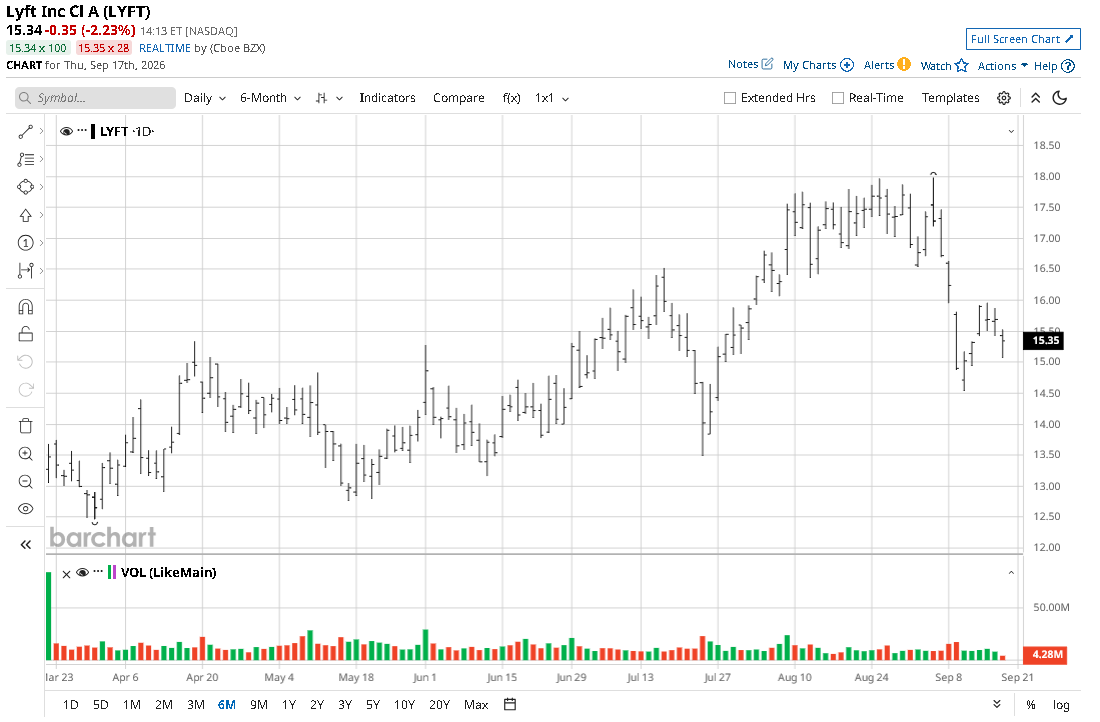
Lyft (LYFT) stock has been in a sharp downtrend this month, but senior Guggenheim analyst Michael Morris believes a swift near-term recovery is unlikely. In a research note this morning, Morris downgraded LYFT to “Neutral” and lowered his price target to $16, signaling a lack of meaningful upside from current levels.
At the time of writing, Lyft shares are already down about 23% versus the start of this year.
What Made Guggenheim Downgrade Lyft Stock?
Morris downgraded LYFT stock mostly because of cooling demand and the absence of a catalyst that could improve sentiment in the near term.
The analyst reduced his second-half estimate for ride growth to 10.6% versus the consensus at 11.9%.
More importantly, Morris expects this weakness to persist, trimming his 2027 ride-growth forecast as well to 10.3%, citing saturation in North America.
With U.S. growth leveling off, the analyst slashed his valuation multiple on LYFT’s estimated 2027 EV/OIBDA from 11x to 8x.
Note that Lyft has a history of losing over 5% on average in October — a seasonal pattern that further dulls its near-term appeal.
What Else Could Weigh on LYFT Share Price?
Beyond slowing domestic ride volumes, Guggenheim flagged operational risks linked to LYFT’s expansion efforts and capital allocation.
While supportive of its international push, including the acquisition of FREENOW, the investment firm highlighted that a “lack of disclosed impact drives uncertainty” as the company absorbs these foreign assets.
Plus, despite positive strategic milestones like expanding its partnership with Waymo in Nashville and teaming up with DoorDash (DASH) in Canada, autonomous vehicle scale remains too early-stage to move the needle.
To maintain financial flexibility for ongoing M&A and balance sheet support, Michael Morris also now expects Lyft Inc to buy back about $500 million worth of its stock, down from his estimate of $548 million.
What’s the Consensus Rating on Lyft?
Others on Wall Street are not nearly as bearish on LYFT shares as Guggenheim’s Michael Morris.
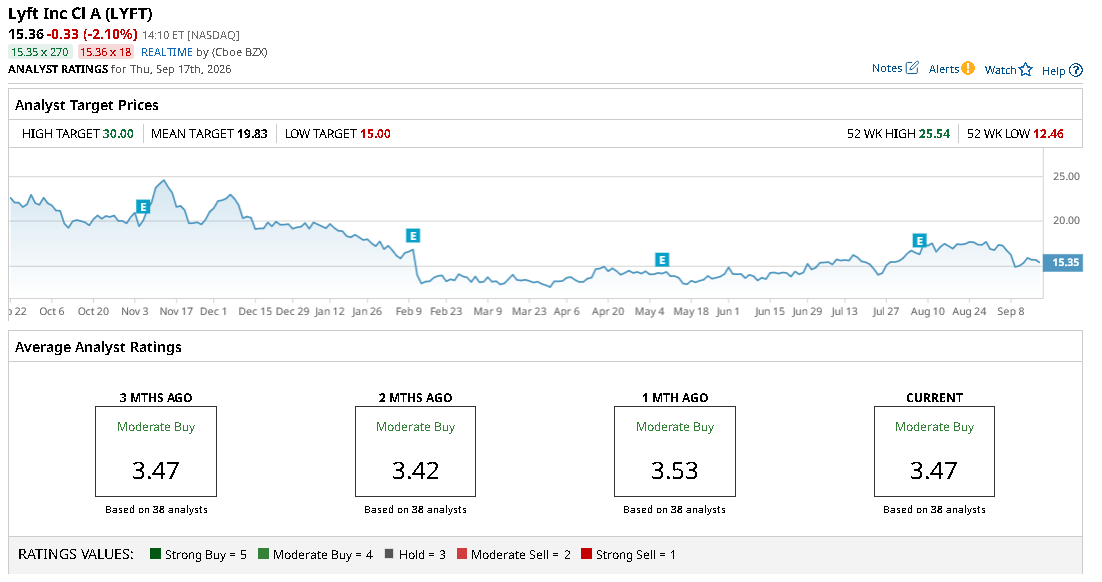
The consensus rating on the ride-hailing giant remains at “Moderate Buy,” with the mean price target of $19.83 indicating potential upside of nearly 30% from current levels.
On the date of publication, Wajeeh Khan did not have (either directly or indirectly) positions in any of the securities mentioned in this article. All information and data in this article is solely for informational purposes. For more information please view the Barchart Disclosure Policy here.