
- PRICING
- LIVE QUOTES
- LEARN
- HELP


EN
Did Debt Exchange Offer Just Shift Universal Insurance Holdings (UVE) Investment Narrative?
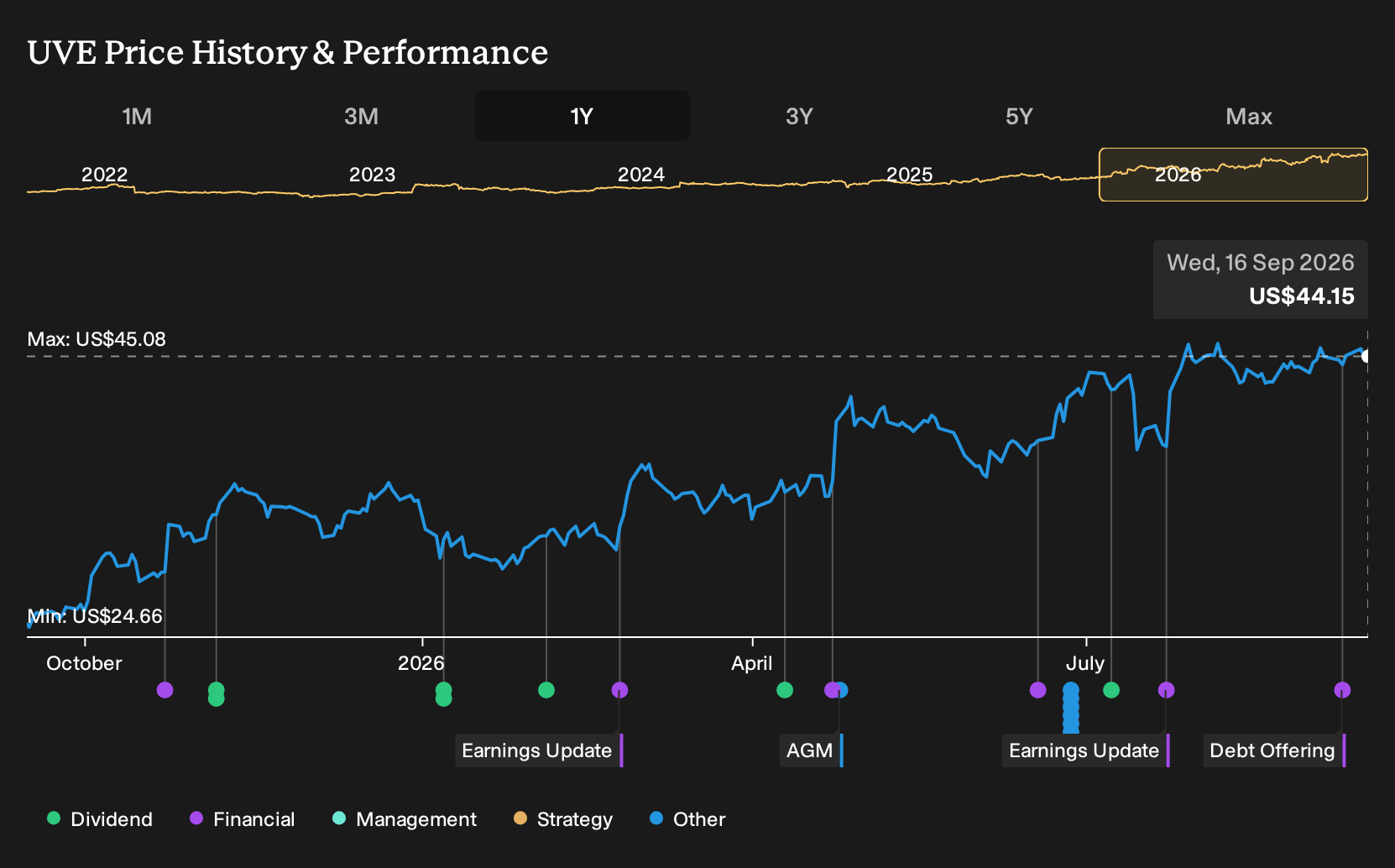
- Universal Insurance Holdings announced a fixed income exchange offer for its callable, senior, unsecured 7.75% Notes due June 30, 2031, covering US$100 million of principal.
- The move reshapes how Universal Insurance Holdings balances debt costs and capital flexibility, which directly links to underwriting capacity and future financial resilience.
- This article examines how Universal Insurance Holdings' investment narrative aligns with the new 7.75% note exchange offer and the associated capital shift.
Scan how Universal Insurance Holdings’ bond move compares with peers by checking a hand picked 11 resilient stocks with low risk scores built around balance sheet resilience and controlled leverage.
Universal Insurance Holdings Investment Narrative Recap
To own Universal Insurance Holdings, you need to be comfortable with a property insurer that leans heavily on underwriting discipline, reinsurance access, and steady residential demand. The big near term swing factor is how loss and expense ratios behave, especially in Florida where direct premiums written have already eased 2.5% and competition is heating up.
The fresh exchange offer for the 7.75% notes looks more like balance sheet housekeeping than a shift in the operating story. It may have limited direct impact on the key short term catalyst, which remains underwriting profitability, while the biggest risk is still reinsurance cost pressure and weather driven loss volatility.
The fixed income exchange offer on the 7.75% senior unsecured notes sits alongside management’s wider capital actions, including share repurchases and consistent dividends at 1.74%. Together these moves point to a focus on capital efficiency while the business works through expected revenue and earnings pressure over the next three years.
For you as a shareholder, the relevance is execution risk. Universal Insurance Holdings is managing higher risk funding and a bond structure with callable debt, at the same time as analysts see earnings declining on average each year. How smoothly the business balances debt costs, reinsurance programs, and underwriting decisions will influence how those catalysts actually play out.
Universal Insurance Holdings Forecasts Baked Into The Bond Story
Universal Insurance Holdings' narrative projects US$1.5b revenue and US$78.0 million earnings by 2029. This aligns with analysts assuming revenue will decline 1.8% per year and earnings will fall by US$117.8 million from US$195.8 million today.
Uncover why Universal Insurance Holdings' fair value indicates a valuation that is roughly in line with its current price.
Exploring Other Perspectives
Two fair value estimates from the Simply Wall St Community cluster between US$44 and about US$58 per share, which already shows how far private investors can disagree on Universal Insurance Holdings. When you layer in rising competition, reinsurance dependence, and Florida concentration risk, you get a wider spectrum of possible outcomes. Explore several viewpoints before deciding where you stand.
Explore another Universal Insurance Holdings fair value estimate, including one that suggests as much as 32% upside from the current price.
Reach Your Own Conclusion
Don't just follow the ticker. Dig into the data and build a conviction that's truly your own.
- A great starting point for your Universal Insurance Holdings research is our analysis highlighting 4 key rewards and 2 important warning signs that could impact your investment decision.
- See our latest analysis for Universal Insurance Holdings. The report includes a comprehensive fundamental analysis summarized in a single visual, the Snowflake, making it easy to evaluate Universal Insurance Holdings' overall financial health at a glance.
Looking For More Investment Ideas Beyond Universal Insurance Holdings?
Once you have a view on Universal Insurance Holdings, it can help to compare it with a broader set of potential opportunities using the Simply Wall St screener tools. This gives you a wider field to test your thesis, pressure check risk levels, and spot ideas that better match your own tolerance for volatility and income needs.
- For investors who want capital growth with a valuation tilt, consider starting with a curated set of 33 high quality undervalued stocks that pair quality fundamentals with pricing that may look appealing relative to underlying business strength.
- If capital preservation and financial resilience matter most to you, a focused list of solid balance sheet and fundamentals (22 results) can highlight businesses with stronger funding profiles and healthier leverage metrics.
- Income oriented readers who still want room for capital appreciation can scan a 6 dividend fortresses that concentrates on higher yield payers while still paying attention to balance sheet support for those distributions.
This article by Simply Wall St is general in nature. We provide commentary based on historical data and analyst forecasts only using an unbiased methodology and our articles are not intended to be financial advice. It does not constitute a recommendation to buy or sell any stock, and does not take account of your objectives, or your financial situation. We aim to bring you long-term focused analysis driven by fundamental data. Note that our analysis may not factor in the latest price-sensitive company announcements or qualitative material. Simply Wall St has no position in any stocks mentioned.
Have feedback on this article? Concerned about the content? Get in touch with us directly. Alternatively, email editorial-team@simplywallst.com