
- PRICING
- LIVE QUOTES
- LEARN
- HELP


EN
Bank of America Just Declared a ‘Generational Entry Point’ in U.S. Bonds. Why Investors Should Be Backing Up the Truck on Treasuries Here.
Long-dated U.S. Treasuries have officially reached their worst 10-year rolling performance in a century. That’s according to Bank of America Securities Chief Investment Strategist Michael Hartnett.
A 10-year rolling annualized return for Treasuries with maturities of 15 years or longer, which I track using ETFs such as the iShares 20+ Year Treasury Bond ETF (TLT) and PIMCO 25+ Year Zero Coupon U.S. Treasury Index ETF (ZROZ) have plunged to negative territory.
A “lost decade” for bonds could be a winning decade for bond portfolios.
If you do not vividly remember the lost decade for stocks (both of them, in fact), don’t worry about it. Just know that the cyclical recovery in stocks we’ve enjoyed since started off a lost decade.
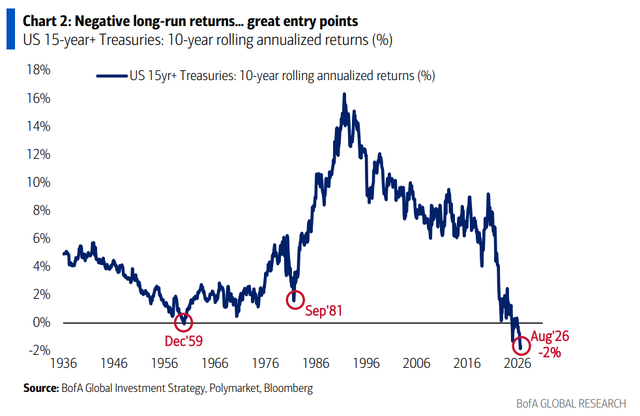
That huge drawdown in bonds is a stark contrast to the SPDR S&P 500 ETF’s (SPY) annualized returns of 15% over the same period. And the Invesco DB Commodity Index Tracking Fund (DBC) gained 11% annualized. Yet, according to BofA’s historical analysis, this extreme divergence is precisely why long-term fixed income might just be the next big thing.
I am particularly attuned to this development, not only because of my written coverage here, and what bigger voices like BofA are now pointing out, but because this week I literally launched Hedged Bond, an all-ETF model signal portfolio I built for my own family, and for subscribers who want to “copy off of Rob’s paper” so to speak. I built it to help my subscribers build a bond ladder like I so often recommend but without having to buy bonds individually.
If you are looking ahead to retirement, and you’re looking back at the madness that has been the four-year, AI-led stock market surge, it is hard not to at least consider that bonds might have a role going forward.
If you build it, it will pay you.
Building the core bond “ladder” with ETFs was actually the easy part, thanks to an innovative product line from iShares known as iBonds ETFs. Simply put, each ETF is dedicated to a type of bond and a maturity year. For instance, the iShares iBonds Dec 2026 Term Treasury ETF (IBTG) launched back in early 2020. At the time, five-year Treasuries yielded all of 1.1%.
But IBTG did what it was supposed to do. It held only bonds maturing in 2026. As the chart shows, that made those yields very uncompetitive as rates spiked to more than 4% over the next few years. Now, as a 2026 maturity bond would, IBTG is nearing its destination, having paid out a modest monthly dividend, and delivering an uninspiring, albeit expected, total return of 7.4% over its lifespan.
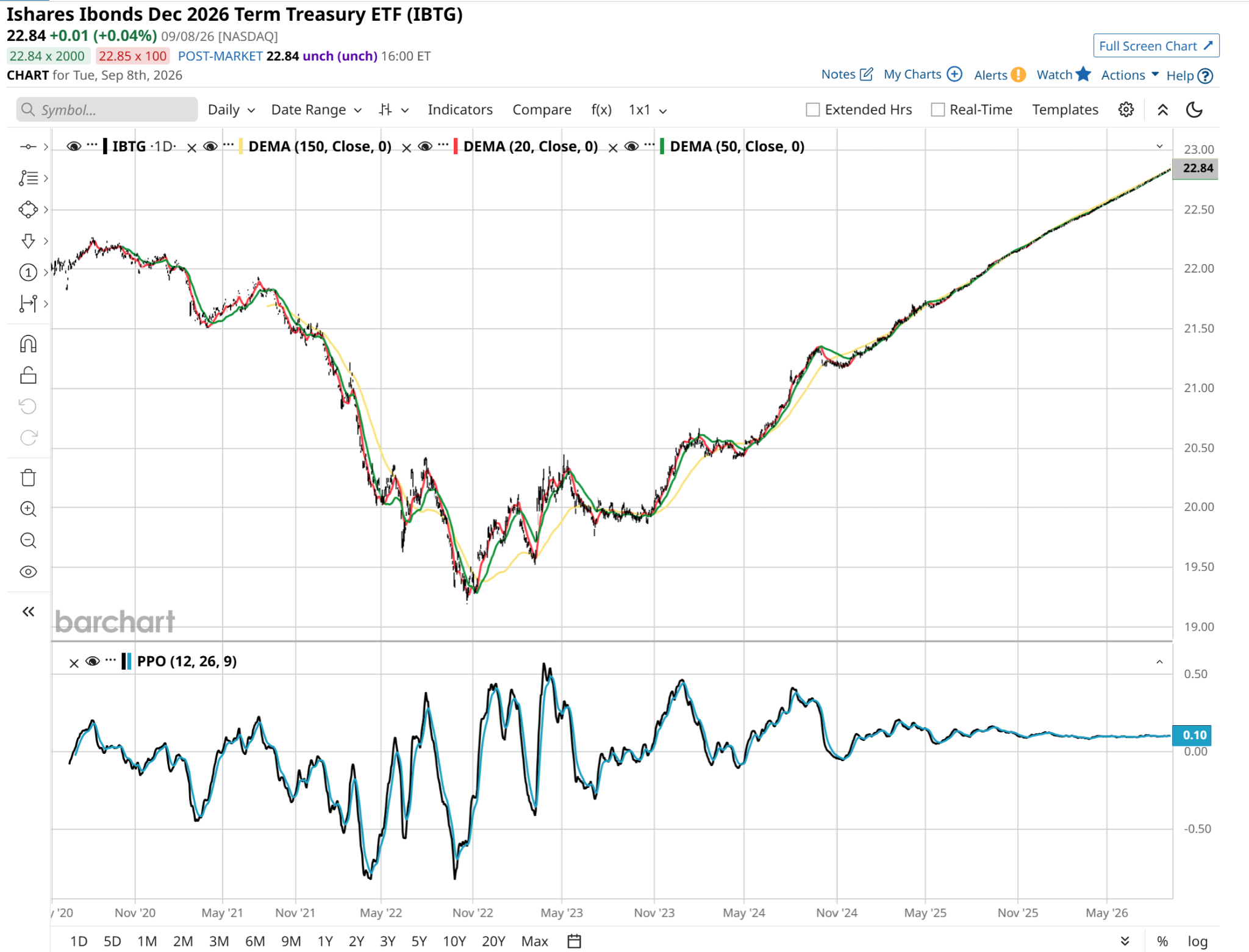
If you’re thinking “what a terrible ETF that is,” consider this: if the S&P 500 Index falls 30% (again), and SPY’s price drops by 30%, did the ETF fail? Of course not. Passive ETFs like this one do what they are supposed to do. If they don’t, THAT would be worth complaining about.
Each iBonds ETF works the same way, and there’s a whole section of the iShares site devoted to them. But the bigger issue here is what Bank of America said. And what I’ve been saying. Translated to simple terms:
DIY investors should start learning all the things about bond investing they have had no reason to learn until now. Because, for example, the iShares iBonds Dec 2031 Term Treasury ETF (IBTL), which matures in 2031, now yields closer to 4% or so. Because that’s what yields are running now. And 5%-plus at the longer end of the curve.
Hartnett from Bank of America points out that periods of severe, negative 10-year rolling returns have repeatedly served as launch points for major asset class turnarounds. Historically, when long-term returns for a major asset class hit this type of extreme generational trough, it signals that bad news, fiscal anxiety, and inflation fears have been fully priced into valuations. Think stocks around February 2009, or commodities in April 2020.
Long-term Treasuries may currently be one of the most unloved trades on Wall Street. And to be clear, long-term rates could very well continue higher for a while. Calling “bottoms” is not the goal here. It is recognizing a potential long-term undervalued situation.
Think of it this way: When a tech stock favorite falls hard in price, DIY investors shout over each other to “buy the dip!” Decades ago, the expression was “if you liked it at $100 a share, you should love it at $70 a share.”
Perhaps bonds are going to have their cyclical bite at that apple. I know I just took a significant step toward that myself. And I’ll continue to write about that experience here.
Rob Isbitts is a semi-retired CIO, former fiduciary investment advisor, and Barchart columnist. Check out his other work at ETFYourself.com (featuring the Fresh Charts weekly trading post), and ROAR.PiTrade.com, helping investors to better-manage their own portfolios.
On the date of publication, Rob Isbitts did not have (either directly or indirectly) positions in any of the securities mentioned in this article. All information and data in this article is solely for informational purposes. For more information please view the Barchart Disclosure Policy here.