
- PRICING
- LIVE QUOTES
- LEARN
- HELP


EN
The Bank of England kept interest rates unchanged and “put on the brakes” more than expected
The Zhitong Finance App learned that the Bank of England announced on Thursday that it will keep the benchmark interest rate unchanged at 3.75%, in line with general market expectations. The Bank of England warned that if inflationary pressure intensifies due to the Middle East conflict, interest rate hikes may be needed. The Bank of England abandoned plans to sell long-term British Treasury bonds and said it will gradually reduce its debt portfolio of 488 billion pounds (653 billion US dollars) by September 2034.
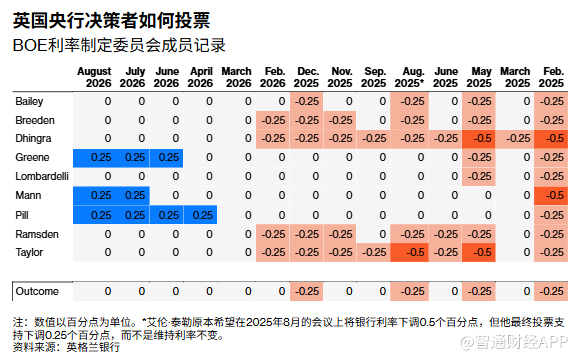
Six interest rate makers, including Governor Andrew Bailey, supported keeping interest rates unchanged, while Kathryn Mann, Megan Greene, and Hugh Peel voted to raise interest rates by 25 basis points. The Bank of England's Monetary Policy Committee had the same differences as at the July meeting.
In a statement prepared in advance, Bailey said that the impact of the global energy shock on UK prices and wages has been limited so far. “But the longer this fluctuation continues, the greater the impact on inflation, and the more likely we will need to raise central bank interest rates,” he added.
Traders have reduced their bets on the Bank of England's interest rate hike, fully priced to raise interest rates once before the end of the year, and have a 50% chance of adding it again. UK treasury bonds rose, led by long-term treasury bonds, and the 30-year yield fell 5 basis points to 5.80%. GBP/USD regained gains and was reported at 1.3374.
The escalation of the US-Iran conflict has made the Bank of England's decision-making more difficult. Soaring oil and gas prices are driving up fuel costs, and causing many problems for British households when the energy price cap is reset in the new year.
In the minutes of the September meeting, the Bank of England kept the core guidance unchanged, that is, “ready to act,” while adding that the risk “favors the upward trend” and is even greater than in July. Price pressure is expected to increase in the next few months, according to the minutes. The indirect effects that have not yet been felt in the UK economy may “only be delayed rather than weakened.”
The Bank of England currently expects the inflation rate to double its 2% target at the beginning of next year and raise the GDP growth forecast for the third quarter to 0.4%.
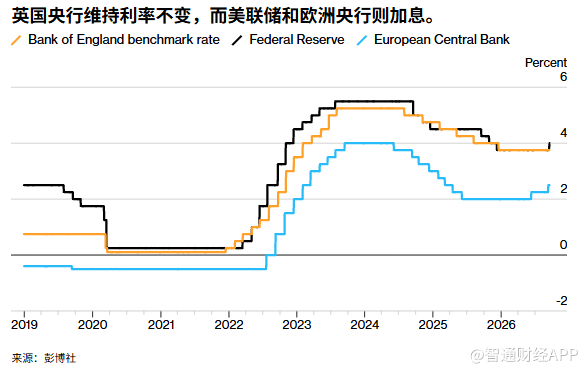
While the Bank of England decided to keep interest rates unchanged, other central banks have tightened their interest rate policies one after another. The Federal Reserve raised interest rates on Wednesday, and the ECB also raised interest rates for the second time this year last week. The rate hike was 25 basis points.
David Rees, head of global economics at Schroder Investments, said: “Domestic inflation in the UK is under control, wage growth is slowing down, and the unemployment rate is close to 5%, indicating significant weakness in the labor market. The current state of the economy does not require higher interest rates.” “The greater risk lies in fiscal policy,” he added.
Major QT adjustments: abandoning the sale of long-term treasury bonds, and the downsizing slowed beyond expectations
However, for bond investors, they are more concerned about the Bank of England's quantitative austerity (QT) plan for the next year rather than Thursday's interest rate decision. The Bank of England has made major adjustments to the QT plan this time, announced that it will abandon the sale of long-term treasury bonds, and plans to gradually reduce its debt portfolio of 488 billion pounds (about 650 billion US dollars) by 2034.
According to the proposal, which has yet to be finalized, the Bank of England will keep £120 billion of treasury bonds due in 2049 or later to match future note issuance. Another 222 billion pounds of treasury bonds due before 2035 will naturally mature, and the remaining 146 billion pounds of bonds due between 2035 and 2049 will be sold at a rate of 20 billion pounds per year, and may be sold directly to the government through the Debt Management Office (DMO).
In a letter to British Chancellor of the Exchequer John Healy, Bailey said the arrangement “maintains the independence of monetary policy” and will “maximize the value of capital throughout the life cycle of the plan by minimising costs and risks.”
All planned QT auctions will be suspended until next April to finalize the terms of the sale to DMO. The move is aimed at avoiding competition with government bond issuances, thereby easing short-term pressure on UK Treasury yields. However, the relevant arrangements may slightly erode Healy's fiscal buffer space.
The market reacted positively, with UK long-term treasury bonds leading the way, and the 30-year yield fell 5 basis points to 5.80%. The premium on the consideration of swap transactions (a measure of sensitivity to future bond supply) stabilized at 68 basis points.
When this new QT program was introduced, the way the plan was managed was being fiercely criticized. Since downsizing began in 2022, QT has accumulated losses of £110 billion, to be borne by taxpayers, while previously making a profit of £124 billion. Bank of England documents show that losses of 100 billion pounds are expected.
According to the new proposal, the portfolio will shrink at an average rate of £46 billion per year, of which £20 billion is active sales. However, the market previously anticipated that the Bank of England will slow down the downsizing rate to 50 billion pounds per year within the next 12 months starting in October, lower than 70 billion pounds in the previous two years, and 100 billion pounds in the earlier year.
The UK Treasury and the central bank have been cooperating on this arrangement for almost a year, but the final terms have yet to be reached. The Bank of England plans to sell treasury bonds directly to DMO, which can then cancel these treasury bonds and issue larger bonds to better meet market demand. The final decision is made by the UK Treasury. The Bank of England said that long-term treasury bonds of 120 billion pounds will be retained as asset support as cash in circulation; this is a liability of the central bank.