
- PRICING
- LIVE QUOTES
- LEARN
- HELP


EN
Waymo revealed that the “secret army” of the convoy is waiting to go to the road, and the pressure on Robotaxi, the pillar of Tesla (TSLA.US) valuation, is even greater
The Zhitong Finance App learned that well-known investor Ross Gerber (Ross Gerber) previously posted a “secret parking lot” full of Waymo vehicles on social media, pointing out that the autonomous driving department under Alphabet (GOOGL.US) is preparing to launch capacity on a large scale, yet Tesla (TSLA.US) Cybercab (TSLA.US) is wasting time because it “did not apply for an exemption to cancel the brake pedal.”
The same week, the US National Highway Traffic Safety Administration (NHTSA) issued a special order to Tesla to answer 21 questions by September 30 on how this driverless taxi without a steering wheel, pedals, and rearview mirror complies with federal safety standards without exemptions.
“Over 100 new Waymo's ready to launch”
Gerber is the CEO and co-founder of wealth management company Gerber Kawasaki. He posted photos on X showing rows of Waymo cars parked neatly at a facility in Santa Monica. “I was walking around Santa Monica today and found a secret parking lot,” Gerber wrote. “It was full of new Waymo ready to launch, with over 100 cars. Something crazy is about to happen...”
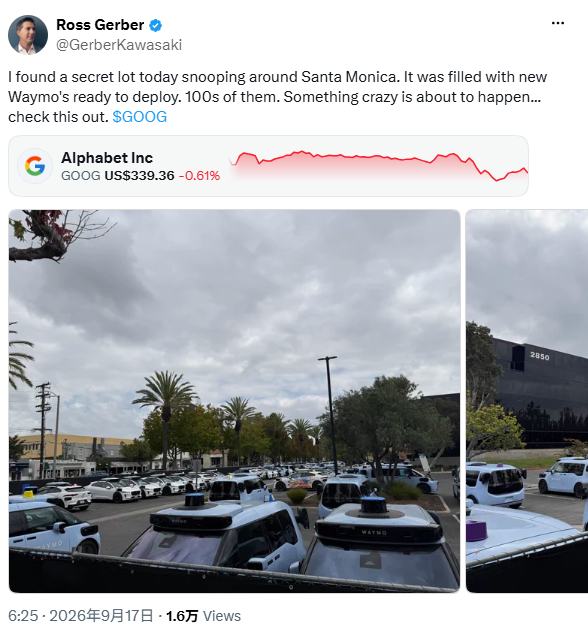
Based on this, he determined that Alphabet's driverless taxi division is entering a large-scale deployment model: “It looks like Waymo is entering a real phase of scaling up, and Tesla's Cybercab is wasting time because they haven't applied for an exemption to remove the brake pedals.”
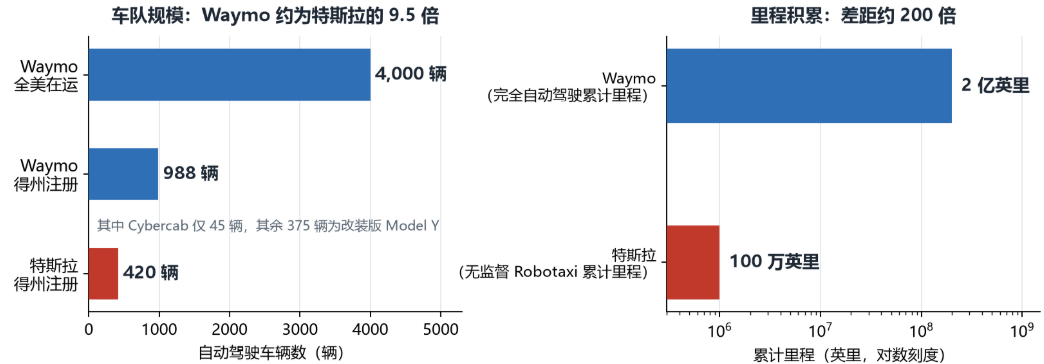
Gerber's observations are in line with Waymo's published expansion data. Waymo currently operates more than 4,000 driverless vehicles across the US, completes more than 500,000 paid orders per week, and plans to achieve 1 million paid rides per week in 20 cities around the world by the end of this year; on September 14 (Monday), Las Vegas officially launched its paid service, becoming its 15th operating city in the US, after the company had just expanded to Denver, San Diego, and Tampa.
In the international market, tests in Tokyo and London are already being prepared. Munich will become its first market in the EU, with commercial service targets set at the end of 2027 (according to Quartz, Bloomberg). Waymo's fleet is still getting thicker: IBD estimates that the number of vehicles on the road may reach around 5,500 by the end of the year, and the Ioniq 5 produced by Hyundai Motor's Georgia plant from 2027 will be the main force in the fleet. According to reports, Waymo plans to purchase 50,000 vehicles by 2028; Morgan Stanley estimates that it will operate nearly 120,000 autonomous vehicles by 2032.
Funding is also plentiful — Waymo has just completed $16 billion in financing at a valuation of $126 billion at the beginning of this year, and is currently in talks with Pimco, Blackstone, and Sixth Street for initial debt financing of over $3 billion, with Goldman Sachs acting as an advisor.
By contrast, Tesla's size gap is huge. Just around the time of Cybercab's commercial debut at the beginning of this month, Texas vehicle registration data showed that Tesla registered a total of 420 autonomous vehicles in the state, of which only 45 Cybercab cars, and the remaining 375 were modified Model Ys; Waymo registered 988 vehicles in the same state. The gap in mileage accumulation is even greater — Tesla announced on September 3 that its Robotaxi fleet has accumulated 1 million miles of unsupervised driving, while Waymo has accumulated more than 200 million miles of fully autonomous driving, a difference of about 200 times.
Regulatory hurdles: 21 questions answered by September 30
The Cybercab is a two-seater robot taxi without a steering wheel, pedals, or rearview mirror, and currently only operates in parts of Austin through the Tesla Robotaxi app. Musk called it “the first car built for unsupervised fully automated driving,” while Tesla executives promised to provide a “first-class experience at the price of economy class.” But this unconventional design is now central to the NHTSA audit.
NHTSA has given Tesla a September 30 deadline to answer 21 questions explaining how Cybercab complies with current federal safety standards without exemptions. Regulators wanted to know: whether temporary steering or braking control devices were used during the certification process, whether passengers can move the vehicle through touch screens, how Cybercab can meet requirements such as foot-operated braking, steering lights, rearview mirrors, rear view, and body stability control warnings; Tesla must also disclose fleet size, expansion plans, and operating restrictions. The key question of the investigation is whether Tesla is using a configuration equipped with artificial driving devices to prove compliance, yet allows Cybercab without these devices to carry passengers on the road for a fee — Tesla's guide for emergency responders has confirmed that some Cybercab “usually” does not have a steering wheel, but in order to test and verify safety systems, some vehicles are equipped with steering wheels, accelerators, and brake pedals.
Here is a background that is easily overlooked: under current US law, fully autonomous vehicles do not require NHTSA approval as long as they are equipped with human driving devices such as steering wheels and brake pedals; if they want to remove these devices, manufacturers can apply for an exemption, but each manufacturer can only put up to 2,500 such vehicles on the road each year. Instead of taking the exemption path, Tesla chose to self-certify — this path has no upper limit, but it also means proving the basis for compliance to the regulators themselves. This is exactly what Gerber said in the context of “not applying for an exemption,” and it is also the bullseye of the NHTSA inquiry.
NHTSA Director Jonathan Morrison (Jonathan Morrison) said the agency “fully supports the safe development and deployment of autonomous vehicles,” but “needs to ensure that all laws are complied with.” The cost of an incomplete response is not small: According to the order documents, Tesla could face lawsuits from the Department of Justice, as well as civil fines of up to $27,874 per day, and a cumulative total of about $139 million for the same series of violations. The regulatory review covered approximately 1,000 Cybercabs — more than 20 times the number operating on Austin roads, showing that regulators are not focusing on the current pilot, but on Tesla's planned expansion. The previous car review was Amazon's Zoox: it followed the same self-certification path in 2022. The audit dragged on for four years, and was eventually forced to recall all 105 robot taxis before approval.
Security noise is also piling up. According to data from the city of Austin obtained by Axios, since testing began in June 2025, there have been 10 incidents or complaints involving Tesla autonomous vehicles. Of these, 7 were classified as safety concerns, including failure to give way at pedestrian crossings and flashing red lights.
Retail sentiment slips to “extremely bearish”
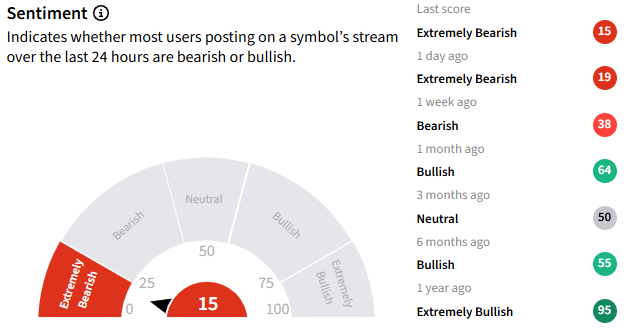
On the Stocktwits platform, retail sentiment surrounding Tesla has slipped from “bearish” to “extremely bearish” in the past 24 hours, and 24-hour news volume has risen 12%. Since this year, Tesla's stock price has dropped by about 20%, making it the worst performer among the “Big Seven.”
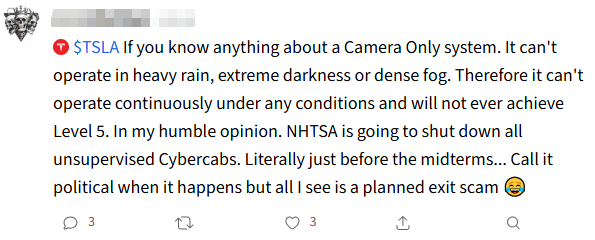
One user wrote, “$TSLA, as long as you know a pure camera system, you know it can't work in heavy rain, extreme darkness, and heavy fog. As a result, it cannot run continuously under any conditions and will never reach L5. IMHO. NHTSA will shut down all unsupervised cybercab before the midterm elections... You can say this is a political maneuver at that time, but what I saw was just a carefully planned exit scam.” Another user questioned the fundamentals: “$TSLA showed us demand data... they claim 500 miles of full power, probably less than 400 miles. How long will it take to charge?? If you have more than 2,000 miles to catch the dead, I wish you the best of luck.”
What's interesting is Gerber's own holdings: According to Koyfin data, as of June 30, Gerber Kawasaki still holds 279,997 Tesla shares worth about $117.8 million, accounting for 3.1% of the portfolio. Criticism is criticism; real money is still on the market. Before and after Cybercab was released earlier this month, Uber (UBER.US) announced the layoff of about 3,300 employees (10% of the total number of employees) to shift resources to the online car-hailing and robo-taxi business. Gerber called these laid-off employees “the first victims of the AI era.”
How much of Tesla's valuation do driverless cars carry?
The reason why this competitive gap is fatal is that a significant portion of Tesla's valuation is betting on the Robotaxi business, which has not yet reached scale.
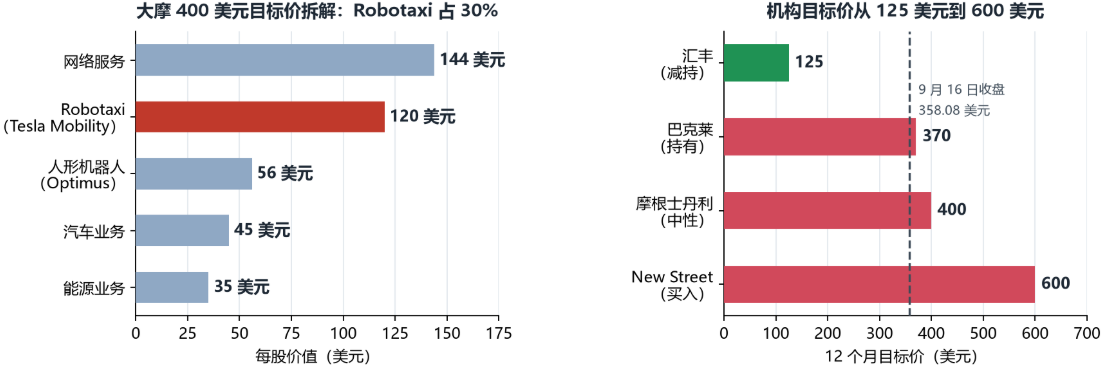
In Morgan Stanley's classification summation (SOTP) model, the Robotaxi business (Tesla Mobility) alone contributed $120 per share, accounting for 30% of the target price of $400, making it the second largest source of value after network services ($144 per share); the automotive business itself is only worth $45 per share.
Damo analyst Andrew Percoco clearly wrote that the continued expansion of the unsupervised fleet is the core driver for Tesla to outperform the market during the year. If the fleet can expand to 25 to 50 cars or more within a few days to weeks after launch, the stock price is expected to receive a positive response; conversely, if there is only limited display, the stock price will be under pressure. The bank also spotted a Cybercab on the streets of New York. Research by its AlphaWise team showed an increase in remote operator recruitment activities in the New York region, suggesting that Tesla is positioning itself for the New York market.
Other major banks are more aggressive: UBS previously estimated that if Tesla can deliver 100,000 vehicles per year by 2027 and reduce the cost per mile to $0.25-0.35, the Robotaxi division alone can be valued at $150-220 per share, accounting for up to 40% of Tesla's valuation; Bank of America has individually valued this business to a maximum of $844 billion, accounting for about half of the company's total market value. ARK Invest predicts that around 2029, Tesla's driverless travel business will support nearly 90% of the company's profit and market value (turnover). Tesla currently has a market capitalization of around $1.4 trillion and a rolling price-earnings ratio of more than 390 times — the market is already paying in advance for a business that has yet to generate significant revenue.
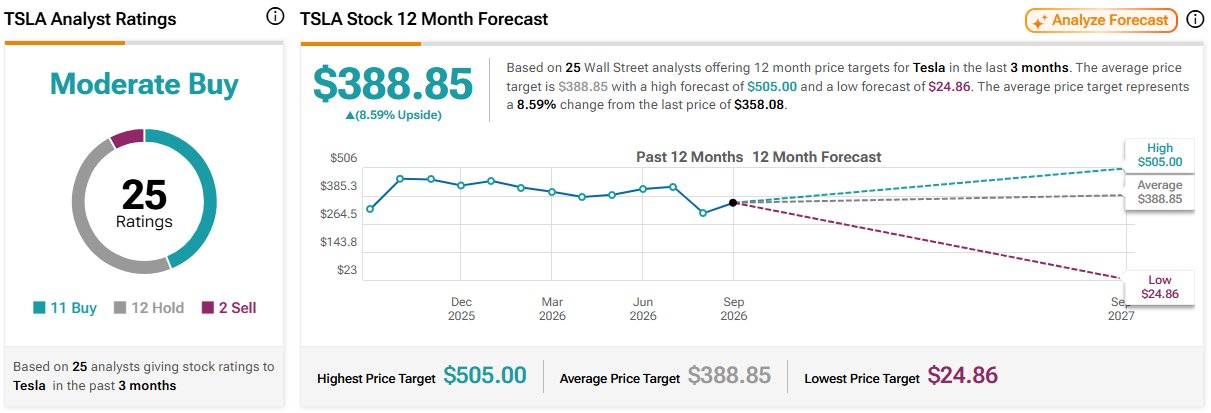
According to Tipranks data, 25 Wall Street analysts in the past three months predicted Tesla's target stock price for the next 12 months. The average target price was 388.85 US dollars, the highest predicted price was 505.00 US dollars, and the lowest predicted price was 24.86 US dollars. Large differences are rare among giant stocks.
Goldman Sachs added another layer of pressure this week: it lowered Tesla's third-quarter delivery forecast from 490,000 units to 435,000 units, citing weak sales in the US, China, and Europe. Citizens analyst Andrew Boone pointed out industry consensus concerns when reiterating “in sync with the market” ratings: the autonomous driving industry is still skeptical about Tesla's camera-only solution, and safety concerns and technical challenges remain significant.
Back to Gerber's “secret parking lot” post — he saw hundreds of Waymo cars waiting to be launched, and also saw a Cybercab that was being questioned by the regulations for certification. For Tesla, driverless driving is not just a new model on the product line, but a valuation pillar of $120 per share, accounting for 30%; every crack in this pillar will be examined by the market until NHTSA's September 30 deadline.