
- PRICING
- LIVE QUOTES
- LEARN
- HELP


EN
Why did Bank of America stocks plummet this week? The Bank of America warning is only the trigger; inflation is an “invisible killer”
The Zhitong Finance App learned that the Federal Reserve raised interest rates as scheduled on Wednesday and released a hawkish signal that interest rates may continue to be raised during the year. The KBW Bank Stock Index closed down 2.9% on the same day, the biggest one-day decline since February, and extended to 5% this week. The sell-off of bank stocks this week is the result of multiple pressures: the cautious performance guidelines released by the Bank of America (BAC.US) CEO directly ignited market concerns about weakening banking fundamentals, while the deeper reasons point to continued stubborn inflation, abnormal changes in interest rate structures, and uncertainty in the global debt market.
Direct trigger: Bank of America CEO's cautious performance guidelines lead to sector collapse
The direct trigger for this week's bank stock sell-off comes from Bank of America CEO Brian Moynihan's statement at the Barclays industry conference.
Moynihan said that the bank's third-quarter trading revenue is expected to be “basically the same” as the same period last year. This forecast contrasts sharply with the strong performance of Wall Street trading in the first half of the year. Moynihan expects investment banking revenue of around US$1.6 billion to US$1.8 billion in the third quarter, while analysts had previously anticipated close to US$2 billion.
After Moynihan made the above remarks, Bank of America's stock price plummeted 6% intraday on Monday, the biggest intraday decline since April last year, and finally closed down 5.14%. Stock prices of other major Wall Street banks such as Goldman Sachs (GS.US) and Morgan Stanley (MS.US) are also under pressure.
Notably, Moynihan clearly stated that the uncertainty of the interest rate environment is currently a key factor affecting capital market activity. Only when companies have greater certainty about future financing costs will they be more willing to make debt issuance decisions. In other words, the current problem is not only the level of interest rates themselves; sharp fluctuations in interest rates are also suppressing companies' willingness to finance and banks' capital market operations.
Deep root cause: High inflation, bank net interest spreads are “squeezed on both ends”
The reason the Bank of America's performance warning triggered such a strong market reaction was because it revealed a deeper problem: continuing higher than expected inflation is driving up interest rates in a way that is unfavorable to banks.
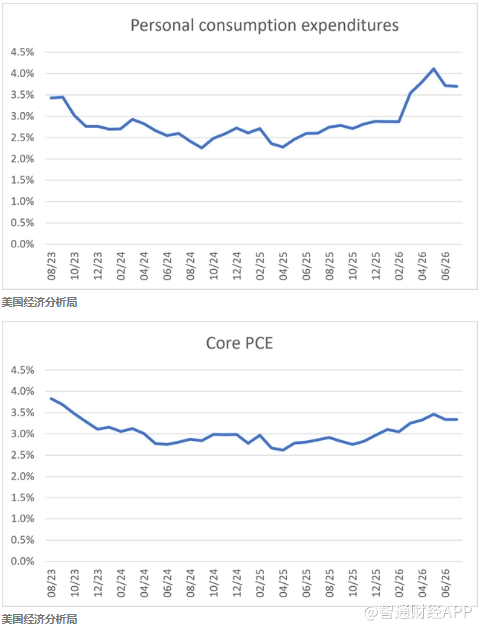
The origin of this round of inflation can be traced back to the outbreak of the US-Iran conflict about seven months ago. As a result of the conflict, energy prices hit the world, and oil prices rose sharply, which quickly spread to overall prices. The Federal Reserve's preferred inflation indicator, the personal consumer spending price index (PCE), jumped from less than 3% in February to more than 4% in May, and the core PCE, which excludes the impact of food and energy price fluctuations, also rose to 3.5% at one point. Despite a decline since then, the overall PCE is still above 3.5%, and the core PCE is about 3.3%, which is far higher than the Federal Reserve's 2% target.
The key reason why inflation puts pressure on bank stocks is that it distorts the interest rate structure. Fixed-income investors see inflation as a loss in the future purchasing power of their capital, and when inflation expectations rise, they demand higher returns as compensation. This has boosted long-term interest rates — 10-year US Treasury yields surpassed 5% this week, a direct reflection of rising inflation expectations.
According to Seeking Alpha writer Jeremy LaKosh, the core of the problem is the bank's profit model. When banks borrow money in the short-term market and release loans in the long-term market, they earn the interest spread between the two — that is, the net interest spread. In a normal interest rate hike cycle, rising short-term interest rates drive up interest rates on loans, and banks' net interest spreads often widen accordingly. However, the situation in this round was quite different.
The US Treasury Department is pressuring long-term interest rates by “selling short-term bonds and buying long-term bonds.” The data shows that since the last Federal Reserve meeting, the yield on US long-term treasury bonds has risen by about 15 basis points, while the yield on 2-year to 5-year treasury bonds has risen by more than 40 basis points. Although the US Treasury's operations have achieved certain results, it is still necessary to issue short-term bonds to raise capital, which has further boosted short-term interest rates.
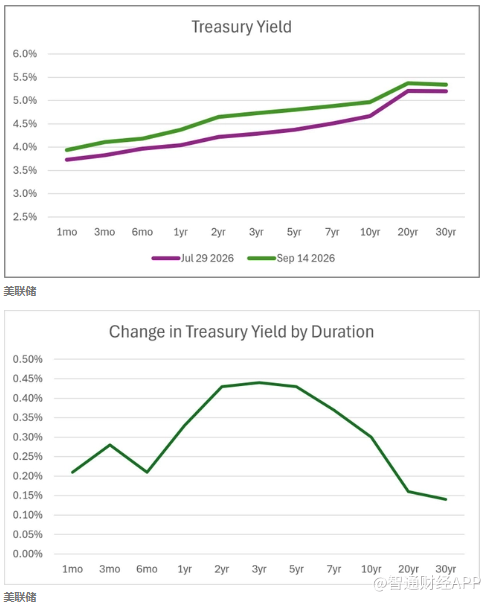
This means that banks' short-term financing costs are rising rapidly, yet the yield on long-term loans is being suppressed by the US Treasury's market operations. Borrowing costs are rising fast, loan earnings are rising slowly, and net interest spreads are clearly compressed, which will eventually drag down banks' profits.
Bank stocks are still under pressure: interest rate hikes are difficult to relieve concerns about inflation, and interest rate fluctuations are a core variable
The Federal Reserve raised interest rates by 25 basis points to the 3.75% — 4.00% range as scheduled on Wednesday. This is the first rate hike since July 2023, and signals that it may continue to raise interest rates during the year. However, for bank stocks, the key is not the interest rate hike itself, but rather that investors are worried that interest rate hikes will not effectively reduce inflation expectations; instead, they are squeezing net interest spreads along with the US Treasury's bond issuance operation.
Many market participants believe that current inflation is mainly driven by supply-side factors, and interest rate hikes are difficult to deal with effectively. LaKosh believes that this view is theoretically valid, but the key to judging whether current inflation is a short-term phenomenon is whether service inflation will be “ignited.”
Currently, most inflationary pressure is still concentrated on the commodity side. The problem is that if inflation starts to spread to the service side, then more vigorous interest rate hikes may be needed to bring prices back under control. Post-pandemic experience has proven this: once service inflation takes root, policy costs will rise significantly.
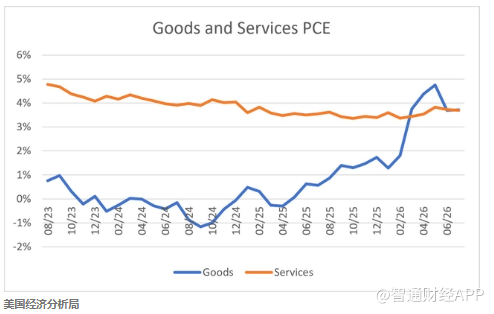
Prior to the Federal Reserve's action, there are opinions that interest rates should be raised early to prevent inflation from taking root in the service sector and to prevent interest rate fluctuations from worsening further. Now the Federal Reserve has chosen to raise interest rates and has sent hawkish signals that it may continue to raise interest rates during the year. However, the market reaction this week showed that the interest rate hike itself did not allay concerns about inflation. Most economists expect to wait at least until 2028 to return to the 2% inflation target.
As far as bank stocks are concerned, short-term performance fluctuations are certainly worth paying attention to, but the more important variable is whether the interest rate environment can stabilize as soon as possible. Moynihan also expressed a similar opinion: “Interest rates will eventually stabilize, and I think this will help some trading activities.”
Judging from investment logic, the impact of rising interest rates on banks' profits is not a one-way benefit. In a period where fundamentals are strong, credit expansion and net interest spreads widen at the same time, bank stocks can often fluctuate upward; however, if fundamental expectations are under pressure, interest rate hikes may instead cause a “double kill in performance and valuation.” The current market reaction suggests that investors are reevaluating banks' profit prospects in an inflationary environment, and this repricing may not be over yet.