
- PRICING
- LIVE QUOTES
- LEARN
- HELP


EN
Top 3 AI Healthcare Stocks To Watch In September 2026
OpenAI’s decision to publicly track and disclose safety incidents has pushed artificial intelligence into the policy spotlight again, and it is forcing investors to separate hype from real-world impact. Healthcare sits where that impact can be most tangible, from earlier cancer detection to faster drug discovery. This article walks through three AI healthcare stocks from our screener that showcase how this shift is playing out.
The three stocks highlighted below are only a small sample of what AI in healthcare can look like. The full screen surfaced 36 more companies with equally compelling narratives that are not covered in this article.
If you want to identify potential leaders in diagnostics, drug discovery, and clinical workflows, head straight into the Transformative Artificial intelligence (AI) Healthcare Stocks screener to filter, analyze, and focus on the highest-conviction plays that fit your own criteria.
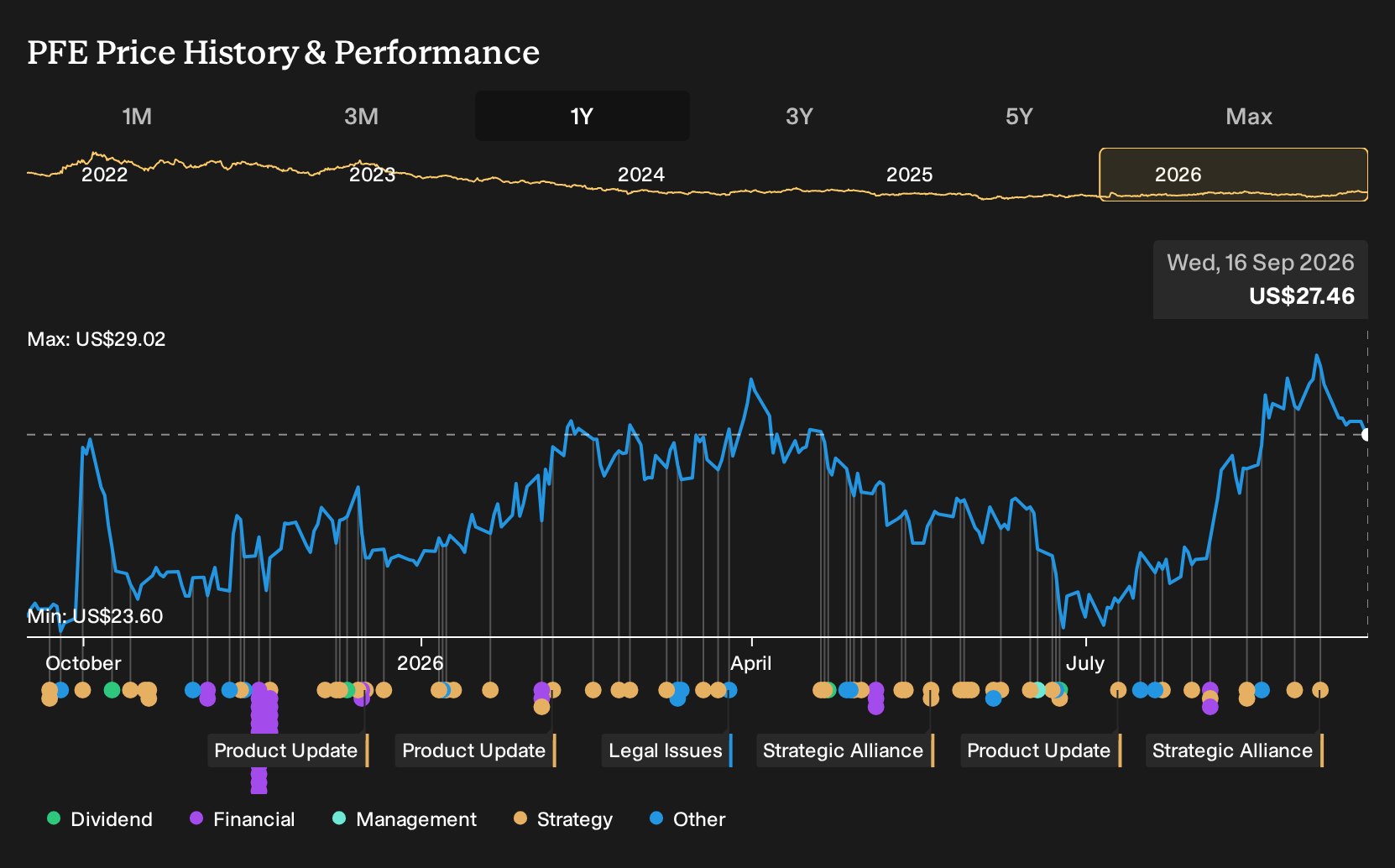
Pfizer (PFE)
Overview: Pfizer is a global biopharmaceutical group that develops and commercializes prescription medicines and vaccines, while using biomolecular AI tools to support drug discovery.
Operations: Pfizer generates about $62.3b from its Global Biopharmaceuticals Business segment, with roughly $37.4b from the United States and the rest from developed and emerging markets.
Market Cap: $157.0b
Pfizer matters for this AI healthcare screen because its core drug research engine is being rewired around biomolecular models that can reshape how quickly complex therapies move from early discovery into real-world treatment.
"Continued investment and rapid progress in digitalization (for example, AI-powered R&D, automation, advanced commercial targeting) has begun to deliver substantial cost improvements and operational efficiencies, underpinning margin expansion and improvement in EPS, even as industry pressures persist."
The real swing factor is how one evolving pressure on Pfizer’s future cash generation interacts with these AI-driven productivity gains over time.
That tension between pressure and productivity is exactly what the full narrative for Pfizer unpacks, showing where Pfizer’s AI engine could accelerate or stall the story from here.
Tempus AI (TEM)
Overview: Tempus AI runs a healthcare data and diagnostics platform that uses AI to turn genomic, clinical, and imaging information into decision tools.
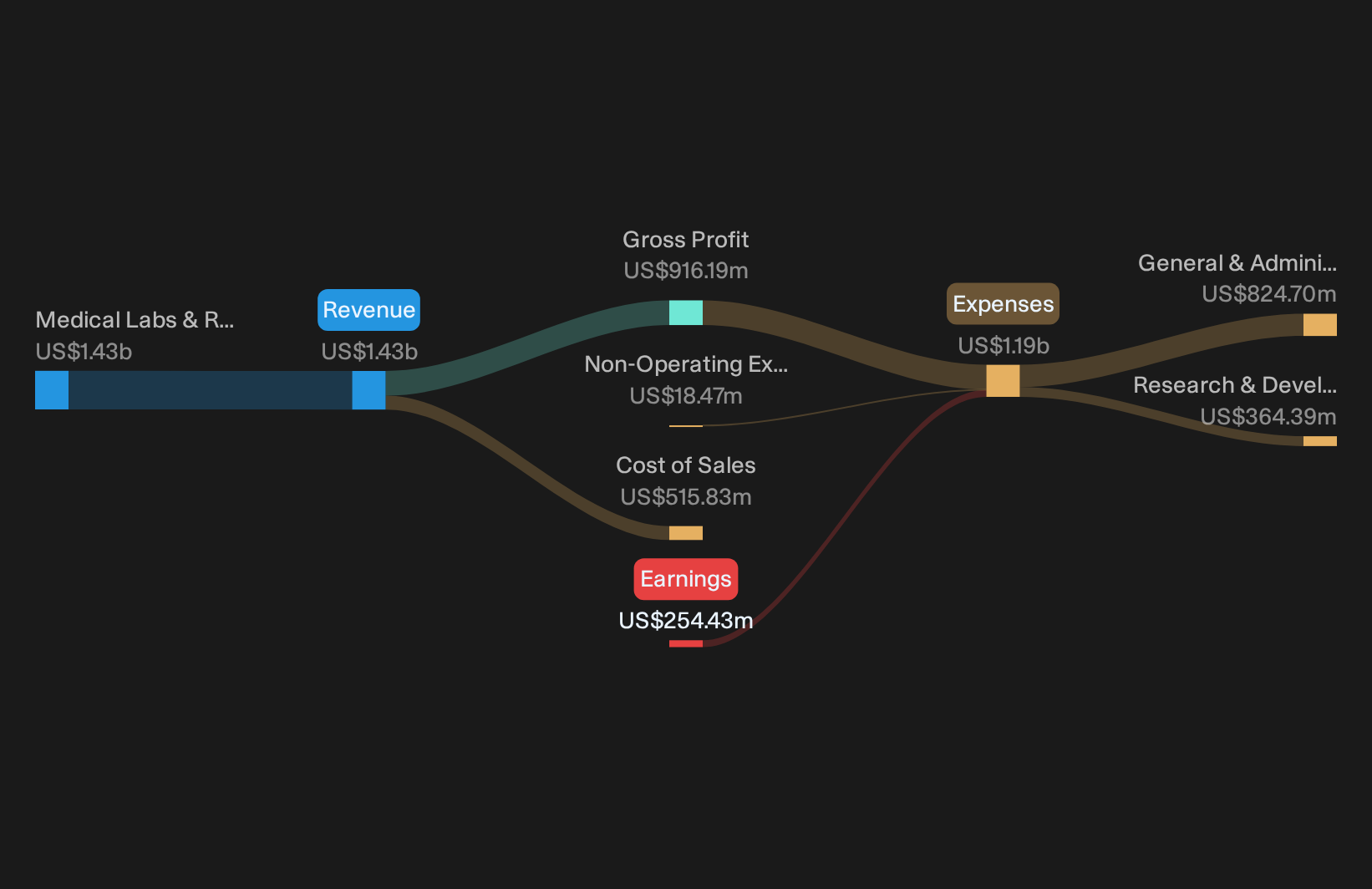
Operations: Tempus AI generates about $1.4b in revenue from Medical Labs & Research services, all currently sourced from the United States market.
Market Cap: $12.4b
Tempus AI matters for this AI healthcare screen because its data-heavy diagnostics platform turns real patient records into training fuel for clinical algorithms, which tightens the link between lab testing, treatment choices, and AI-guided care decisions.
"The biggest development is the $1.5 billion acquisition of Personalis, which strengthens Tempus’ position in molecular residual disease (MRD) testing. This allows Tempus to expand from diagnosing and selecting cancer treatments into monitoring patients for cancer recurrence."
What happens to Tempus AI’s future economics depends heavily on how one quiet shift in where the highest-margin work sits ultimately plays out.
That shift in where value accrues is the real story, and the full narrative for Tempus AI shows how Tempus AI could turn that MRD foothold into a broader oncology data engine.
Medtronic (MDT)
Overview: Medtronic develops medical devices across cardiovascular, neuroscience, and surgical care, including AI-powered tools that support more informed, efficient procedures.
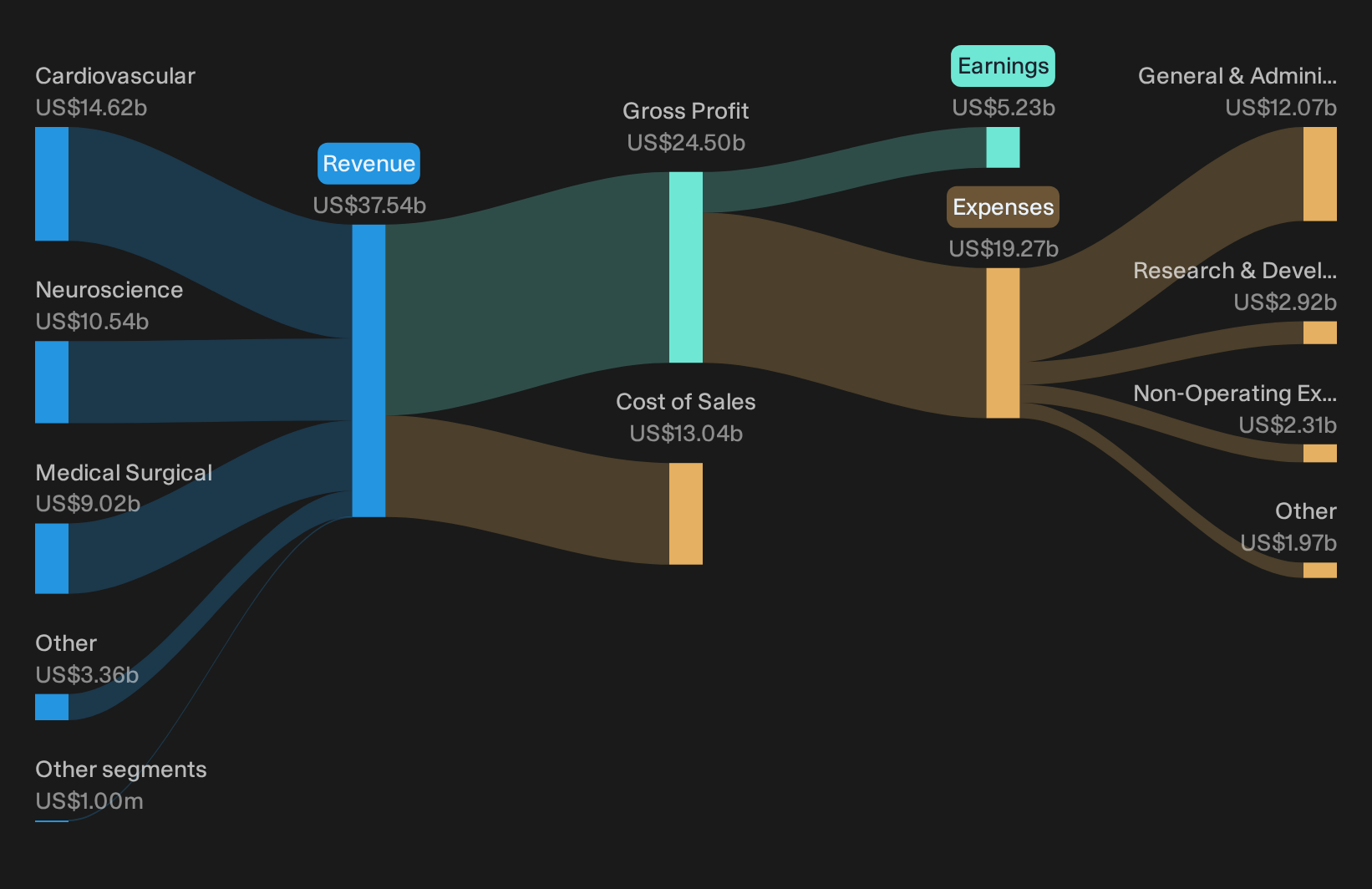
Operations: Medtronic generates about $14.6b from Cardiovascular, $10.5b from Neuroscience, and $9.0b from Medical Surgical, split roughly evenly between the United States and other regions.
Market Cap: $119.9b
Medtronic matters in this AI healthcare screen because its surgical video and analytics platform puts machine learning directly into the operating room, where small gains in accuracy and efficiency can compound into meaningful outcomes for both patients and hospital economics.
"Medtronic's investments and breakthroughs in digital health technologies, robotics (Hugo), next-generation sensors, and AI-enabled ecosystems (for example, spine AiBLE and advanced neuromodulation) align with industry-wide digital transformation and minimally invasive trends."
The real swing factor is how one unresolved question around scaling this AI and robotics ecosystem ultimately filters through to margins and growth.
That scaling question is exactly what the full narrative for Medtronic unpacks, revealing where Medtronic’s AI and robotics push could accelerate returns or quietly stall progress.
Curious About Alternatives You Might Be Missing
Fresh ideas move first. Watch where new momentum builds, before the crowd catches on and ideal entry points start dropping out of reach. Scan these curated picks and consider them promptly.
- Identify resilient balance sheets early by reviewing a curated list of solid balance sheet and fundamentals (22 results) list before those sturdier fundamentals are fully reflected in prices.
- Review companies linked to structural demand for critical materials by exploring a focused group from the 29 top copper producer stocks while they still receive relatively limited attention.
- Evaluate high-yield income opportunities by assessing carefully vetted 6 dividend fortresses candidates before payout stability and momentum draw broader interest.
This article by Simply Wall St is general in nature. We provide commentary based on historical data and analyst forecasts only using an unbiased methodology and our articles are not intended to be financial advice. It does not constitute a recommendation to buy or sell any stock, and does not take account of your objectives, or your financial situation. We aim to bring you long-term focused analysis driven by fundamental data. Note that our analysis may not factor in the latest price-sensitive company announcements or qualitative material. Simply Wall St has no position in any stocks mentioned.
Have feedback on this article? Concerned about the content? Get in touch with us directly. Alternatively, email editorial-team@simplywallst.com