
- PRICING
- LIVE QUOTES
- LEARN
- HELP


EN
How Investors Are Reacting To Best Buy (BBY) Holiday Rewards Push
- Best Buy recently outlined its holiday season playbook, including refreshed in-store tech experiences, expanded categories such as gaming and next-gen TVs, and season-long savings tied closely to its My Best Buy Plus and Total membership tiers.
- The focus on immersive store formats and richer loyalty rewards signals a push to deepen customer engagement and shift more holiday spending into Best Buy’s higher-value ecosystem.
- We will now look at how Best Buy’s expanded holiday loyalty rewards could shape the broader investment narrative for the retailer.
Scan beyond Best Buy and size up other retailers gearing up for the holiday rush with our hand picked 34 high quality undervalued stocks that could be setting up for their own seasonal momentum.
Best Buy Investment Narrative Recap
To own Best Buy, you need to believe the retailer can keep turning its store footprint, member base, and service offering into reliable cash generation, even as electronics demand stays cyclical and online rivals stay aggressive. The holiday playbook around gaming, next generation TVs, and in store experiences speaks directly to that thesis. The key near term swing factor remains how effectively Best Buy converts this traffic into higher margin services and memberships without giving too much away through promotions.
The biggest operational risk right now is mix and margin pressure. More gaming and computing, along with heavy discounting and membership perks, can pull gross profit rates lower if service attach, vendor funding, and retail media do not keep up. At the same time, Best Buy continues to carry cost pressure from labor, real estate, and omnichannel investments. If seasonal momentum does not offset those expenses, operating income could be constrained.
The most relevant piece of news is the expanded rewards tied to My Best Buy Plus and Total memberships, layered on top of the remodelled holiday store experiences. Those richer perks matter because they are one of the clearest ways Best Buy can support higher margin service revenue, repeat purchases, and attachment of installation or protection plans during a peak demand window.
For you as an investor, the central issue is execution. Stronger member rewards and immersive stores can support the existing catalysts around smart home adoption, AI driven hardware upgrades, and vendor funded in store displays. They also carry the risk of higher SG&A and weaker unit economics if promotional intensity increases faster than member quality. Watching holiday conversion into membership growth, service penetration, and gross margin per visit becomes a focused way to evaluate Best Buy’s performance after this announcement.
Best Buy's analyst narrative points to US$44.0b in revenue and US$1.6b in earnings by 2029, built on expectations of 1.4% yearly revenue growth and an earnings increase of about US$0.3b from US$1.3b today.
Uncover why Best Buy's fair value indicates a 7% potential downside to its current price, a premium that may not hold.
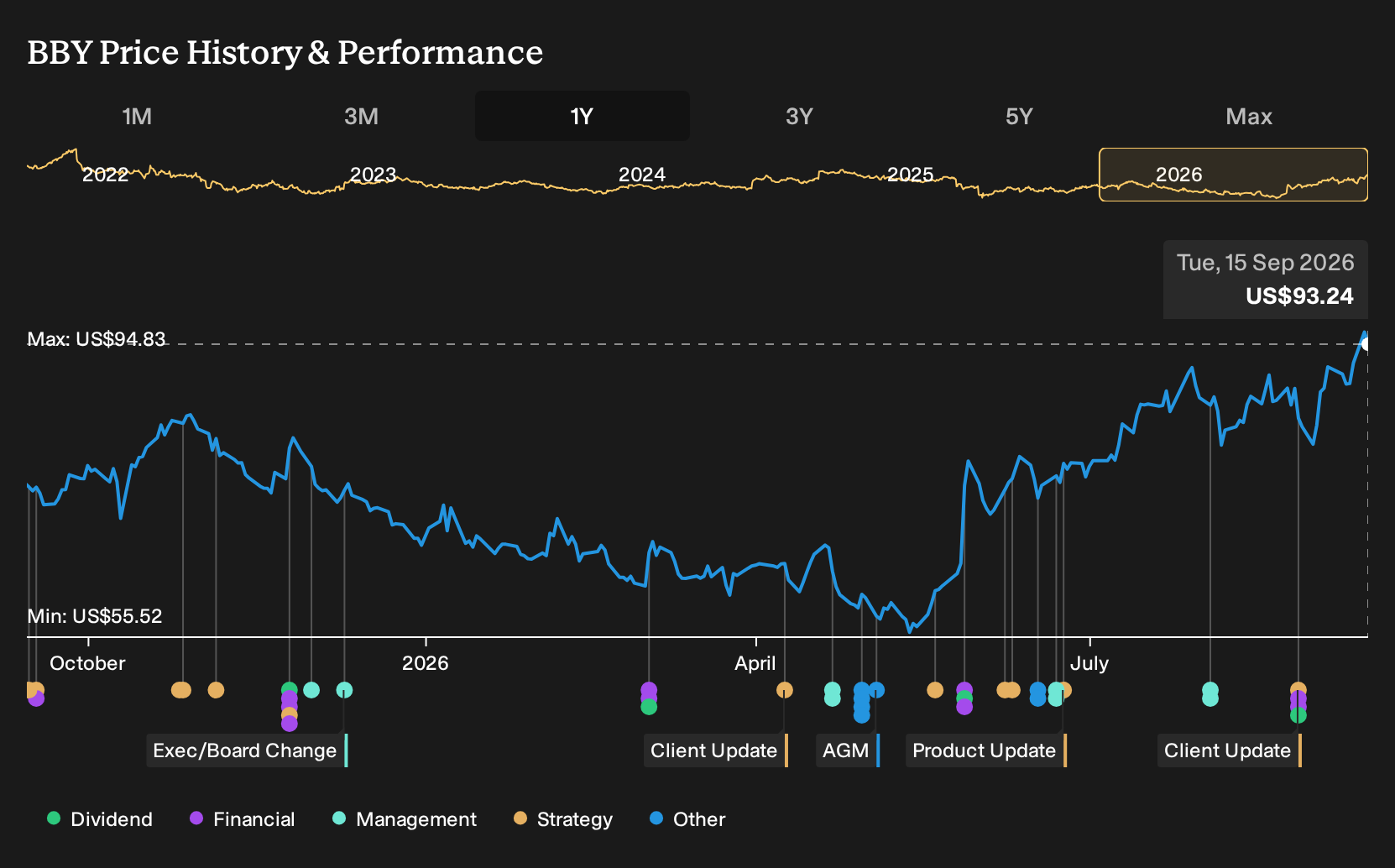
Exploring Other Perspectives
One alternate view puts tariffs and inflation at the center of the Best Buy story instead of holiday memberships. The most cautious analysts were looking for flat revenue near US$42.7b and earnings of about US$1.5b by 2029 before this news. That is a much tougher narrative, and the latest holiday update could eventually shift it.
Explore 6 other Best Buy fair value estimates, including one that suggests as much as 30% downside from the current price.
Reach Your Own Conclusion
Don't just follow the ticker; dig into the data and build a conviction that's truly your own.
- A great starting point for your Best Buy research is our analysis highlighting 4 key rewards and 1 important warning sign that could impact your investment decision.
- See our latest analysis for Best Buy. The report includes a comprehensive fundamental analysis summarized in a single visual, the Snowflake, making it easy to evaluate Best Buy's overall financial health at a glance.
Looking For More Investment Ideas Beyond Best Buy?
If the Best Buy story has sharpened your thinking about retail and membership models, it can be useful to compare it with other businesses that share similar financial traits or risk profiles. The Simply Wall St Screener can help you build that wider watchlist quickly by filtering for balance sheet strength, income potential, or overlooked quality.
- For investors who care most about financial resilience and low leverage, start by scanning a list of solid balance sheet and fundamentals (22 results) that can help you focus on companies with sturdier foundations.
- If capital preservation and smoother ride potential matter to you, look across a 11 resilient stocks with low risk scores that concentrates on businesses with lower overall risk scores.
- When the goal is to spot quality that the market might be ignoring, use a 16 high quality undiscovered gems that surfaces underfollowed companies with stronger fundamentals.
This article by Simply Wall St is general in nature. We provide commentary based on historical data and analyst forecasts only using an unbiased methodology and our articles are not intended to be financial advice. It does not constitute a recommendation to buy or sell any stock, and does not take account of your objectives, or your financial situation. We aim to bring you long-term focused analysis driven by fundamental data. Note that our analysis may not factor in the latest price-sensitive company announcements or qualitative material. Simply Wall St has no position in any stocks mentioned.
Have feedback on this article? Concerned about the content? Get in touch with us directly. Alternatively, email editorial-team@simplywallst.com