
- PRICING
- LIVE QUOTES
- LEARN
- HELP


EN
New India Can Plant Could Be A Game Changer For Ball (BALL)
- Ball Corporation recently detailed plans to build a new two-line beverage can plant in Uttar Pradesh, India, targeted to start operating in 2029 alongside its existing Taloja and Sri City sites.
- The project is backed by customer contracts and framed around strong economic value added, which puts execution risk, capital discipline, and demand visibility in India at the center of Ball’s operating story.
- Attention now turns to how Ball’s investment narrative absorbs this India capacity build, especially the contract backed Uttar Pradesh facility.
Scan how Ball's India buildout compares with other contract backed expansion stories by reviewing the hand picked 34 high quality undervalued stocks that may be pricing in similar capacity bets.
Ball Investment Narrative Recap
To own Ball, you need to believe in a packaging specialist that leans into long term, contract backed demand for aluminum cans while managing capital intensity, debt and input costs. The India buildout fits that belief. The near term swing factor still looks more about execution on existing plants, mix, and cost discipline than about a site that opens in 2029.
The biggest immediate risk remains margin pressure from aluminum prices, product mix and operational friction, especially in North America, layered on top of debt that is not well covered by operating cash flow. The Uttar Pradesh project does not change that in the near term. It mainly reinforces that Ball is committing capital based on contracted volumes.
Among the recent developments, the addition of Darlene Nicosia and Sherry Buck to Ball’s board on September 21, 2026, is most relevant to the India story. You now have a director with deep beverage and procurement experience, plus a director with a long finance track record in industrials and advanced materials, both plugged directly into capital and governance committees.
For a shareholder focused on catalysts, that board refresh matters. The India capex cycle will test Ball’s promise that spending averages depreciation and amortization over time, while debt coverage is already a flagged issue. A board with stronger operating and financial oversight increases scrutiny on project timing, returns and any trade off between growth projects and balance sheet repair.
What The Ball India Buildout Assumes About 2029
Ball's long term capacity bet in India sits next to a broader analyst model that already sketches out where the business might be by 2029. The Uttar Pradesh site is not being dropped into a vacuum. It is being layered onto forecasts that have revenue, earnings and the P/E multiple already pencilled in.
Analysts currently expect Ball's revenue to grow by 3.9% a year over the next three years, with profit margins moving from 6.6% today to 8.2% in that same time frame. Earnings today are put at about US$945.0 million, rising to a consensus of US$1.3b by 2029. Earnings per share are projected at US$5.28, and the P/E multiple on those 2029 profits is put at 17.4x, a touch below the 18.6x cited for the wider US packaging sector.
On those numbers, the move from US$945.0 million in earnings today to US$1.3b around 2029 implies roughly a 40% uplift in profit over the period. For anyone weighing the Uttar Pradesh expansion, that gap between current and forecast earnings is a useful yardstick. It frames how much of the India story might already sit inside consensus, and how much would need to come from better margins, tighter capital use or smoother operations in North America and other regions.
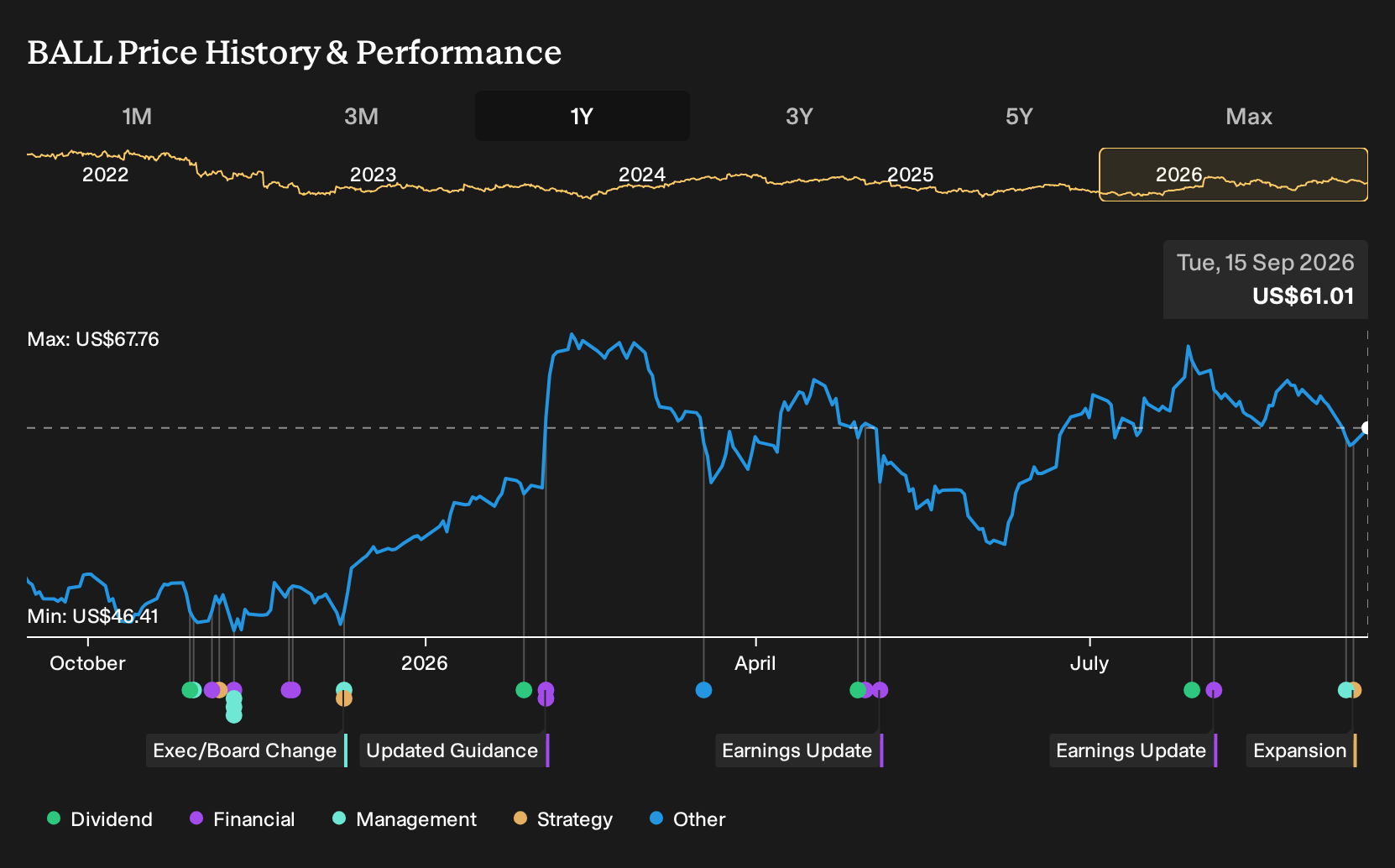
On the valuation side, the same analyst set ties the 2029 picture together with forecast revenue of US$16.1b and expected earnings of US$1.3b in that year, paired with a 17.4x P/E and a discount rate of about 7.4%. Those datapoints sit behind a current consensus price target of US$72.57, compared with a recent share price around US$63.30, with bullish and bearish targets spread between US$79.00 and US$63.00.
Ball's narrative projects US$16.1b revenue and US$1.3b earnings by 2029. This rests on 3.9% yearly revenue growth and roughly a 40% earnings increase from US$945.0 million today.
Uncover why Ball's fair value indicates a 19% potential upside to its current price that could narrow quickly.
Exploring Other Perspectives
One alternate story around Ball Corporation focuses less on India growth and more on the risk that North American volumes stall. The most bearish analysts were only pencilling in about US$15.8b of revenue and US$1.2b of earnings by 2029 before this news. That is a far cooler outlook. Use that gap to compare different expectations and decide which camp you lean toward as new information filters in.
Explore 4 other Ball fair value estimates, including one that suggests it could be worth just $63.26.
Form Your Own Verdict
Don't just follow the ticker. Dig into the data and build a conviction that's truly your own.
- A great starting point for your Ball research is our analysis highlighting 3 key rewards and 1 important warning sign that could impact your investment decision.
- See our latest analysis for Ball. The report includes a comprehensive fundamental analysis summarized in a single visual, the Snowflake, making it easy to evaluate Ball's overall financial health at a glance.
Looking For More Ball Investment Ideas Beyond This Stock?
If the Ball story has you thinking about where else contract backed growth, cash generation and balance sheet strength might intersect, it can help to scan a broader set of opportunities using the Simply Wall St screener before committing fresh capital.
- For investors who care most about quality at a reasonable entry point, review a hand picked mix of companies trading below their estimated worth through the 34 high quality undervalued stocks.
- If income and resilience matter more to you than headline growth, focus on businesses targeting meaningful payouts by checking the 6 dividend fortresses.
- When capital protection and financial strength sit at the top of your checklist, filter for robust balance sheets and steady fundamentals with the list of solid balance sheet and fundamentals (22 results).
This article by Simply Wall St is general in nature. We provide commentary based on historical data and analyst forecasts only using an unbiased methodology and our articles are not intended to be financial advice. It does not constitute a recommendation to buy or sell any stock, and does not take account of your objectives, or your financial situation. We aim to bring you long-term focused analysis driven by fundamental data. Note that our analysis may not factor in the latest price-sensitive company announcements or qualitative material. Simply Wall St has no position in any stocks mentioned.
Have feedback on this article? Concerned about the content? Get in touch with us directly. Alternatively, email editorial-team@simplywallst.com