
- PRICING
- LIVE QUOTES
- LEARN
- HELP


EN
Learn Why The Bull Case For Wells Fargo Stock Could Change Following Asset Cap Removal
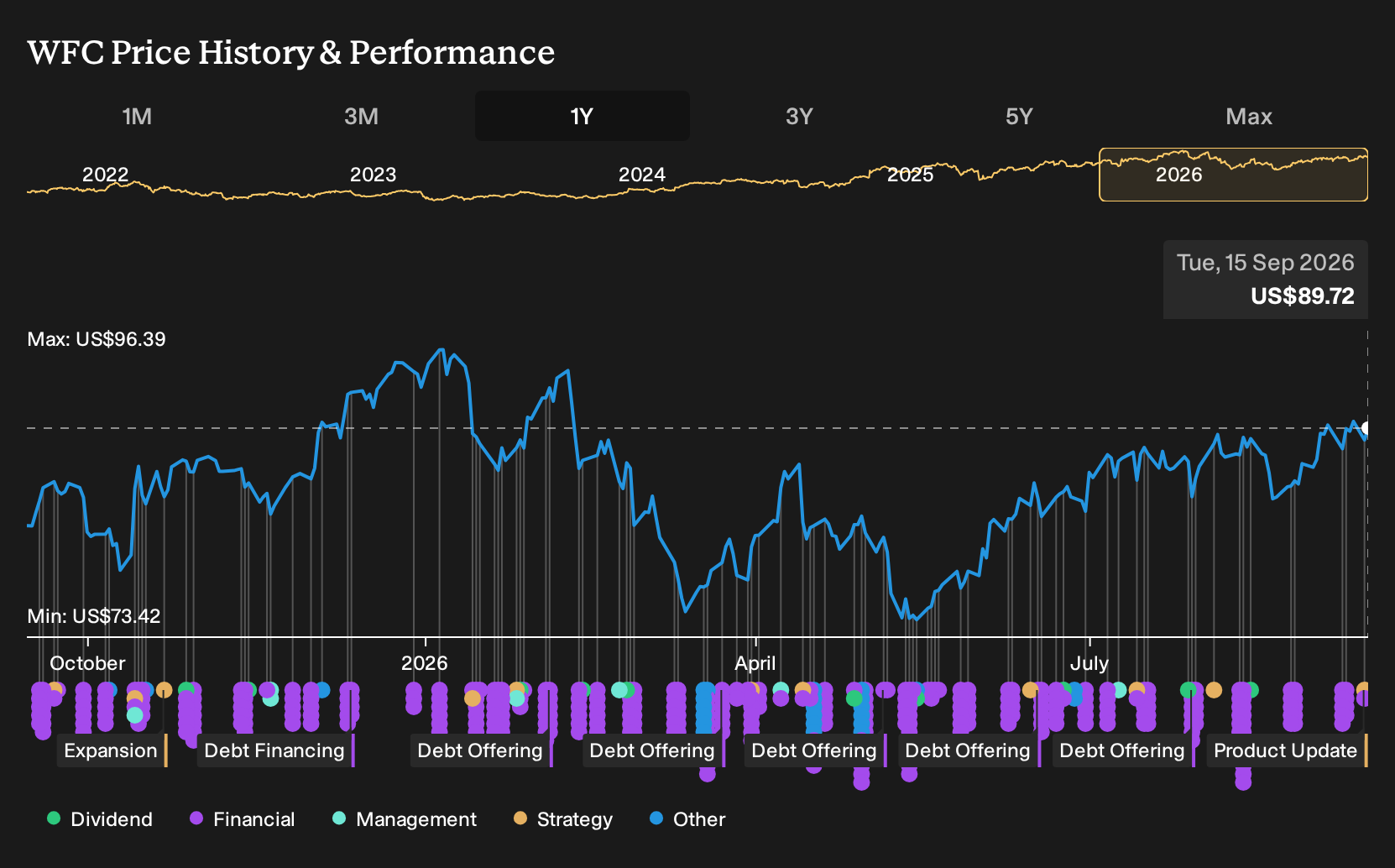
- Wells Fargo recently priced and completed multiple fixed income offerings in US dollars and euros and also rolled out ExpressSend Mobile, which integrates its international remittance service into the Wells Fargo Mobile app for customers sending money to 12 countries.
- The combination of fresh senior and subordinated funding and a dedicated cross-border transfer feature inside Wells Fargo’s core app highlights a push to support balance sheet flexibility while deepening engagement with digitally active, internationally connected retail customers.
- The next area of attention is how Wells Fargo’s broader investment narrative might be influenced by ExpressSend Mobile’s rollout within its banking platform.
Scan how Wells Fargo’s funding moves and ExpressSend rollout compare with other large, well-capitalized banks by reviewing our curated list of solid balance sheet and fundamentals (22 results).
Wells Fargo Investment Narrative Recap
To own Wells Fargo, you need to believe the business can turn its balance sheet freedom, digital push and capital strength into steadier earnings, even with slower forecast growth than the wider US market. The key near term swing factor is execution on loan and deposit growth without eroding net interest margin in a highly competitive banking industry.
The biggest risk right now sits in execution, both on digital and on long running regulatory remediation, which still consumes time and money. The recent wave of fixed income offerings and the ExpressSend rollout looks incremental for that story. They matter at the margin but do not fundamentally shift the main near term thesis or risk.
Among the recent headlines, ExpressSend Mobile looks most connected to the current catalyst mix. It directly ties into Wells Fargo’s push to move more activity onto its mobile platform, deepen engagement with internationally connected retail clients and support fee income alongside interest based revenue. For a shareholder, that feeds into the question of whether digital usage can keep climbing in a way that actually lowers unit costs.
The same launch also spotlights one of the central risks. If execution on new digital services like ExpressSend Mobile is clunky, or if fintech competitors offer a smoother cross border experience, Wells Fargo could see slower deposit growth or weaker customer loyalty. For now this product is another test of whether management can translate heavy tech spending, AI and tokenized deposit ambitions into practical tools that support earnings resilience rather than just higher expense.
Wells Fargo's current analyst story points to revenue of US$101.1b and earnings of US$23.6b by 2029, based on an assumed 6.8% yearly revenue growth rate and an earnings increase of about US$2.0b from earnings today of US$21.6b.
Uncover how Wells Fargo's fair value indicates a 12% potential upside to its current price before that discount to Wells Fargo closes.
Exploring Other Perspectives
Three fair value views from the Simply Wall St Community cluster between about US$100.6 and US$122.5 per share, so you are looking at a fairly tight band rather than an extreme outlier. When you set that against Wells Fargo’s fresh fixed income issuance and ExpressSend Mobile launch, you see a very different emphasis on growth, funding costs and execution risk. Use these contrasts as a prompt to explore more opinions before forming your own stance.
Explore 2 other Wells Fargo fair value estimates, including one that suggests it could be worth just $100.63.
Form Your Own Verdict
Don't just follow the ticker. Dig into the data and build a conviction that's truly your own.
- A great starting point for your Wells Fargo research is our analysis highlighting 2 key rewards and 1 important warning sign that could impact your investment decision.
- See our latest analysis for Wells Fargo. The report includes a comprehensive fundamental analysis summarized in a single visual, the Snowflake, making it easy to evaluate Wells Fargo's overall financial health at a glance.
Looking For More Investment Ideas Beyond Wells Fargo?
Once you have a handle on Wells Fargo, it helps to widen the lens and compare it with other companies that fit different risk and income profiles using the Simply Wall St Screener.
- If you want balance sheet strength to be front and center in your process, start with a list of solid balance sheet and fundamentals (22 results) that can handle tougher conditions without stretching their finances.
- For investors hunting for quality at a reasonable price, scan the 34 high quality undervalued stocks that pair solid fundamentals with what our models view as discounted valuations.
- If income is a priority, focus on the 6 dividend fortresses that aim to combine higher yields with more resilient cash flows.
This article by Simply Wall St is general in nature. We provide commentary based on historical data and analyst forecasts only using an unbiased methodology and our articles are not intended to be financial advice. It does not constitute a recommendation to buy or sell any stock, and does not take account of your objectives, or your financial situation. We aim to bring you long-term focused analysis driven by fundamental data. Note that our analysis may not factor in the latest price-sensitive company announcements or qualitative material. Simply Wall St has no position in any stocks mentioned.
Have feedback on this article? Concerned about the content? Get in touch with us directly. Alternatively, email editorial-team@simplywallst.com