
- PRICING
- LIVE QUOTES
- LEARN
- HELP


EN
How Motor Oil Rationing Will Impact Costco Stock Investors
- Costco Wholesale has raised the price of Kirkland Signature and other synthetic motor oils and imposed weekly purchase limits after supply disruptions in the Middle East squeezed base oil availability and pushed energy costs higher.
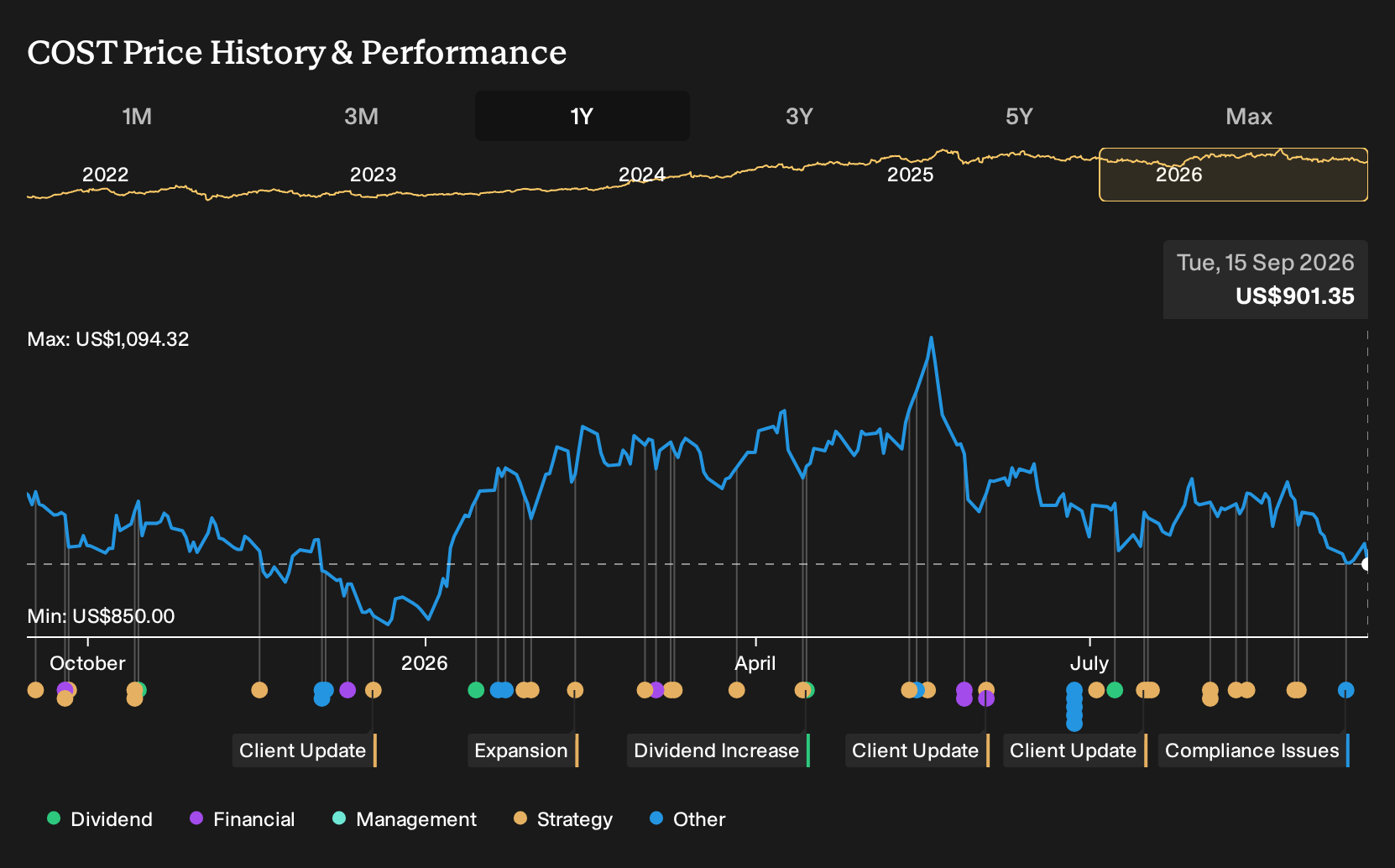
- These petroleum product constraints feed directly into Costco Wholesale's fuel and merchandise economics. This puts extra attention on how the retailer balances cost pressures, price perception, and member loyalty in a membership driven model.
- We will look at how Costco Wholesale's long term investment narrative is tested by higher input costs from the motor oil squeeze.
Scan how Costco Wholesale’s fuel and merchandise pressures compare with other retailers facing energy driven cost shocks by reviewing the hand picked 38 power grid technology and infrastructure stocks in our screener set.
Costco Wholesale Investment Narrative Recap
For Costco Wholesale, the long term story still hinges on high member retention, steady warehouse expansion, and tight cost control in a low margin model. The motor oil squeeze and broader fuel spike feed directly into that cost equation, but the big swing factor near term is how well membership renewals and traffic hold up as prices on everyday items feel less predictable.
The biggest near term risk sits in sustained pressure on gross margin from energy, freight, and higher wages at a time when the stock already trades on a rich P/E multiple. The forthcoming earnings update on September 24 will likely be the key checkpoint for how those pressures are flowing through.
The most relevant recent update is Costco Wholesale’s August and fiscal 2026 net sales release, with August revenue at US$23.7b and full year net sales at US$297.3b. Those figures show that, up to the end of August, shoppers were still spending heavily across warehouses even as fuel and input costs climbed.
That backdrop matters when thinking about today’s fuel driven merchandise strains. Strong top line momentum and rapid digital growth provide some cushion while Costco copes with higher energy and transportation costs. The tension for investors is whether that sales base offsets the current squeeze on merchandise margins and any future inflation sensitive pullback in discretionary baskets.
Costco Wholesale's analyst narrative points to revenues of US$363.2b and earnings of US$11.6b by 2029, built on an assumed 7.4% annual revenue growth rate and an earnings increase of about US$2.8b from earnings today of US$8.8b.
Uncover why Costco Wholesale's fair value suggests a 20% potential upside to its current price before the market begins to close that gap.
Exploring Other Perspectives
One alternate view says the bigger issue for Costco Wholesale is not fuel margins but slower membership and revenue expansion as urban shoppers buy less in bulk. The most cautious analysts were penciling in about US$355.3b of revenue and US$11.2b of earnings by 2029, so the motor oil squeeze and new EPA fuel site approval could push that already cooler story in either direction. You can use those lower estimates as a reference point to explore how much opinions can differ and whether this news changes your own stance.
Explore 14 other Costco Wholesale fair value estimates, including one that suggests as much as 19% downside from the current price.
The Verdict Is Yours
Disagree with existing narratives? Extraordinary investment returns rarely come from following the herd, so rely on careful research and your own judgment.
- A great starting point for your Costco Wholesale research is our analysis highlighting 2 key rewards that could impact your investment decision.
- See our latest analysis for Costco Wholesale. The report includes a comprehensive fundamental analysis summarized in a single visual, the Snowflake, making it easy to evaluate Costco Wholesale's overall financial health at a glance.
Looking For More Costco Wholesale Investment Ideas?
Costco Wholesale is only one piece of a much bigger opportunity set. If you want to pressure test your thesis or find stocks with different risk and income profiles, it helps to line them up side by side in the Simply Wall St Screener and see how the numbers compare.
- For investors hunting for potential mispricing, scan companies that combine quality fundamentals with attractive valuations using the 34 high quality undervalued stocks.
- If capital preservation and stability matter most to you, filter for companies with resilient finances through the 11 resilient stocks with low risk scores.
- When you want balance sheet strength front and center, focus on businesses that show robust financial footing with the list of solid balance sheet and fundamentals (22 results).
This article by Simply Wall St is general in nature. We provide commentary based on historical data and analyst forecasts only using an unbiased methodology and our articles are not intended to be financial advice. It does not constitute a recommendation to buy or sell any stock, and does not take account of your objectives, or your financial situation. We aim to bring you long-term focused analysis driven by fundamental data. Note that our analysis may not factor in the latest price-sensitive company announcements or qualitative material. Simply Wall St has no position in any stocks mentioned.
Have feedback on this article? Concerned about the content? Get in touch with us directly. Alternatively, email editorial-team@simplywallst.com