
- PRICING
- LIVE QUOTES
- LEARN
- HELP


EN
Lyft (LYFT) Stock Still Sits Below Fair Value Despite 71% Fall
Lyft shares closed at US$15.69 after a mixed stretch, with the stock down 20.7% year to date, and the key issue now is whether that price still lines up with what the business earns.
- Over the past 5 years the share price has fallen 71.2%, which puts the focus firmly on whether the current valuation is still anchored to Lyft's earnings power.
- New union representation for California drivers and the expansion of robotaxi services with Waymo can influence future pay structures, cost per ride and the timing of when earnings turn more predictable.
- There is a second opinion on Lyft worth weighing. See what analysts think Lyft's shares could be worth.
For investors, the debate is whether Lyft's current market value is adequately supported by the earnings the company is generating today and is expected to produce over time.
If you are weighing whether Lyft's earnings justify its recent share price, it can help to compare that question across a wider set of companies using 34 high quality undervalued stocks.
Is Lyft a Bargain on Earnings?
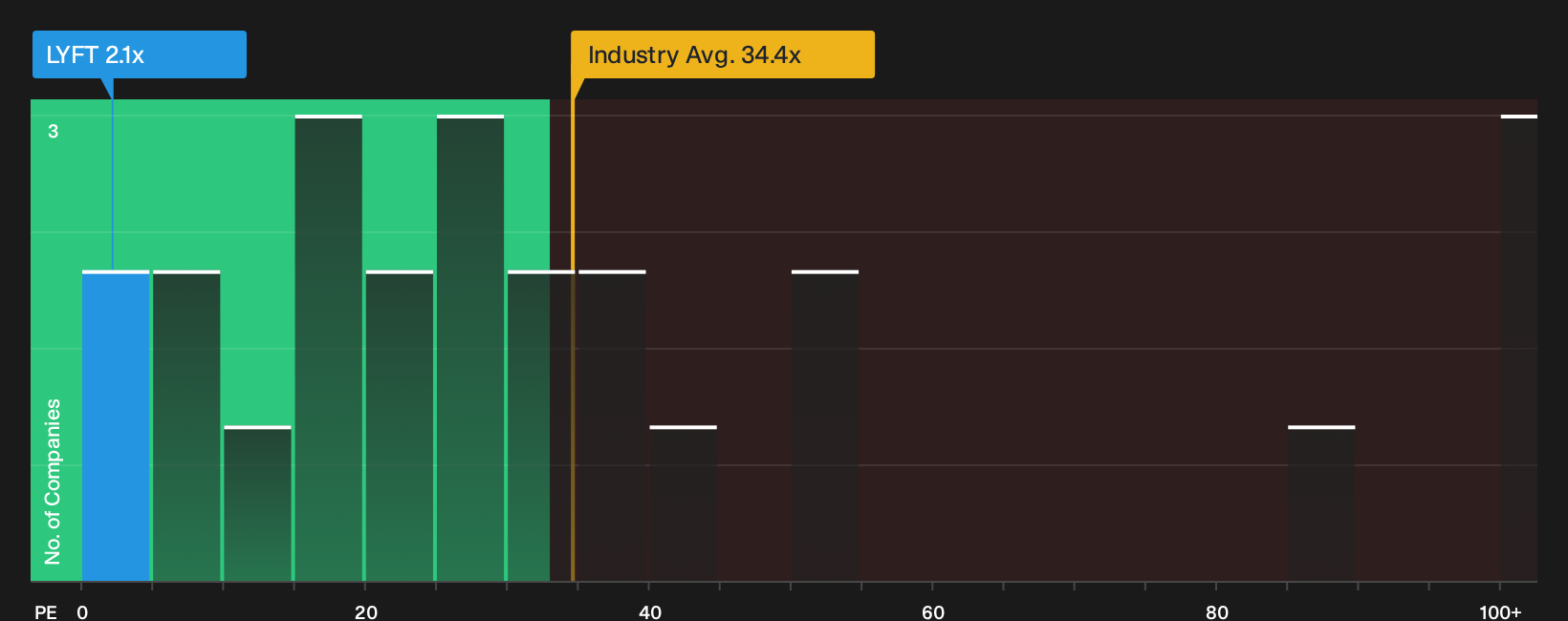
The P/E ratio is a relevant metric for Lyft because investors often focus on how efficiently a platform business can convert rides into earnings. On this basis, Lyft trades on a P/E of 2.1x, which is significantly below the Transportation industry average of about 34.4x and the broader peer group near 45.8x. This gap indicates that the market is currently assigning a much lower price to each dollar of Lyft's earnings than to those of many comparable operators.
The fair multiple implied by Lyft's own profile, including its margins, risk and scale, appears higher than the current 2.1x level, so the stock screens as undervalued under this framework. Because the newly certified California Gig Workers Union may affect driver pay and cost per ride over time, the market could be discounting the sustainability of recent earnings even though the ratio looks low against that tailored benchmark. Explore the numbers behind Lyft's P/E valuation.
The Lyft Narrative: What Would Justify Today's Price?
Narratives on Simply Wall St pick up where the Lyft valuation puzzle leaves off by spelling out which paths for growth, margins and earnings would need to play out for the stock to be worth far more or far less than today’s price. Each scenario links its number to a specific view of how Lyft's scale, profitability and risks could evolve, giving you a reference point you can check back against as fresh information comes through.
Community views on Lyft split between those who see a platform with more to give and those who worry the risk balance is already full.
Bull case: 19% undervalued
"Strategic global and cross-industry partnerships (e.g., with United Airlines, Chase, DoorDash) are driving higher-frequency usage and access to premium customers..."
Discover why this Narrative puts Lyft at 19% undervalued.
Bear case: 12% overvalued
"Increasing legislative scrutiny and labor activism could force Lyft to reclassify drivers as employees or provide expanded benefits..."
Explore why this Narrative puts Lyft at 12% overvalued.
Before you act on Lyft’s valuation, there is one more factor to check
Price tags are only part of the story for Lyft, because the people setting priorities and how they are rewarded can tilt risk and reward in ways the current valuation does not fully reveal. See who runs Lyft and how they are paid.
This article by Simply Wall St is general in nature. We provide commentary based on historical data and analyst forecasts only using an unbiased methodology and our articles are not intended to be financial advice. It does not constitute a recommendation to buy or sell any stock, and does not take account of your objectives, or your financial situation. We aim to bring you long-term focused analysis driven by fundamental data. Note that our analysis may not factor in the latest price-sensitive company announcements or qualitative material. Simply Wall St has no position in any stocks mentioned.
Have feedback on this article? Concerned about the content? Get in touch with us directly. Alternatively, email editorial-team@simplywallst.com