
- PRICING
- LIVE QUOTES
- LEARN
- HELP


EN
Rumor has it that the US is urging Japan to “increase” defense spending. Tokyo is considering a 3.5% GDP target, and the bond market and yen take the lead in putting pressure on
The Zhitong Finance App learned that under pressure from the US side, Japan is considering setting a new medium-term defense spending target. It plans to raise defense spending to 3.5% of gross domestic product (GDP), in line with NATO and other US allies. Once implemented, this idea may cause turbulence in the financial market, as investors are currently very concerned about Takaichi Sanae's fiscal expenditure plan.
According to people familiar with the matter, during talks with the US, Japanese defense officials have expressed their willingness to drastically increase defense spending.
According to people familiar with the matter, one plan being considered is to follow South Korea's promise to raise defense spending to 3.5% of GDP within 10 years. According to one of those sources, lower targets such as 3% are also likely.
In response to this news, Japan's Ministry of Defense press secretary Akim Kimihito denied that Japan had indicated to the US that it intended to drastically raise defense spending to 3.5% of GDP.
“Japan's defense construction is based on our own independent judgment, adhering to the basic principle that we must defend the country ourselves,” Akin Kimihito said at a press conference on Tuesday. “Nor is it a matter of setting a target expenditure figure first. What matters is the substance of our defense capabilities.”
Like other US allies, Japan has been pressured by the Trump administration to strengthen its defenses and reduce its dependence on the US military. Takaichi Sanae has accelerated defense spending two years ahead of schedule to nearly 2% of GDP for the fiscal year ending March this year.
Until 2022, Japan's defense spending had an unwritten ceiling of about 1% of GDP for a long time, which also highlights the rapid transformation of Japan's defense mentality in recent years. Japan is expected to release a new version of the five-year defense budget plan by the end of this year. Despite Takaichi Sanae's promise to implement an “active and responsible fiscal policy,” the expectation of large-scale bond issuance may unease the market if the 3.5% target is finalized.
After the news broke, Japan's defense stock IHI and Kawasaki Heavy Industries both rose. Japan's treasury bonds continued to decline. The benchmark 10-year yield rose to its highest level since 1996, and the yen depreciated to 155.44 against the US dollar.
“The reaction of the bond market already reflects market concerns about fiscal issues, and it is difficult for investors to be optimistic about this kind of news,” said Daisuke Aiba, an analyst at Iwai Cosmo Securities Co. “Furthermore, there are questions about whether Japan is actually capable of expanding its current limited defense capabilities.”
The Japanese government's borrowing costs are already high, and bond yields are hovering around a 30-year high. Driven by concerns about inflation and fiscal spending, and market expectations that the Bank of Japan might raise interest rates faster, the benchmark 10-year Treasury yield hit 3% for the first time since 1996 earlier this month, and at this point last year, the yield was only half of that level.
US defense officials have largely avoided publicly pressuring Japan to commit to a 3.5% defense spending target, but they have made it clear that they expect Japan to increase its investment significantly.
“We are eagerly awaiting Japan to step up its efforts,” US Deputy Secretary of Defense Policy Elbridge Colby said of Tokyo's defense spending last month.
In June, the Liberal Democratic Party, where Sanae Takaichi is based, indicated that 3.5% has become the global standard for defense spending, but there are no suggestions on how Japan can afford this level of expenditure.
“We will conduct a comprehensive review of expenditure and revenue,” Finance Minister Katayama Satsuki said on Tuesday. “While keeping a close eye on taxation, we will determine a level of fiscal spending consistent with a steady reduction in the debt-to-GDP ratio — including defense spending, of course.”
According to people familiar with the matter, during the talks between defense officials of the two countries, Japan has indicated that it is likely to be consistent with other US allies, but has avoided discussing details. These individuals requested anonymity due to the sensitive nature of the matter.
According to these sources, some Japanese officials said they are not ready to make a formal commitment, and if this goal is made public, they will deny its existence. In public, Japan's Minister of Defense Shinjiro Koizumi also stated that spending will depend on military needs rather than monetary targets.
Behind Japan's cautious approach to clearly setting targets are concerns about the amount of capital needed to reach 3.5%. When Japan set a 2% target in 2022, it said it would continue to measure spending based on that year's GDP. Koizumi Shinjiro said in April that the current fiscal year's defense spending of 10.6 trillion yen (68.8 billion US dollars) and related expenses is equivalent to 1.9% of nominal GDP in 2022.
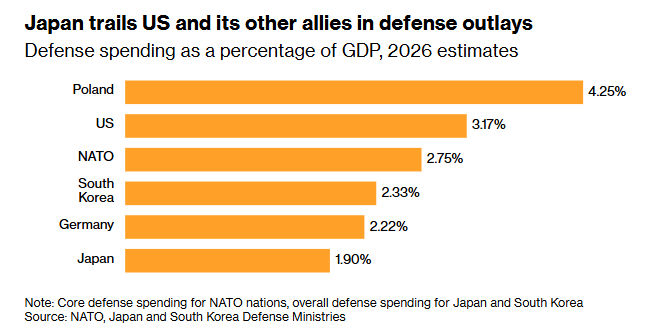
He said that according to the Cabinet Office's forecast of nominal GDP for the current fiscal year, the expenditure will be 1.5%. According to this forecast, 3.5% of the budget will reach 24 trillion yen, which is more than double the current amount.
Since NATO member states promised to reach 3.5% by 2035 in June last year, spending 3.5% of GDP on defense has become the global benchmark for US allies.
As a national security hawk and staunch supporter of the US-Japan alliance, Takaichi Sanae has made it clear that she wants to further strengthen the military.
“Japan needs to proactively pursue the fundamental strengthening of its defense capabilities,” she said in the Diet this year.
But she also has ambitious financial plans. This year, Takaichi Sanae announced a growth plan with the goal of achieving a combined public and private investment of more than 370 trillion yen by 2040. The plan may put pressure on the national treasury. Meanwhile, a sharp increase in defense spending could test investors' confidence in Japan's ability to control debt.
Japan made major investments in long-range strike capabilities, such as land-based and sea-based Tomahawk missiles, after removing the unwritten ceiling on defense spending in 2022. In the budget application for the fiscal year beginning in April next year, Japan's Ministry of Defense applied for a record 8.9 trillion yen, an increase of 0.9% over the previous year.
However, many of the items in the budget application have yet to give estimated costs, which means that the final budget is likely to be much higher. The weak yen has also weakened Japan's purchasing power to buy weapons from overseas.
Even if Japan promises 3.5%, it will still lag behind NATO countries. For NATO, this target targets so-called “core” defense spending, such as arms and military salaries. Member states also promised to spend an additional 1.5% of GDP on defense-related spending, such as protecting critical infrastructure.
And Japan calculates core and non-core spending in its defense budget together, which means that even if Japan increases defense spending to 3.5% of GDP, its military spending as a share of GDP will still be lower than that of NATO countries.
Robert Ward, head of Japan affairs at the International Institute for Strategic Studies, said that Japanese policy makers and bureaucracy have laid the foundation for a sharp increase in defense spending. He pointed out that now it is mainly a matter of time when Japan will reach 3.5%.
“Whether it's five or ten years, given the importance of the US-Japan alliance, I don't see any other choice,” Ward said.