
- PRICING
- LIVE QUOTES
- LEARN
- HELP


EN
How DP World Africa Deal Will Impact Hapag Lloyd Stock Investors
- Hapag-Lloyd and DP World recently agreed to extend their cooperation in Africa, securing long term terminal capacity and supporting port infrastructure development that feeds directly into Hapag-Lloyd’s terminal strategy.
- The focus on African terminal access gives Hapag-Lloyd more control over where and how its ships load and unload, which can influence schedule reliability, asset utilization, and long term cost efficiency across key trade lanes.
- This article examines how Hapag-Lloyd's investment narrative is shaped by this African terminal capacity deal with DP World.
Scan supply chain focused plays that could benefit from tighter control of ports and infrastructure with our curated list of 38 power grid technology and infrastructure stocks
Hapag-Lloyd Investment Narrative Recap
To own Hapag-Lloyd, you need to be comfortable with a shipping business that is managing moderating demand, normalizing freight rates and structurally higher costs, while leaning on network efficiency, terminal access and digital tools to support earnings. The near term swing factor still looks tied to how quickly margins stabilize from today’s 0.3% level after a year of much higher profitability.
The DP World Africa deal and the leadership reshuffle around operations and terminals do not immediately change that core earnings risk. They sit more in the “execution quality” bucket. The biggest near term threat remains weaker pricing and cost inflation. The main potential upside is management delivering on efficiency and volume resilience despite softer trade growth.
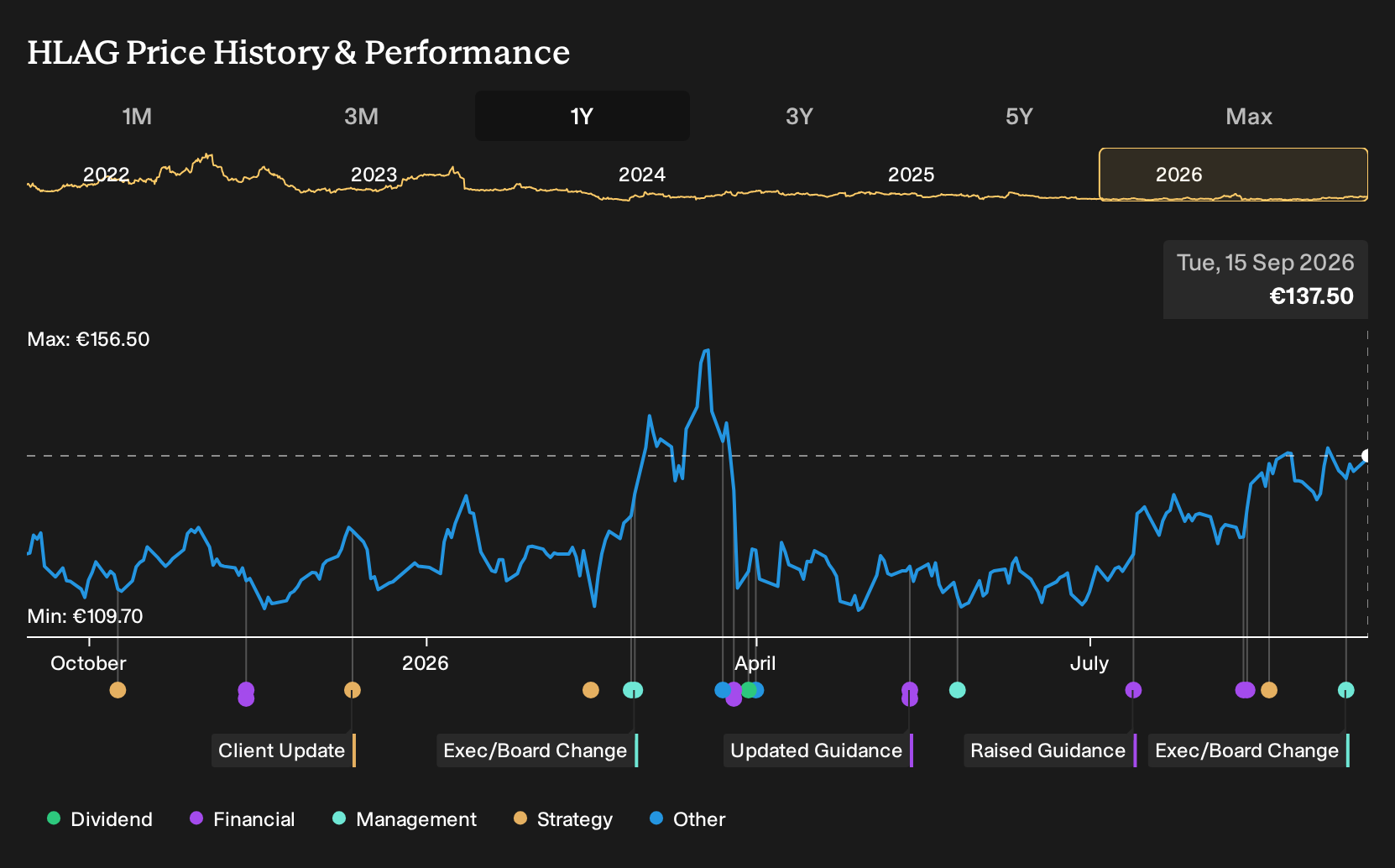
The most relevant fresh development for this story is the decision to appoint Anders Boenaes as COO from October 2026 and to extend Dheeraj Bhatia’s CTIO contract to 2029. Both roles sit in areas where the pressure is highest for Hapag-Lloyd, namely the liner network plus the ports and terminals that underpin schedule reliability and unit costs.
Boenaes brings long experience running Africa trades and global networks, while Bhatia is already leading Hanseatic Global Terminals, which bundles terminal and infrastructure holdings. For you as an investor, execution from this duo will be central to whether terminal deals, fleet investments and the $1b savings program offset softer freight rates and higher environmental and fuel costs.
Hapag-Lloyd's current analyst story centers on revenue rising by 4.0% a year, with earnings today at €58.0 million and consensus forecasts pointing to €332.1 million of profit on €20.4 billion of revenue by 2029. This implies roughly a 6x increase in earnings from today.
Uncover how Hapag-Lloyd's fair value indicates a 26% potential downside to its current price, suggesting that the current premium may not be sustainable.
Exploring Other Perspectives
One alternate view puts much more weight on the risk that global trade shrinks as supply chains move closer to end customers. Those more pessimistic analysts were already working with revenue of €15.3b and earnings of €219.4m by 2028, well below consensus, so this Africa focused Hapag-Lloyd and DP World deal could eventually prompt them to revisit that story.
Explore 3 other Hapag-Lloyd fair value estimates, including one that suggests as much as 53% downside from the current price!
Reach Your Own Conclusion
Disagree with existing narratives? Extraordinary investment returns rarely come from following the herd, so go with your instincts.
- A great starting point for your Hapag-Lloyd research is our analysis highlighting 1 key reward and 3 important warning signs that could impact your investment decision.
- See our latest analysis for Hapag-Lloyd. The report includes a comprehensive fundamental analysis summarized in a single visual, the Snowflake, making it easy to evaluate Hapag-Lloyd's overall financial health at a glance.
Looking for more Hapag-Lloyd style investment ideas?
If the Hapag-Lloyd story has you thinking about portfolio construction, it can help to line it up against other businesses with different risk and balance sheet profiles. The Simply Wall St Screener lets you scan for opportunities that match your own comfort level on volatility, income and financial strength.
- For investors who want potential upside without stretching on quality, consider scanning a curated group of 623 high quality undiscovered gems that already post solid fundamentals but still fly under the radar.
- If capital preservation sits high on your priority list, filter for 102 resilient stocks with low risk scores that score well on volatility and financial resilience, so you are not relying on luck to manage downside.
- For those who care most about robust finances backing every earnings story, use the screener to focus on a list of solid balance sheet and fundamentals (196 results) and compare them side by side with Hapag-Lloyd.
This article by Simply Wall St is general in nature. We provide commentary based on historical data and analyst forecasts only using an unbiased methodology and our articles are not intended to be financial advice. It does not constitute a recommendation to buy or sell any stock, and does not take account of your objectives, or your financial situation. We aim to bring you long-term focused analysis driven by fundamental data. Note that our analysis may not factor in the latest price-sensitive company announcements or qualitative material. Simply Wall St has no position in any stocks mentioned.
Have feedback on this article? Concerned about the content? Get in touch with us directly. Alternatively, email editorial-team@simplywallst.com