
- PRICING
- LIVE QUOTES
- LEARN
- HELP


EN
Trump’s Surgeon General Pick Loves These 3 Tobacco Stocks
President Trump has nominated Nicole Saphier as Surgeon General, and she has revealed her investment portfolio, which includes tobacco stocks Philip Morris International (PM), Altria Group (MO), and British American Tobacco (BTI). If confirmed in the hearing scheduled for Sept. 16, Saphier would divest these holdings no later than 90 days after her confirmation, as part of an ethics agreement. This clearly avoids conflicts of interest with the role’s public health mandate.
Meanwhile, the tobacco market is transforming, with smoke-free products gaining prominence. Bank of America’s four‑week scanner data through May 30 showed that most U.S. tobacco categories continued to lose volume, while oral nicotine products remained the sector’s strongest growth area.
We look at the three tobacco stocks in Saphier’s portfolio up close now.
Tobacco Stock #1: Philip Morris International Inc. (PM)
Philip Morris International is a leading global consumer-goods company focused on tobacco and next-generation smoke-free products. Headquartered in Stamford, Connecticut, Philip Morris sells cigarettes, heated tobacco, nicotine pouches, and e-vapor products in several markets worldwide. The company has a market capitalization of $297.79 billion.
Over the past 52 weeks, Philip Morris’ stock has gained 20%, while it has been up 21% year-to-date (YTD). Investors have essentially rewarded the company’s shift to smoke‑free products and stronger‑than‑expected earnings. It reached a 52-week high of $207.76 on July 28 but is down 7% from that level.
In June, the U.S. Food and Drug Administration (FDA) granted Modified Risk Tobacco Product orders for 20 Zyn nicotine‑pouch variants, allowing Philip Morris to market those specific products with an FDA‑authorized claim that using Zyn instead of cigarettes lowers the risk of various smoking‑related diseases. This differentiates Zyn from other oral‑nicotine brands, strengthening Philip Morris’ positioning in the fast‑growing U.S. pouch market.
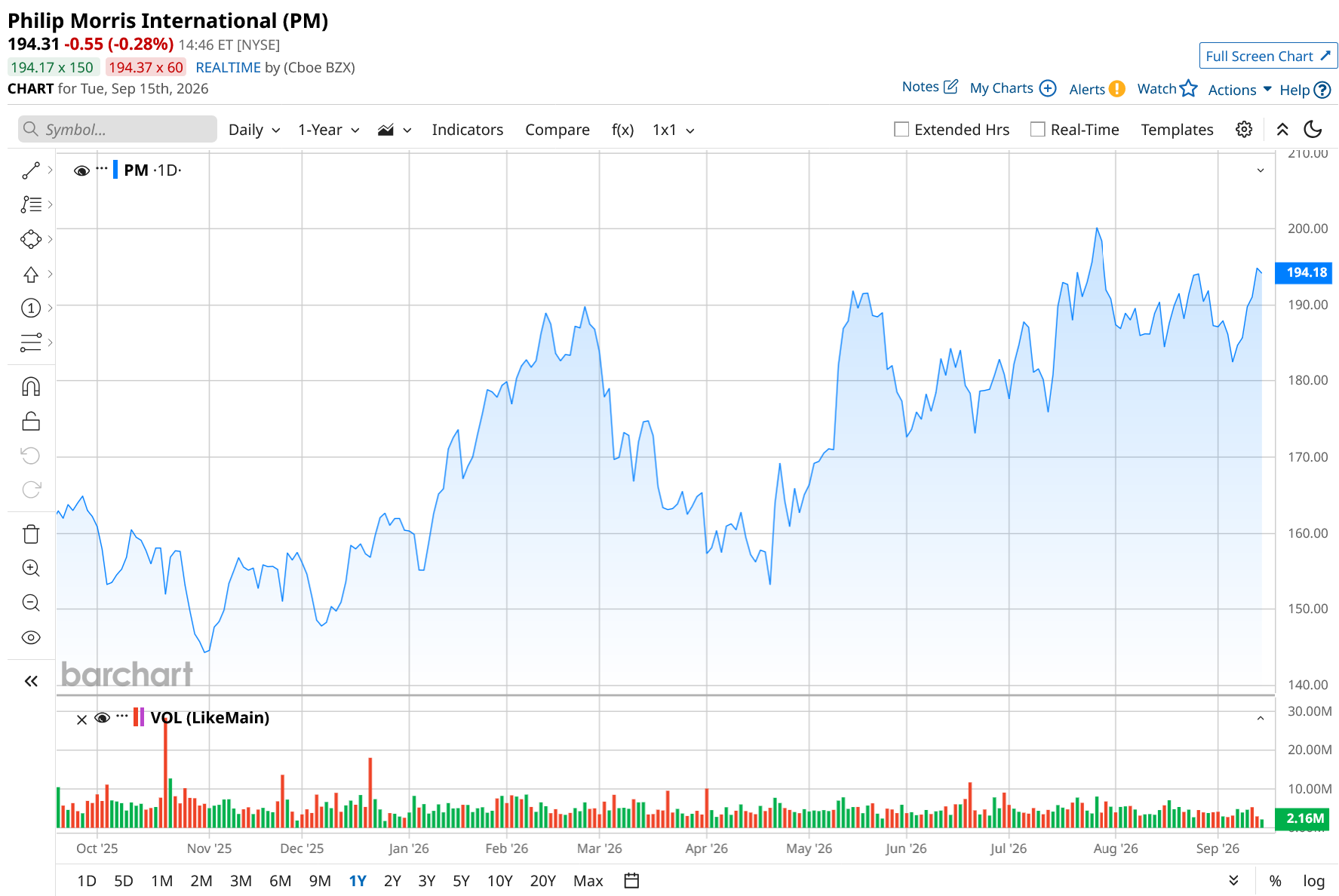
Philip Morris’ growth is being driven by the momentum in its smoke-free business. In the second quarter, shipments rose 2.5%, driven by a 7.5% increase in smoke-free products, mainly from its IQOS heated tobacco electronic product. The company’s total revenue increased by 10.4%, or 7.6% organically, to $11.20 billion. Moreover, its smoke-free business accounted for about 42% of total net revenues during the quarter, showing that its business has diversified significantly. Wall Street analysts expect PM’s EPS to grow 12.5% year-over-year (YoY) to $8.48 in the current year, followed by an 8.4% climb to $9.19 in the next year.
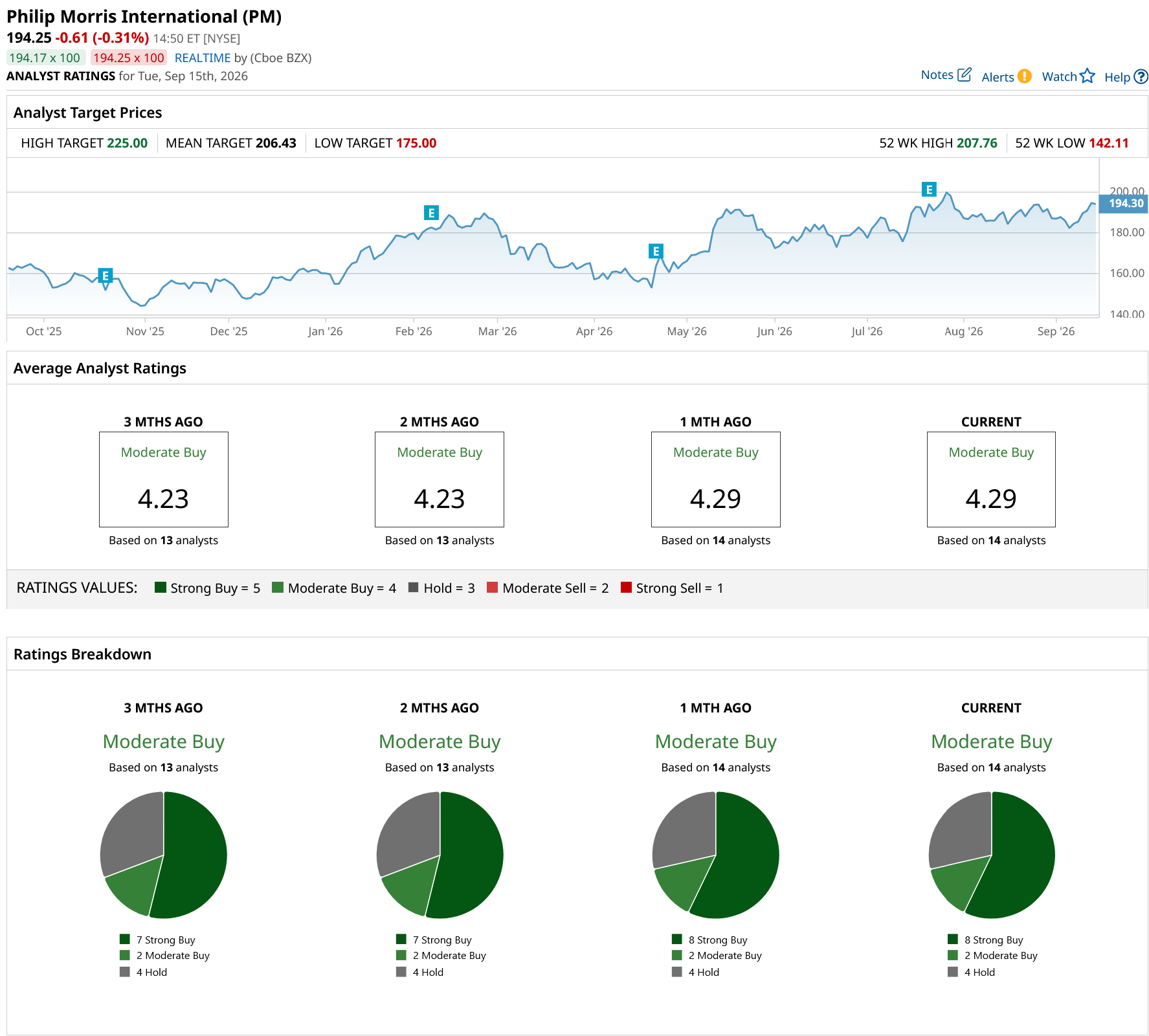
Philip Morris is still coveting Wall Street attention, with analysts awarding it a consensus “Moderate Buy” rating. Of the 14 analysts rating PM stock, eight have given it a “Strong Buy,” two a “Moderate Buy,” and four a “Hold.” The consensus price target of $206.43 represents a 6% upside from current levels. Moreover, the Street-high price target of $225 indicates a 16% upside.
Tobacco Stock #2: Altria Group (MO)
Altria Group, with a market capitalization of $115.18 billion, is a U.S.-focused tobacco and nicotine company that manufactures and markets cigarettes, smokeless tobacco, and oral nicotine pouches. Headquartered in Richmond, Virginia, Altria operates almost entirely within the U.S. through subsidiaries that produce brands such as Marlboro, Copenhagen, Skoal, and on! for national distribution.
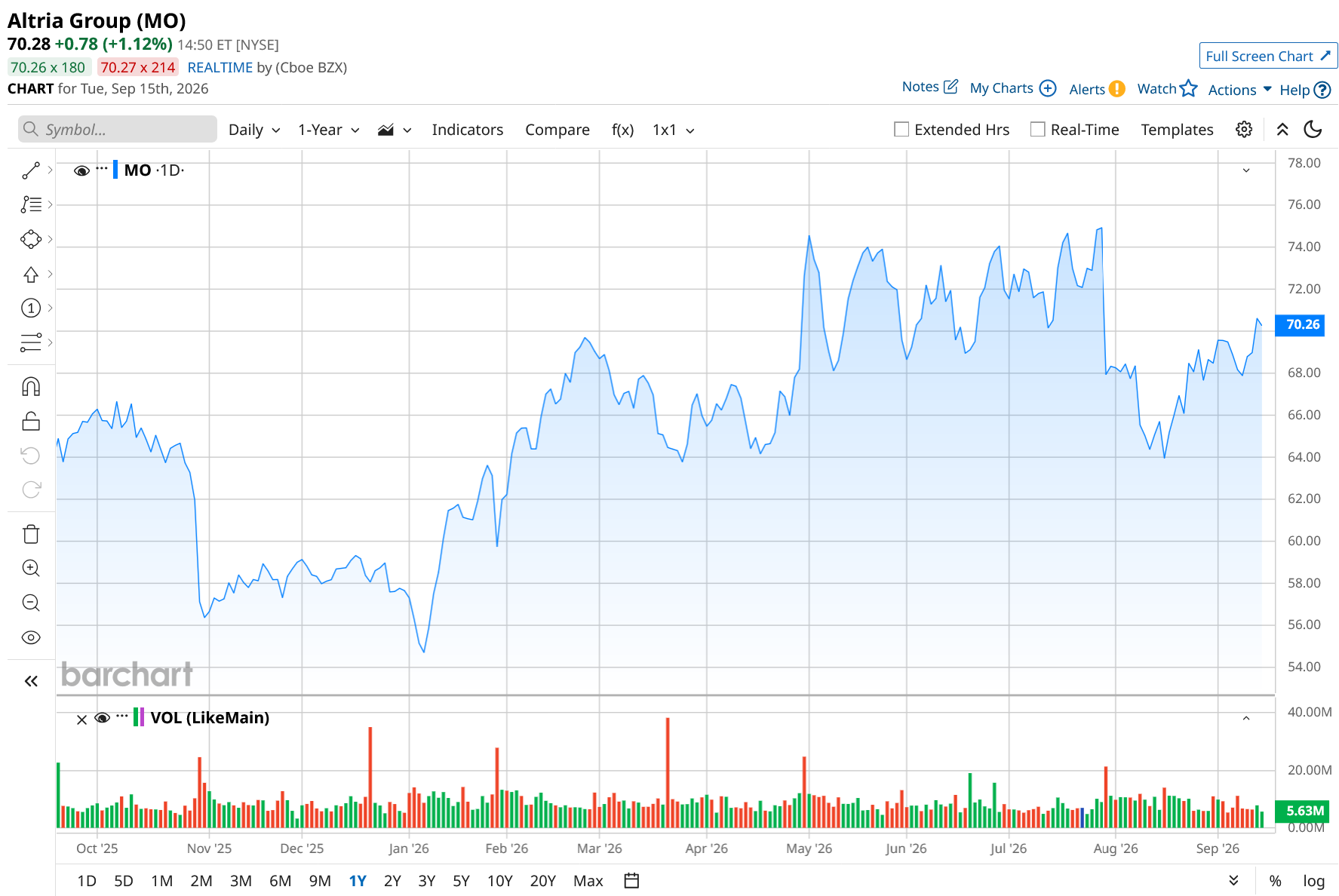
Over the past 52 weeks, Altria’s stock is up about 8%. This year, MO stock has gained 22%, as investors reward its resilient fundamentals and signs that pricing and smokeless growth can offset falling cigarette volumes. It reached a 52-week high of $77.06 on July 28 but is down 9% from that level.
On a forward-adjusted basis, Altria’s price-to-earnings (non-GAAP) ratio of 12.15x is lower than the industry average of 14.91x.
Advancing its smoke-free portfolio has also been a priority for Altria. The company’s Helix brand expanded on! PLUS to 120,000 stores in the nation. For the second quarter, Altria reported a marginal increase in its net revenues to $6.11 billion, while its adjusted EPS increased by 2.8% YoY to $1.48. For the current year, Street analysts expect a 4.6% increase in EPS to $5.67, followed by a 3% increase to $5.84 next year.
Last month, Altria entered an agreement with Philip Morris to grow cigarette imports and exports and take advantage of a tax rebate known as the “double duty drawback.” Altria expects “economic benefits” from this contract manufacturing agreement.
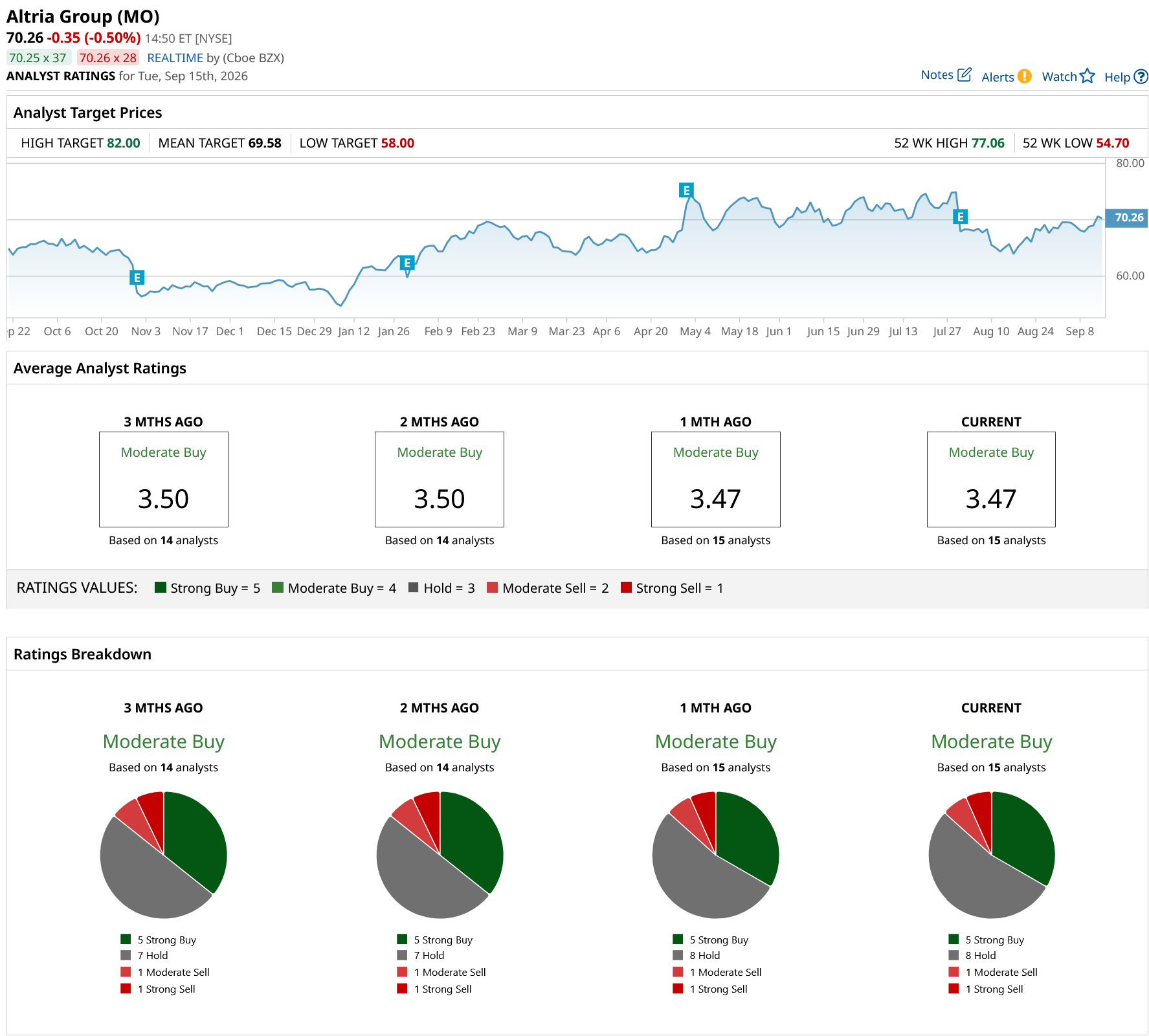
Wall Street analysts are taking a positive stance on Altria’s stock now, with a consensus “Moderate Buy” rating overall. Of the 15 analysts rating MO stock, five gave a “Strong Buy,” eight are playing it safe with a “Hold,” one suggested “Moderate Sell,” and one gave a “Strong Sell” rating. The consensus price target of $69.58 is roughly flat compared to current levels. However, the Street-high price target of $82 indicates an 17% upside from current levels.
Tobacco Stock #3: British American Tobacco (BTI)
British American Tobacco (abbreviated as BAT) is a global consumer‑goods company that manufactures and sells cigarettes, heated tobacco, and oral nicotine products in several markets. Headquartered in London, U.K., BAT operates through a portfolio of international and local brands, supported by large‑scale manufacturing, distribution networks, and a growing non‑combustible nicotine business. The company has a market capitalization of $118.95 billion.
British American Tobacco’s shares have also been doing poorly over the past year as investors price in faster‑than‑expected declines in global cigarette volumes and heightened litigation and geopolitical risks. Over the past 52 weeks, the stock is up just 1%, while it is flat YTD. It reached a 52-week high of $67.30 on May 14 but is down 16% from that level.
BAT stock is also under pressure from a restructuring, with the company announcing it will cut 9,000 jobs. The company will have slashed 5,500 jobs and outsourced a further 3,500 by the end of this year to cut costs and also simplify its global operations. It would also need to invest in sustainable nicotine alternatives to stay afloat as the world moves towards smokeless options.
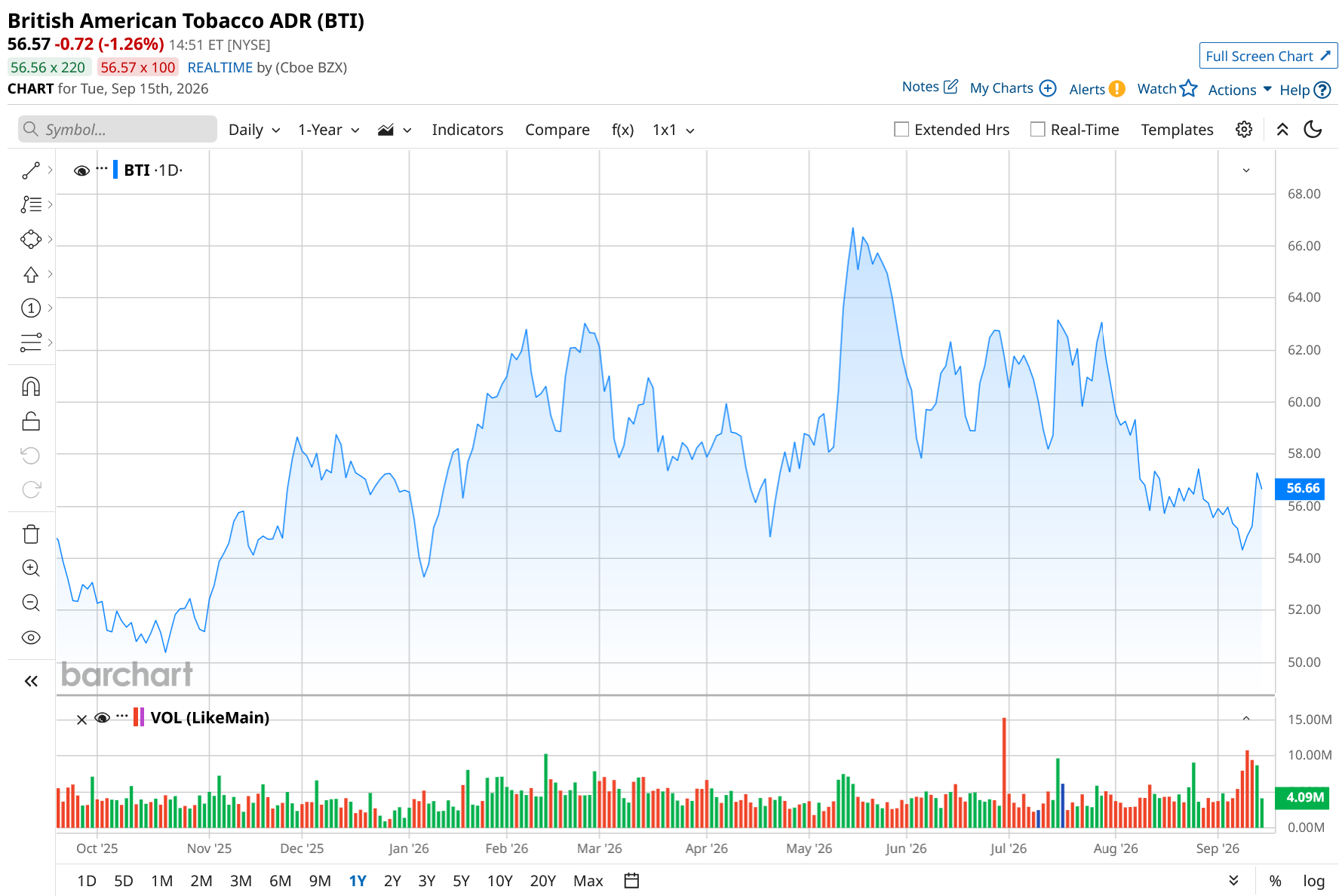
BAT’s stock is trading cheaply right now. Its forward-adjusted price-to-earnings ratio of 11.33x is lower than the industry average of 16.12x.
For the first half of the year, BAT’s cigarette volume share dropped by 30 basis points YoY. Despite that, the company’s revenue increased by 1.4% to £12.24 billion ($16.55 billion), as smokeless product customers increased to 35 million. Smokeless products now make up 19.8% of total revenue. For the current year, Street analysts expect a 4.3% YoY growth in its EPS to $4.84, followed by a 7.6% increase to $5.21.
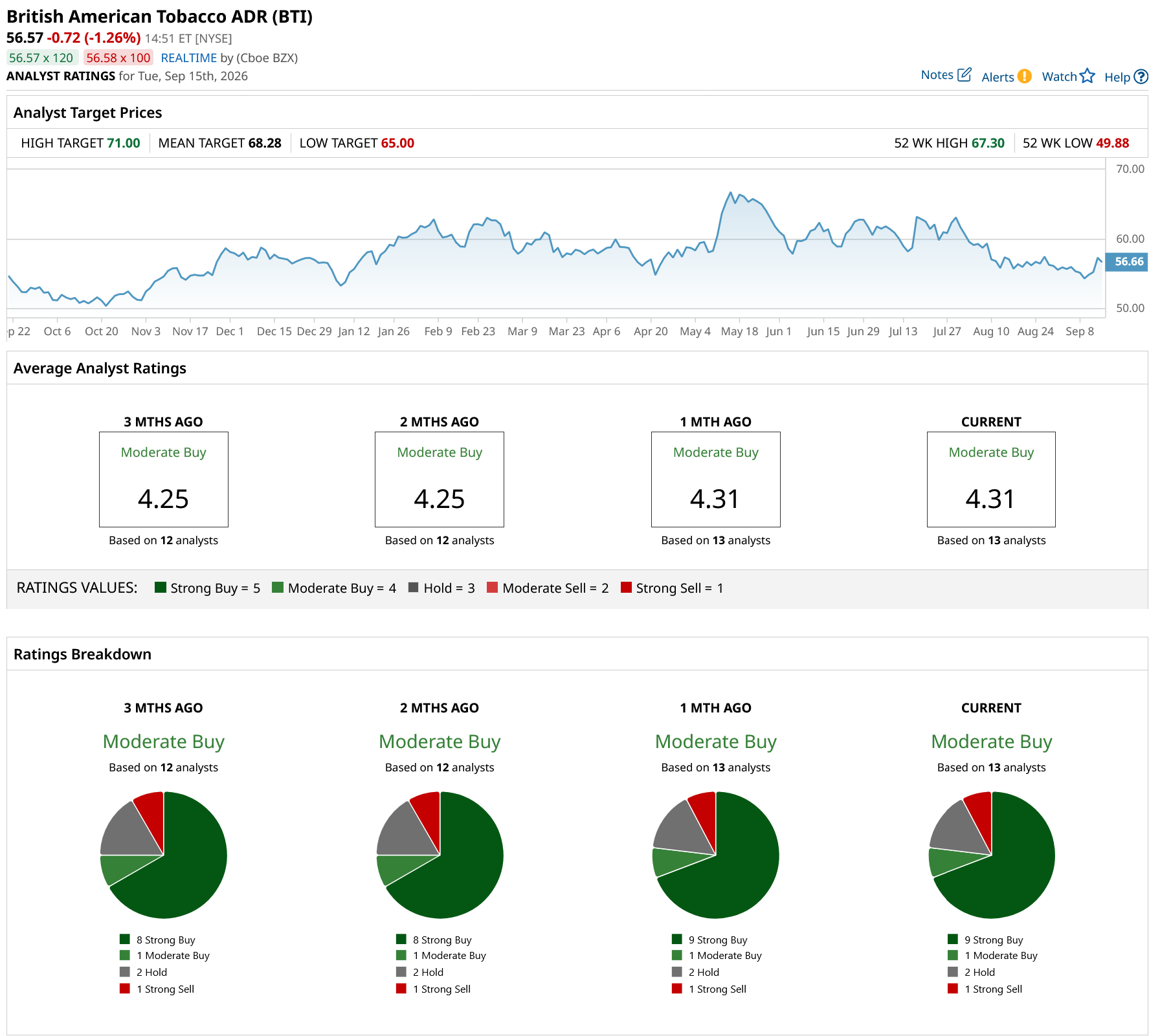
BAT has gained significant Wall Street attention, with analysts awarding it a consensus “Moderate Buy” rating. Of the 13 analysts rating the stock, nine have given it a “Strong Buy,” one a “Moderate Buy,” two a “Hold,” and one a “Strong Sell.” The consensus price target of $68.28 represents a 22% upside from current levels. The Street-high price target of $71 indicates a 27% upside.
On the date of publication, Anushka Dutta did not have (either directly or indirectly) positions in any of the securities mentioned in this article. All information and data in this article is solely for informational purposes. For more information please view the Barchart Disclosure Policy here.