
- PRICING
- LIVE QUOTES
- LEARN
- HELP


EN
SpaceX Bags AI Hosting Deal Worth More Than $1 Billion a Month. What This Means for SPCX Stock.
SpaceX (SPCX), the company led by Elon Musk, is known for its rockets and broadband service Starlink, but the company is now geared towards capturing the AI market. However, despite describing it as a $28 trillion opportunity, SpaceX is still a fringe player, so to make a splash, it is renting out compute to keep its seat at the table.
After inking deals with the likes of Google (GOOG) (GOOGL) and Anthropic, CFO Bret Johnsen revealed that the company has signed an AI hosting deal worth $1.11 billion a month, with annual recurring revenue of $13 billion.
Here For the Long Haul
SpaceX's current deal cadence of renting compute is an evolving one, with an initial period of 90 days extending to another 90 if commitments are fulfilled. With this, it has bagged deals worth $2.17 billion per month from Google and Anthropic. Where the Anthropic deal has a value of about $1.25 billion a month, the one with Google is worth $920 million a month.
The latest deal comes as a welcome addition. It is how SpaceX is looking to gain a foothold in the AI industry, while being careful about not compromising its own compute needs. Yet, this is just short-term. Over the long haul, data centers in orbit are its preferred AI destination.
Notably, SpaceX wants to build a distributed computing network in low Earth orbit, powered by solar energy and connected through laser links. The planned satellites would process AI workloads in space, communicate with one another, and use Starlink to move selected data back to Earth. Nvidia (NVDA) is helping design the first payload, called Starmind AI1, which is expected to use Rubin graphics processors and Vera central processors.
SpaceX argues that this architecture can eventually avoid some of the electricity, land, water, and permitting constraints slowing terrestrial data center construction. However, initial orbital workloads are more likely to involve inference, satellite data processing, defense applications, and jobs that can tolerate some communication delay.
Also, the regulatory strategy is already underway. SpaceX asked the Federal Communications Commission for permission to operate as many as one million computing satellites at altitudes between 500 and 2,000 kilometers. The proposed network would use optical links to communicate among computing satellites and with existing Starlink spacecraft.
One million should be viewed as a regulatory ceiling rather than a committed production target. It gives SpaceX room to expand without repeatedly filing new applications. The FCC notice confirms that the application was accepted for public review in February, but acceptance is not final authorization. Regulators still need to evaluate spectrum use, collision risk, orbital debris, launch volume, and requested waivers from normal deployment obligations. Overall, the company said deployment could begin as early as 2028.
The Next Frontier
In the same conference where CFO Johnsen revealed the AI hosting deal, he also said the first orbital computing satellites are targeted for 2027, followed by much larger deployments in 2028. That suggests 2027 will be a demonstration period rather than the start of commercial scale. The first missions will need to prove that standard AI chips can survive radiation, large solar arrays and radiators can function reliably, and optical links can move data efficiently. They must also show that the economics work after including launch, replacement, and failure costs.
Here, Starship remains the decisive variable. SpaceX needs a reusable vehicle that can carry large satellites, solar arrays, radiators, and replacement hardware at a much lower cost than existing rockets. The company says Starship could reduce the cost of reaching orbit by 99% or more relative to historical averages. That claim has not yet been demonstrated through regular commercial missions, though.
Stable Q2 Results
Amid all this, SpaceX posted a steady set of numbers for Q2, its first as a public company. Revenue of $7.8 billion represented a 92% increase year-over-year, with net losses narrowing to $541 million from $1 billion a year earlier. At the end of the quarter, the company held $93.5 billion in cash and cash equivalents.
Capital expenditures have risen substantially over the past three years, increasing from $4.4 billion in 2023 to $20.7 billion in 2025. Artificial intelligence-related spending has expanded particularly rapidly, starting at $463 million in 2023 as the smallest category among space, connectivity, and artificial intelligence before climbing to $12.7 billion in 2025 and becoming the largest area of investment. This trend illustrates how SpaceX, which initially focused on space operations and connectivity services, is increasingly treating AI as a core foundation for future growth across its businesses. In the second quarter alone, AI capital expenditures totaled $15.8 billion.
Looking at the second quarter 2026 revenue breakdown, connectivity remains the primary contributor at $4.29 billion of the $7.8 billion total. The artificial intelligence segment generated $2.56 billion, a strong result for a relatively new business line, while the space segment contributed $962 million.
From a valuation perspective, SPCX shares continue to appear significantly overvalued. For instance, the P/S and P/CF ratios of 45.87 times and 72.41 times, respectively, stand well above the sector median.
Notably, the stock has recovered since its decline. It is now down just 6.1% since its IPO.
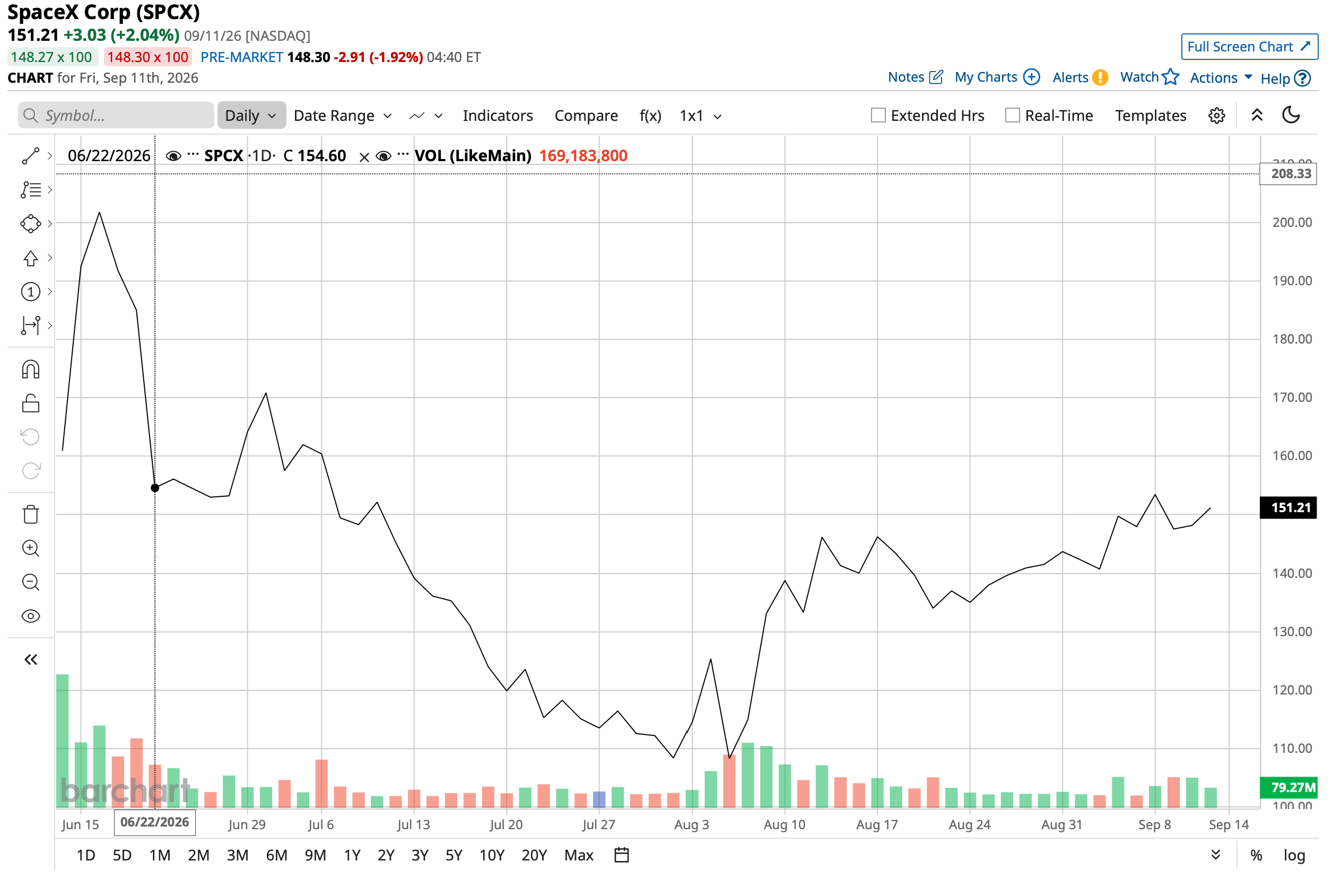
Analyst Opinion On SPCX Stock
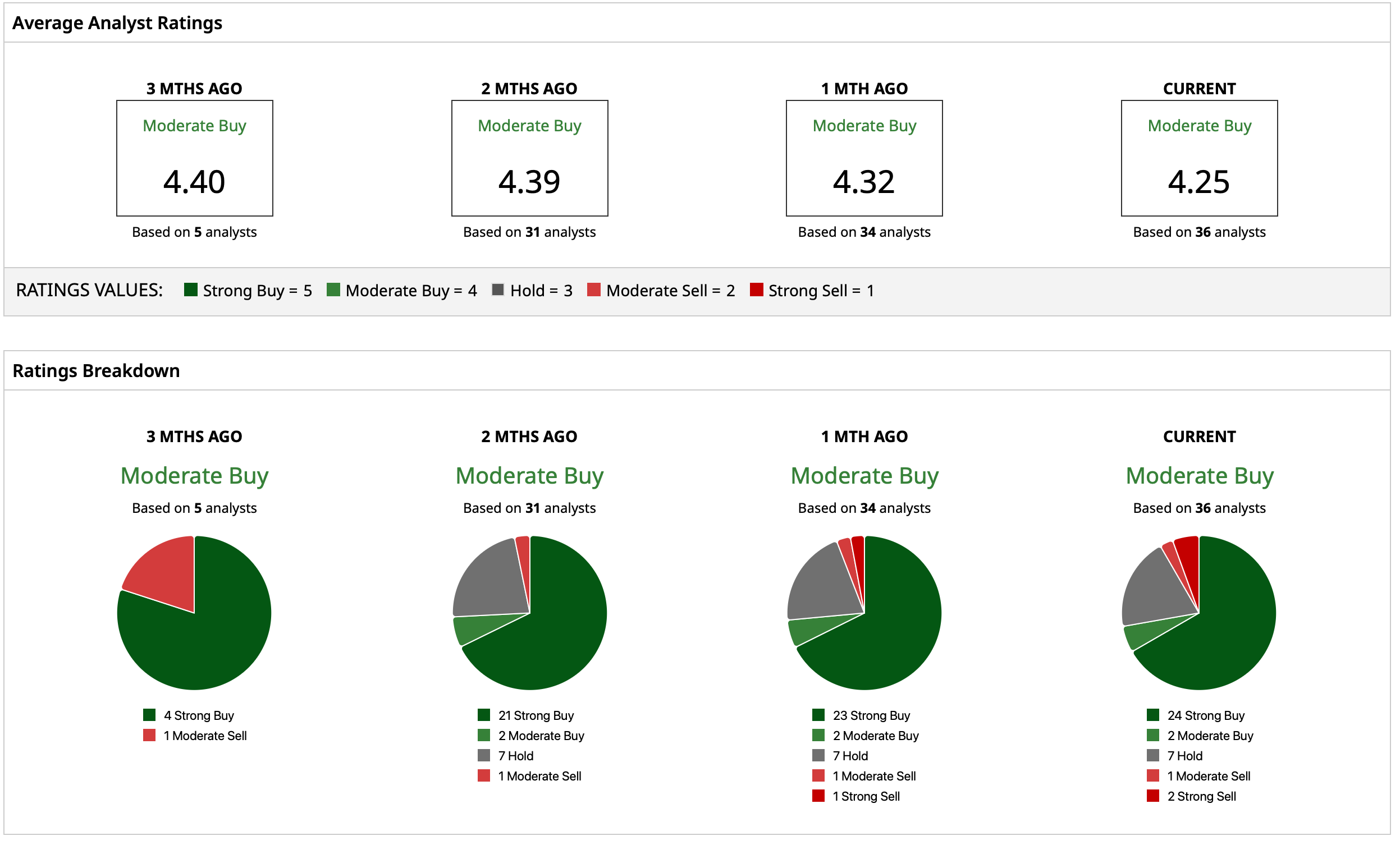
Overall, analysts are cautiously optimistic about SPCX stock and have earmarked a rating of “Moderate Buy.” Out of 36 analysts covering SpaceX stock, 24 have a “Strong Buy” rating, two have a “Moderate Buy” rating, seven have a “Hold” rating, one has a “Moderate Sell” rating, and two have a “Strong Sell” rating. The mean target price of $219.71 indicates potential upside of about 45% from current levels.
On the date of publication, Pathikrit Bose did not have (either directly or indirectly) positions in any of the securities mentioned in this article. All information and data in this article is solely for informational purposes. For more information please view the Barchart Disclosure Policy here.