
- PRICING
- LIVE QUOTES
- LEARN
- HELP


EN
Oracle’s Q1 Results Prove the AI Trade Is Going Nowhere
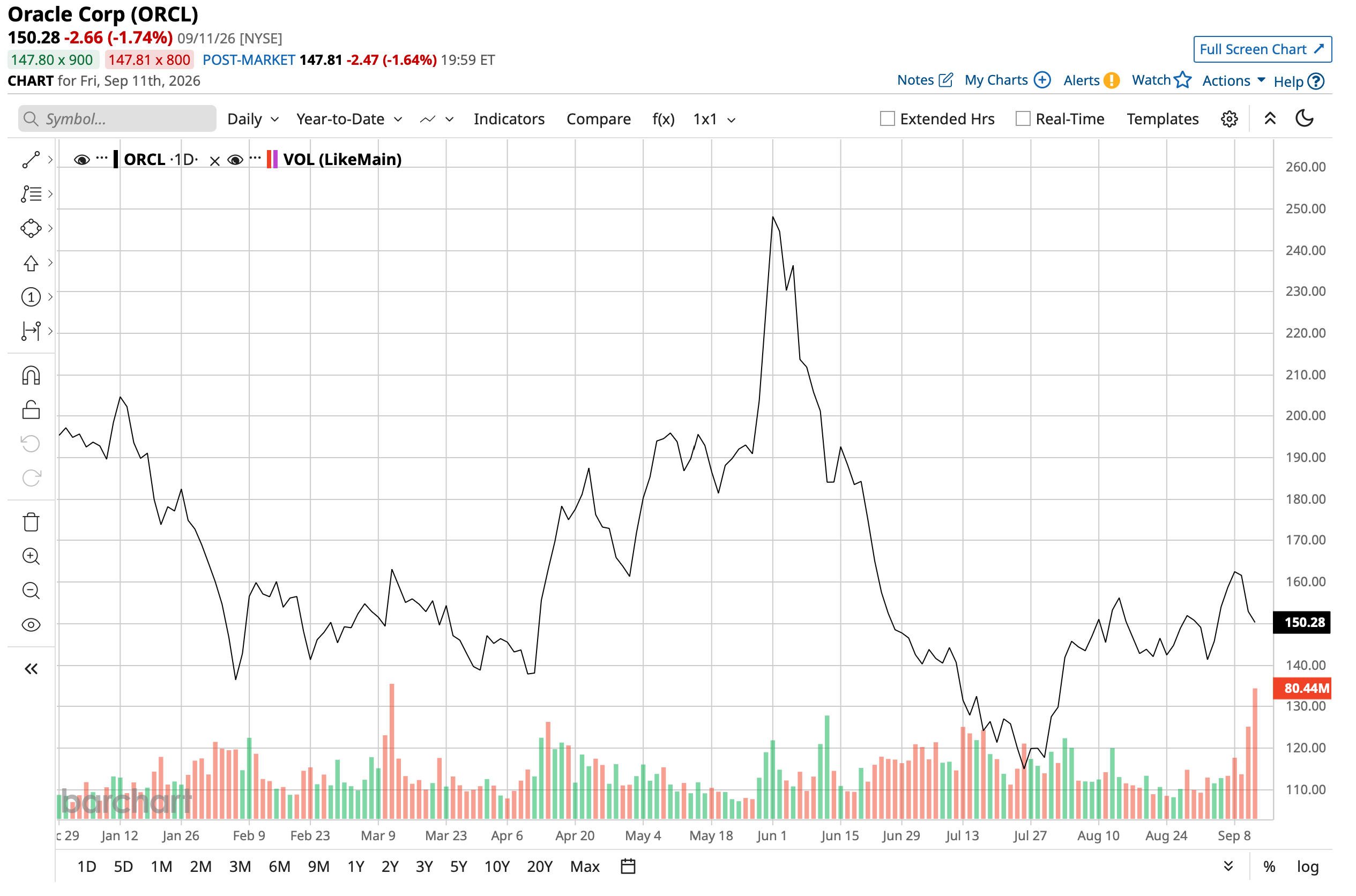
Oracle (ORCL) has not been a favorite among AI enthusiasts this year. The stock is down 22.9% year-to-date, and the Larry Ellison-led company would prefer to bring back the glory days of 2025, when Ellison briefly became the wealthiest individual in the world.
To that end, its latest results for fiscal Q1 FY 2027 could be a turning point.
About Oracle
Founded in 1977, Oracle gained prominence for its prowess in providing database services, became an enterprise-software giant through decades of acquisitions, and is now trying to become a major AI cloud infrastructure provider. Oracle went public in 1986 and has grown its market cap over the past four decades to become a $432.9 billion behemoth.
ORCL stock also offers a dividend yield of 1.31% and has raised its dividends for each of the past 11 years. Moreover, with a payout ratio of just under 29%, the company can opt to raise its dividends if it wants to. Yet, at the present juncture, it would not be a prudent move. In fact, instead of raising dividends, Oracle is increasingly opting for equity offerings to fund its growth, the latest being a $20 billion at-the-market (ATM) equity program in Q1, as its Q1 2027 results demonstrate.
Beat, Raise, and Caution: Q1 Had It All
In Q1, Oracle reported record revenues of $19.34 billion, up 30% from the previous year and exceeding the Street's expectations by $215.9 million. Under this, total cloud revenues (now making up 60% of the company's overall revenues versus 48% a year ago) came in at $11.61 billion, up 62% year-over-year.
Oracle Cloud Infrastructure, or OCI — the focus area of the company right now — saw its revenues more than double to $7.4 billion. Here, the momentum only strengthened after the company revealed it delivered 850 MW of additional data center capacity, while tripling the number of GPUs delivered in Q4 FY 2026 to 300,000.
Remaining performance obligations (RPO) — a key indicator of future demand — continued to rise, increasing by 31.5% on a YoY basis to $664 billion. This was the ninth consecutive quarter of RPO increases reported by the company, of which it expects half to be converted to revenue within the next three years.
Earnings climbed by 30% in the same period to $1.92 per share, coming in ahead of the consensus estimate of $1.74 per share. Notably, this was the fourth straight quarter of earnings beats; despite gross margins declining to 60% from 67% a year earlier due to the expansion in data center infrastructure, operating margins remained steady at 42%. Capital expenditures ramped up to $28.5 billion from $8.5 billion in the year-ago period as data center buildouts in Texas (Shackelford County), New Mexico (Project Jupiter), Wisconsin (Port Washington), and Michigan (The Barn) continue at full throttle.
Net cash from operating activities remained robust at $23.1 billion, an increase of 185.2% YoY. Yet, free cash flow remained negative at $5.4 billion, widening sequentially from $1.9 billion. Overall, Oracle ended Q1 with a cash balance of $36.4 billion, much higher than its short-term debt levels of $7.6 billion. However, total debt exceeded $156 billion as interest expense climbed 55% from the previous year to $1.4 billion.
Meanwhile, Oracle raised its EPS guidance for the full year to $8.10 from the $8.05 guided earlier in Q4 FY 2026. Guidance for total revenues at $90 billion remained unchanged.
For Q2 FY 2027, the company expects revenues to grow by 30%-34% YoY, while EPS is expected to be between $1.85 and $1.93, the midpoint of which is in line with the consensus estimate of $1.89.
Finally, Oracle's weak stock performance this year has brought its valuation down to undervalued levels. Its forward P/E and P/CF of 18.46 and 7.71, respectively, are both lower than the sector medians of 22.46 and 19.75, respectively. On the other hand, the forward P/S of 5.02 is just above the sector median of 3.37.
Thus, the Q1 print did give us signs that the ground is fertile for a comeback for ORCL stock. Yet, the risks of rising debt and negative free cash flow can pose serious concerns for the company if there are any signs of a demand slowdown for AI infrastructure.
Analyst Opinion
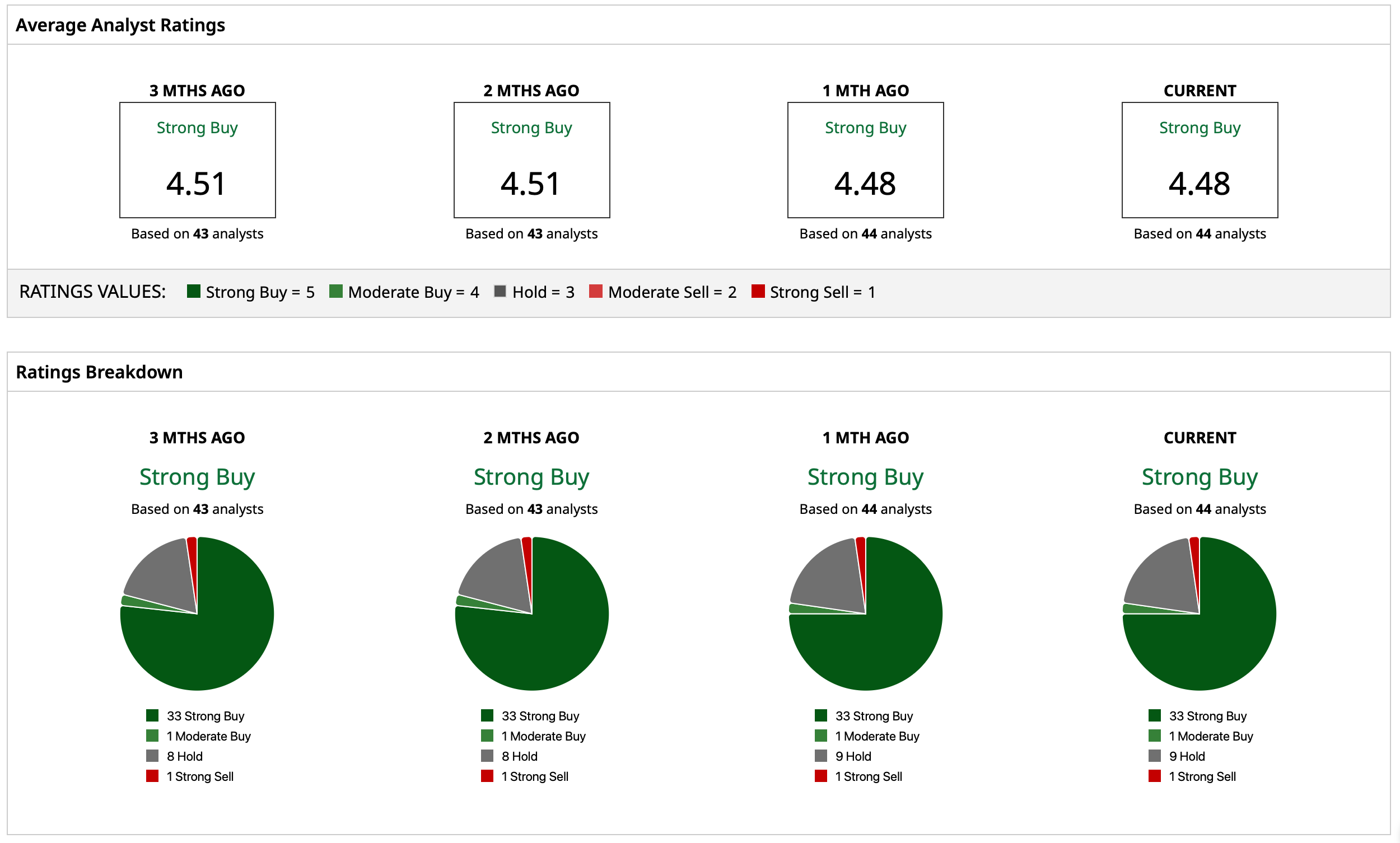
Considering this, analysts deem ORCL a “Strong Buy.” The mean target price of $247.19 denotes potential upside of 64.5% from current levels. Out of 44 analysts covering the stock, 33 have a “Strong Buy” rating, one has a “Moderate Buy” rating, nine have a “Hold” rating, and one has a “Strong Sell” rating.
On the date of publication, Pathikrit Bose did not have (either directly or indirectly) positions in any of the securities mentioned in this article. All information and data in this article is solely for informational purposes. For more information please view the Barchart Disclosure Policy here.