
- PRICING
- LIVE QUOTES
- LEARN
- HELP


EN
3 Logistics Stocks Riding The AI Trade Boom
Global trade is quietly being rewired by AI, and the companies that move, track, and clear goods across borders are on the front line of that shift. As AI-related products account for a growing share of world commerce, the firms that keep those flows running could see their role become more important. This article explores three large-cap stocks exposed to this AI trade story and explains why they may deserve a closer look now.
The three examples below are only a starting sample, since the full screen on Simply Wall St surfaced 55 more large-cap trade and logistics platforms with equally compelling AI-linked narratives that are not covered here.
If you want to move beyond the short list and identify, compare, and analyze those extra opportunities in a structured way, head straight into the Global AI-Enabled Trade & Logistics Platforms screener.
J&T Global Express (SEHK:1519)
J&T Global Express sits squarely in the AI-enabled trade and logistics story, using tech-heavy express networks across China and faster-growing emerging markets to keep e-commerce parcels moving as cross-border volumes rise.
J&T Global Express runs integrated express delivery and cross-border logistics, with its reported Transportation, Air Freight segment generating about US$14.3b in revenue, and the stock valued at roughly HK$89.8b by market cap.
"The rapid expansion of e-commerce, especially in Southeast Asia and emerging markets like Latin America, continues to drive strong parcel volume growth for J&T (e.g., 58% volume growth in Southeast Asia and 22% in new markets in H1 2025), supporting both top-line revenue growth and reinforcing a long-term structural demand tailwind."
The real swing factor is how one quiet cost pressure shapes future delivery economics across those AI-enabled corridors investors are watching closely.
That quiet cost pressure is exactly what the full narrative for J&T Global Express unpacks, separating near term margin strain from longer term upside in J&T Global Express' AI freight corridors.

Landstar System (LSTR)
Landstar System plugs into the Global AI‑Enabled Trade & Logistics Platforms story as an asset‑light freight orchestrator. The company uses software and data to stitch together truck, rail, air and ocean capacity across borders and turn fragmented carrier supply into a coordinated service for shippers.
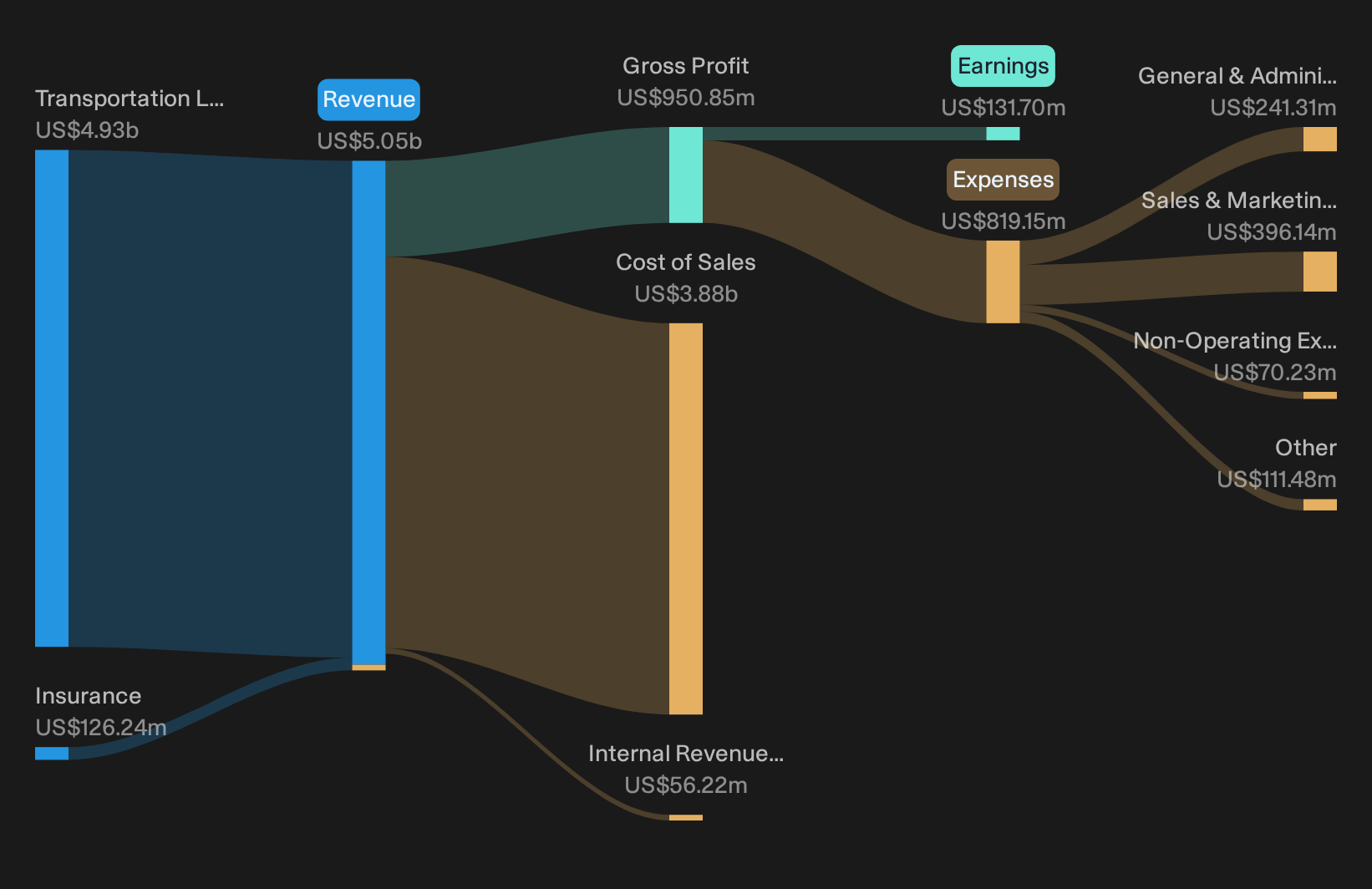
Landstar System generates about US$4.9b from Transportation Logistics and around US$126 million from Insurance, with a small internal revenue offset, and the stock is valued at roughly US$5.9b by market cap.
For investors tracking how AI starts to reshape real world freight flows, Landstar System offers a useful example of software meeting steel wheels and truck fleets in a highly networked setting.
"The company's scalable, asset-light business model, expanding through a focus on independent agents and capacity providers, allows Landstar to flex capacity rapidly without heavy fixed costs, supporting margin stability and robust free cash flow across market cycles."
What really matters from here is how one largely invisible shift in how loads are priced and routed shows up in future margins and earnings resilience.
That quiet shift in pricing and routing is exactly what the full narrative for Landstar System unpacks, showing where Landstar System’s asset light model could be quietly decoupling earnings from freight cycles.
Megaport (ASX:MP1)
Megaport plugs directly into the Global AI-Enabled Trade & Logistics Platforms theme by providing the data interconnection layer that lets AI-heavy supply chain, cloud, and trade platforms move information across borders as quickly as freight moves through ports and warehouses.
Megaport runs a global software defined network that lets enterprises connect data centers and clouds on demand, with about A$198 million from the Americas, A$70 million from Asia Pacific, and A$44 million from Europe, and the stock valued around A$3.9b by market cap.
"Skyrocketing enterprise bandwidth, surging AI/cloud adoption, and the rapid proliferation of data centers are combining to create secular tailwinds. Megaport's automation, global reach, and software-defined architecture are described as giving it strong potential to be a connectivity backbone for AI factories, data-native SaaS, and hybrid enterprise networks."
What investors really need to watch now is how one unresolved pressure around funding this build out shapes the balance between expansion and future margins.
That funding question is exactly where the full narrative for Megaport shows how Megaport's expansion plans, AI demand, and capital intensity could either compress or accelerate future shareholder returns.

Curious About The Next Alternatives
Fresh ideas move first, then everyone else chases the breakout. Scan these under the radar for now opportunities before the momentum gets fully caught by the crowd and review them carefully.
- Review cash generative AI platforms before they become widely noticed by checking the curated list of 75 profitable AI stocks that aren't just burning cash built to spotlight real businesses, not hype plays.
- Identify potential yield workhorses while prices are still dropping or stalled by checking the focused group of 161 dividend fortresses that prioritise stability alongside income potential.
- Explore the infrastructure buildout early by scanning the pre filtered universe of 38 power grid technology and infrastructure stocks that focuses on transmission upgrades, grid tech, and essential electrification projects.
This article by Simply Wall St is general in nature. We provide commentary based on historical data and analyst forecasts only using an unbiased methodology and our articles are not intended to be financial advice. It does not constitute a recommendation to buy or sell any stock, and does not take account of your objectives, or your financial situation. We aim to bring you long-term focused analysis driven by fundamental data. Note that our analysis may not factor in the latest price-sensitive company announcements or qualitative material. Simply Wall St has no position in any stocks mentioned.
Have feedback on this article? Concerned about the content? Get in touch with us directly. Alternatively, email editorial-team@simplywallst.com