
- PRICING
- LIVE QUOTES
- LEARN
- HELP


EN
Tyler Stock In Focus As Nebraska Expands AI Assistant Statewide
- Tyler Technologies reported that Nebraska has moved from a pilot at the state’s DMV to a statewide rollout of Tyler’s Resident AI Assistant, while also expanding use of its Document Automation platform to modernize motor carrier operations and compliance.
- The Nebraska deployment shows Tyler Technologies’ AI assistant handling high resident volumes in over 50 languages and feeding usage insights back to agencies. This highlights real-world demand for automation that can reduce call load and support staff capacity constraints.
- We will examine how Tyler Technologies’ investment narrative aligns with Nebraska’s statewide AI assistant rollout and what this may indicate for long-term demand.
Scan how Tyler Technologies’ statewide AI rollout compares to other automation driven opportunities by reviewing our hand picked 60 AI infrastructure stocks shaping digital public services and high volume workflows.
Tyler Technologies Investment Narrative Recap
To own Tyler Technologies, you need to believe public agencies will keep prioritizing digital self service, cloud delivery, and AI tools that compress labor strain. The Nebraska Resident AI Assistant rollout fits that thesis by showing one state using Tyler software to handle high inquiry volumes, multilingual support, and off hours usage, though on its own it does not change the overall story.
The nearer term swing factor still sits with execution on larger SaaS implementations and cloud flips, where timing and complexity can make bookings lumpy and margins choppy. Reliance on government budgets remains the main risk, since a prolonged pullback in state or local tech spending could slow new deals even if Nebraska’s deployment performs well.
The Nebraska news fits squarely within Tyler Technologies’ broader push into AI powered automation, already flagged by analysts as a key operational catalyst. Resident AI Assistant and Document Automation both speak to agencies looking to manage heavier workloads without adding headcount, which ties directly to Tyler’s aim to grow recurring software and transaction based revenue.
Evidence from the pilot, including a 59% engagement rate, call volume reductions of up to 20%, and more than 3,400 referrals to online services, provides concrete proof points that state clients are using these tools at scale. For investors tracking execution risk, the question is less about product vision and more about how consistently Tyler can replicate this kind of deployment across other large jurisdictions while keeping support and implementation costs in check.
Tyler Technologies' narrative projects US$3.2b revenue and US$565.1m earnings by 2029. This assumes 9.8% yearly revenue growth and requires roughly a US$240.5m earnings increase from US$324.6m today.
Uncover why Tyler Technologies' fair value indicates a 21% potential upside to its current price, which could narrow quickly.
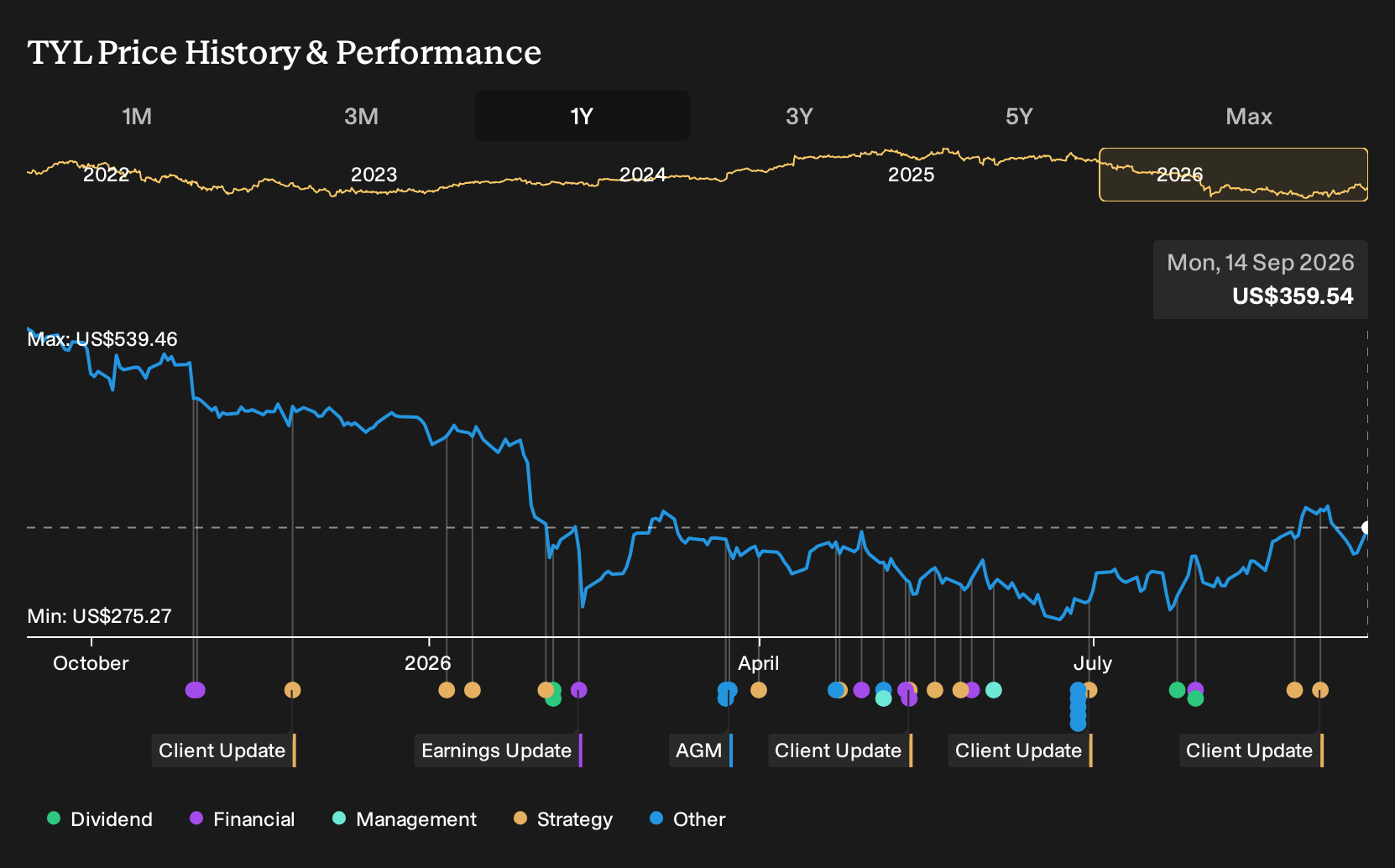
Exploring Other Perspectives
One alternate, more optimistic angle on Tyler Technologies leans heavily on AI as a revenue catalyst. Before this Nebraska news, the most bullish analysts were already penciling in US$3.3b of revenue and US$548.6m in earnings by 2029. Opinions range from cautious to very upbeat, so it helps to compare several viewpoints yourself.
Explore 6 other Tyler Technologies fair value estimates, including one that suggests potential 50% upside from the current price.
Decide For Yourself
Disagree with existing narratives? Extraordinary investment returns rarely come from following the herd, so trust your own analysis and judgment.
- A great starting point for your Tyler Technologies research is our analysis highlighting 3 key rewards that could impact your investment decision.
- See our latest analysis for Tyler Technologies. The report includes a comprehensive fundamental analysis summarized in a single visual, the Snowflake, making it easy to evaluate Tyler Technologies' overall financial health at a glance.
Looking For More Investment Ideas Beyond Tyler Technologies?
If Tyler Technologies has sharpened your thinking about software, automation, and recurring revenue, it can be useful to compare it with other stocks that share some of those quality markers. A focused screener helps you quickly zero in on different profiles rather than scrolling endlessly through tickers.
- If you want potential mispricings with solid underpinnings, start with a curated group of stronger balance sheets and cash flows by reviewing the 35 high quality undervalued stocks that might warrant a closer look.
- If capital preservation and steadier business profiles matter most to you, scan through a set of stocks screened for resilience and financial robustness via the 11 resilient stocks with low risk scores that could suit a more cautious approach.
- If you are hunting for quality that has not yet attracted broad attention, work through a focused pool of underfollowed companies with healthy fundamentals using the 15 high quality undiscovered gems that may have flown under the radar.
This article by Simply Wall St is general in nature. We provide commentary based on historical data and analyst forecasts only using an unbiased methodology and our articles are not intended to be financial advice. It does not constitute a recommendation to buy or sell any stock, and does not take account of your objectives, or your financial situation. We aim to bring you long-term focused analysis driven by fundamental data. Note that our analysis may not factor in the latest price-sensitive company announcements or qualitative material. Simply Wall St has no position in any stocks mentioned.
Have feedback on this article? Concerned about the content? Get in touch with us directly. Alternatively, email editorial-team@simplywallst.com