
- PRICING
- LIVE QUOTES
- LEARN
- HELP


EN
Are US stocks dangerous? AI industry leaders call for “putting on the brakes”, investors worry about declining capital expenditure
The Zhitong Finance App learned that after industry leaders called for controlling the pace of AI development, investors showed nervousness about the AI-driven rise in the stock market and feared that the huge capital expenses supporting this round of gains might ebb. However, there are also opinions that a more clear security fence may ultimately benefit the long-term development of the AI industry.
Behind this nervousness is a series of recent severe warnings that AI may endanger humans. AI industry leaders, including Anthropic CEO Dario Amodei, called over the weekend to slow down development and allow more time to manage risk. OpenAI's Sam Altman and SpaceX's Elon Musk expressed support for increased regulation. In contrast, the CEOs of Microsoft and Meta are against slowing development.
Tech giants have invested heavily in building AI data centers, benefiting many companies and their stock prices, and driving the S&P 500 index to more than double since it began a bull market in October 2022. Wall Street has been wary of signs that such spending may be losing momentum. This type of expenditure is expected to be close to $800 billion in 2026.
“If you do see order cancellations and data center and construction deals cancelled, this is a problem,” said Chuck Carlson, CEO of Horizon Investment Services. “I need to see concrete evidence of a slowdown, not just lack of practice.”
If leading AI developers OpenAI and Anthropic are forced to slow down the pace of development, their valuations will be under greater pressure as the two companies prepare to go public. Carlson believes that as these companies finally go public, “the shareholders' meeting requires them to continue to grow.”
Ed Yardeni, president of Yardeni Research, tried to tone down concerns about AI slowing down on Monday. Yardeni believes that the weekend calls to slow down AI are probably more about establishing security than reducing capital expenses. He said that as technology becomes more powerful, stronger guardrails may become necessary, but this will not necessarily weaken the investment cycle. He also pointed out that productivity data supports the AI-driven growth narrative and believes that the economy is still in a “productivity-driven technological boom.” He maintained the S&P 500 target of 8,400 points by the end of the year.
“Shovel sellers” such as semiconductors have become the focus of the storm
So far this year, the S&P 500 index has risen by more than 11%, mainly due to the increase in corporate profits driven by large spending in the past few years.
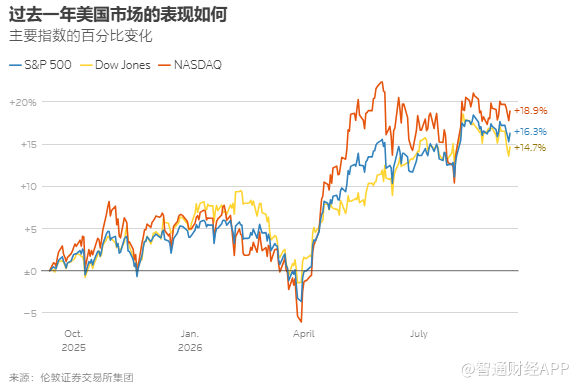
According to Bank of America Global Research, AI hyperscale companies such as Microsoft, Alphabet, Amazon, Meta, and Oracle expect capital expenditure of about 795 billion US dollars this year, and close to 1.08 trillion US dollars in 2027.
Most of that spending went to semiconductor companies, whose stock prices and profits soared this year but were sold off on Monday. Despite this, the Philadelphia Semiconductor Index is still up nearly 60% in 2026 so far.
“The market punishes' sellers' more severely than hyperscale companies because this sector is the most vulnerable to the slowdown in AI development,” said Eric Kratz, chief investment officer and co-head of wealth at Arena Private Wealth.
However, Kratz said that a stricter review of industry safety may bring a glimmer of hope. “The construction process will not stop when the CEO asks for a safety fence. On the contrary, long-term capital spending is more likely to be supported by financing if there is a credible security framework.
AI concerns have not been resolved, and macroeconomic headwinds are stepping up
Recent market fluctuations have reminded some investors of the turmoil caused by China's DeepSeek AI model in early 2025, when people had doubts about the pace of AI infrastructure spending. But it turns out that the sell-off was just a brief episode of the AI deal.
However, investors are now weighing a wider range of risks, including the possibility of increased government regulation, even though US President Trump on Monday called the AI security threat a “scam” and downplayed the need for regulation.
“The real risk is not a slowdown in development, but regulatory overreaction,” Kratz said.
Michael Bruhn, co-head of global private equity at Goldman Sachs Alternative Investments, said investors are judging “whether regulations will be strengthened or relaxed, geopolitical tension will increase or ease, and whether a new paradigm will emerge in the technology sector.”
If AI concerns intensify, the stock market may become vulnerable, as both the S&P 500 and Nasdaq Composite Index are only about 2% below their all-time highs, and the market is facing challenges such as rising bond yields, rising oil prices, and the possibility that the Federal Reserve may raise interest rates this week to curb inflation.
“AI semiconductor and infrastructure stocks have long been priced to continue to prosper in capital expenditure, and there is little room for fault tolerance to handle the industry's own limits,” said James Humphreys, managing partner at Wealth Management. “If the market faces more stubborn inflation than expected and a vague US Federal Reserve interest rate path, then cutting off the main growth engine of the market will completely expose the wider index to these macroeconomic headwinds.”