
- PRICING
- LIVE QUOTES
- LEARN
- HELP


EN
VIX soars 18 and options transactions double: traders bet “AI risks are scarier than the Fed's interest rate hike”
The Zhitong Finance App notes that as far as the two major threats currently facing the US stock market are concerned, traders in the options exchange have clearly indicated which “monster” is scarier and has more potential to disrupt AI trading.
Volatility as measured by the Chicago Options Exchange VIX Index jumped to 18 on Monday. Options trading volume surged to more than double the 30-day average trading volume. At the same time, semiconductor and data center stocks dragged down the S&P 500 index. The weak performance of these stocks stems from a renewed debate between tech leaders and politicians over whether AI infrastructure construction is progressing too fast.
As of noon, three of the top five most popular VIX contracts were call options, and the biggest transaction of the day was for someone to buy a call option with an execution price of at least $3.6 million and expiring in mid-November.
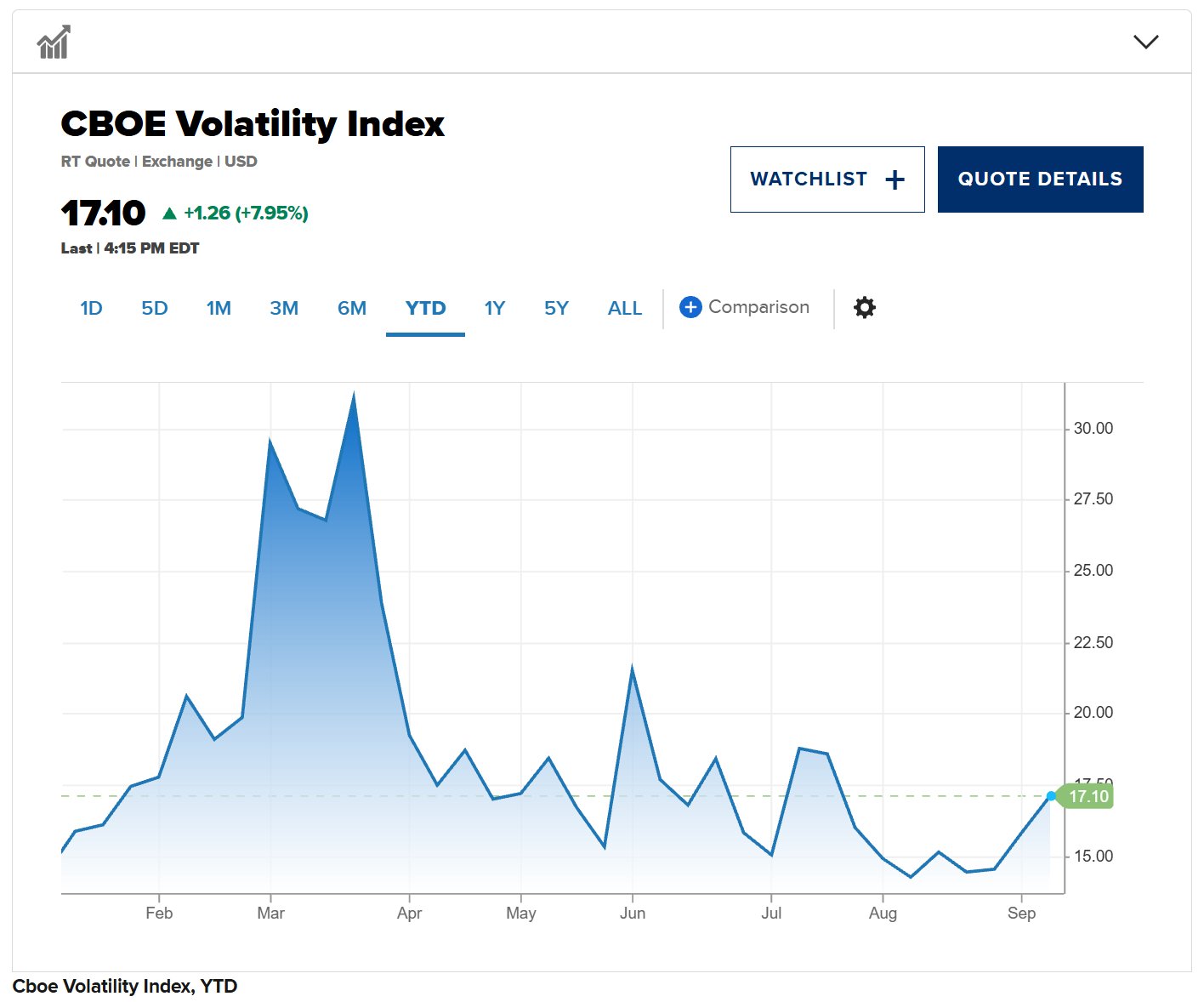 Last Friday's situation was almost the complete opposite — even though inflation data raised the market's probability that the Federal Reserve would raise interest rates at this week's meeting to 90%, VIX returned two days of gains. According to an analysis released by New York-based options management agency Carrick Lane, as of the close of trading last Friday, the fluctuation range of S&P 500 options for weekly contracts due on September 18 was 0.8%, lower than the 50th percentile of the volatility normally expected for a week with FOMC meetings.
This month, VIX once hit a yearly low of 14 as the probability of interest rate hikes steadily increased. John Marshall, head of Carrick Lane, said that combined with VIX's decline after the inflation data was released last Friday, this shows that the market is gradually adapting to higher interest rates.
Marshall said, “Right now, people in the stock market seem to think that the FOMC outcome is a foregone conclusion, so they are more concerned about AI.” “Technology risk and interest rate risk are usually related, because technology stocks are long-term assets, but maybe the timing for AI is now, and profit is now, so people don't price it as a distant future.”
Notably, interest rate fluctuations have not disappeared in the overall market. According to a report by Mandy Xu, head of Cboe derivatives market intelligence, the Merrill Lynch Options Volatility Estimation (MOVE) Index, which measures the volatility of US Treasury bonds, rose 10 points to a high of the 92nd percentile last week.
Similarly, according to Marshall's analysis, the pricing of volatile options for interest-sensitive investment targets — such as the iShares 7-10-year Treasury Bond ETF (IEF) and the Pioneer Real Estate Index ETF (VNQ) — is above the 90th percentile and above the 80th percentile, respectively.
However, the volatility pricing of bonds does not seem to be a factor to consider in the stock market. As stock prices strengthened on Monday, the probability that the market would raise interest rates on Wednesday's meeting rose to over 91%.